Architecture did not begin as a profession. Before schools, licences, and textbooks, there were people decorating tools, drawing on cave walls, and carving figures in stone. Over time, those same people were asked to design shelters, homes, and places of worship, and in doing so they became the first builders and architects. The profession came later, built on what they had already worked out.
This article gathers my series on architecture and art into a single argument: the same elements and principles governed painters, sculptors, and architects, and architecture was born gradually from that shared practice. I test the argument against two works from practice, one sculpture and one painting. Each section links to the article in the series that gives the full analysis.
Creators: artists who became architects
Art developed in three stages: the decoration of daily tools and crafts, then painting on walls and façades, then realistic three-dimensional painting and sculpture. As each stage matured, artists were commissioned to do more than decorate. They were asked to design, and they began to sketch plans, elevations, and perspectives. The series opens with this origin story in Introduction, and The Art Influence shows art first appearing as ornament on doors, corners, entrances, and column tops before painters and sculptors moved from decorating to designing.
The Greek examples are telling. The sculptor Phidias worked with Ictinus and Callicrates on the Parthenon, and sculptor-architects such as Pytheos, Hermogenes (the Ionic order), and Callimachus (the Corinthian order) gave Greek building its vocabulary. In the Renaissance, Brunelleschi, Alberti, Raphael, Michelangelo, and Leonardo da Vinci wrote down what they had learned. Alberti’s On Painting (1435), on representing a three-dimensional scene on a flat surface, is one example of knowledge that began in painting and went on to shape design. Even the best-known name in the story, Vitruvius, raises a question about whether he truly authored the Ten Books. Pioneers of Art and Architecture follows these figures in detail.
Principles: one vocabulary for three fields
The seven elements of design are line, direction, shape, size, texture, value, and colour. In painting, Mondrian and Kandinsky show how lines and shapes, in harmony or contrast, build a composition. In architecture the same elements become a focal point, an axis, a column, a wall, a plane. Elements of Design 1 covers line, direction, and shape, and Elements of Design 2 covers size, texture, value, and colour.
On top of the elements sit the principles. In art they are harmony (including repetition), gradation, contrast, and unity, all aiming at balance. In architecture they appear as ordering principles: axis, symmetry, hierarchy, datum, rhythm, repetition, and transformation. Principles of Design makes the core argument: architecture, like art, must achieve balance, and unbalanced architecture invites criticism.
Establishment: from personal practice to a profession
Function and form were not fixed at the start. They were shaped by the people designing. In Greece, temples reflected the views of their designers rather than fixed rules, and in the Renaissance, architects such as Brunelleschi, Palladio, Alberti, and Sangallo set personal principles. Raphael and Sangallo’s Villa Madama shows an ordered progression from public to private space. Evolution of Function in Architecture traces this.
Form has its own myth to correct. The Parthenon (447 BC) is often said to use the golden section, yet Euclid described it only around 300 BC, so Greek builders could not have applied it knowingly. They relied on the elements and principles of design and on proportions drawn from the human body, as in the three Greek column orders, later five under the Romans. The golden section’s genuine architectural use came in the Renaissance, with da Vinci, Michelangelo, Alberti, and Raphael, guided by written principles. Evolution of Form in Architecture sets out the evidence.
This is how a profession formed. Artists founded informal classes, then formal art and architecture schools, and wrote the first design-principle booklets, so the profession existed before academic schooling did. The curriculum that grew from it still mirrors their progression, from design elements to construction and functional design.
Examples from practice
If the argument is right, the principles from the series should operate in a sculpture and a painting exactly as they do in a building. Two works put that to the test.
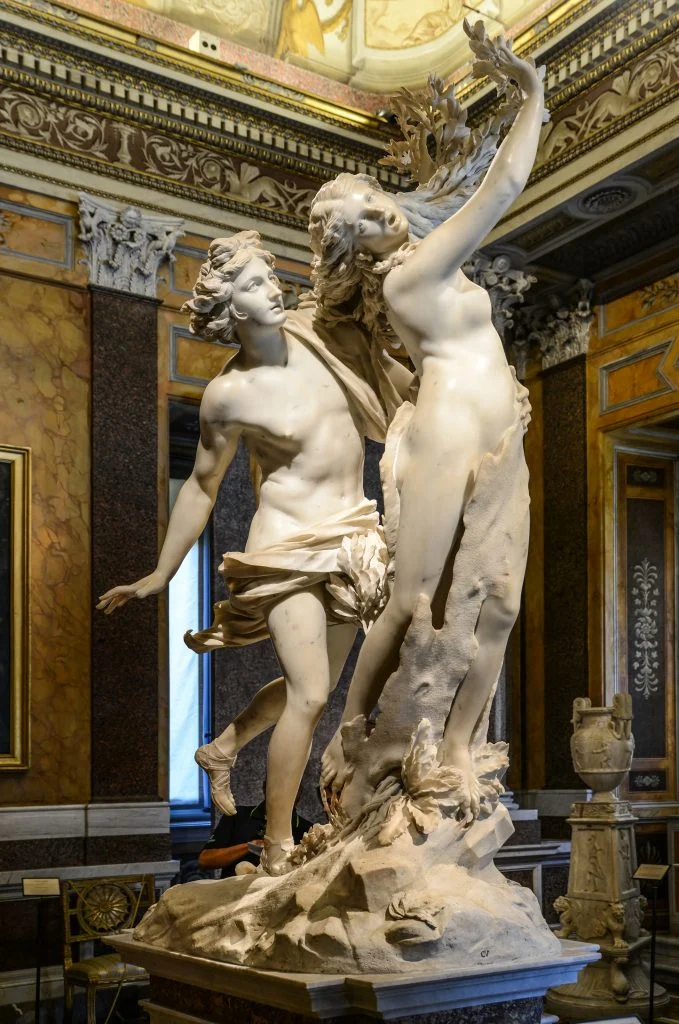
Sculpture: Bernini, Apollo and Daphne (1622 to 1625)
Carved in Carrara marble for Cardinal Scipione Borghese and now in the Galleria Borghese in Rome, the work is a high Baroque masterpiece by Gian Lorenzo Bernini, with Giuliano Finelli. Bernini was also an architect, the designer of the colonnade of St. Peter’s Square, which makes him a single figure standing in both fields. Six characteristics of the sculpture map directly onto the series.
- Motion and direction. The composition is organised on diagonal axes that carry the eye in an upward spiral, with Apollo mid-stride and Daphne lunging forward. This is line and direction at work, the subject of Elements of Design 1: in architecture the same thread runs from a focal point to axes, columns, walls, and planes.
- A chosen moment and a sequence. Bernini selects the instant the chase ends and the transformation begins, putting time into a static medium. In architecture, the equivalent is a planned sequence of space, the ordered progression described in Evolution of Function.
- Texture. Soft skin gives way to rough bark, and the leaves at Daphne’s fingers are carved paper-thin. Texture, as Elements of Design 2 explains, is what gives façades and interiors depth and unity.
- Contrast. Daphne’s open-mouthed terror sits against Apollo’s breathless confusion. Contrast is one of the four principles in Principles of Design.
- Space and path. The figures reach outward into the viewer’s space, and the work was staged so that a visitor entering the room meets it from behind Apollo and discovers the story while walking around it. This is point, axis, and path, the same logic by which a building is experienced through movement.
- Light and shadow. Deep hollows in the drapery, hair, and leaves contrast with polished skin, bringing the painter’s chiaroscuro into three dimensions. This is the element of value, which in a building is modelled by niches, colonnades, and recesses.
There is an apparent tension here. Baroque dynamism seems to oppose the balance and order that the series treats as essential. In fact the work does not abandon the principles. It pushes them to their limit, using controlled imbalance to reach a new kind of balance.
Painting: Monet, Poppy Field (1873)
Painted at Argenteuil near Paris and shown at the first Impressionist exhibition in 1874, Poppy Field looks like the opposite of a designed object. Read through the series, it is built from the same principles.
- Rhythm and direction. The repeated touches of red poppies create rhythm through repetition of similar parts, and a shallow diagonal path gives the otherwise static design movement and leads the eye across the field (Çelik & İnan, 2022). Rhythm and repetition are named ordering principles in Principles of Design, and the diagonal returns to the direction discussed in Elements of Design 1.
- Hierarchy through colour. The red accents dominate the green surroundings, so emphasis comes from colour tone rather than size or position. The architectural parallel is an accent material or colour that marks a focal point or entrance, an application of Elements of Design 2.
- Harmony and contrast together. One family of strokes, greens, and yellows keeps the whole canvas harmonious, while the complementary opposition of red and green supplies contrast, pitched so that it vibrates.
- Colour carries the structure. The picture is close to equiluminant: its contrast lies almost entirely in colour rather than in light and dark (Giráldez, 2020). Remove the colour and the composition nearly dissolves. This is value and colour doing structural work, as in the materials that separate one plane of a façade from another.
- Line dissolved, principles intact. Monet avoids outline, and the figures are built from the same broken touches as the landscape around them. Line, the foundation in Elements of Design 1, has been taken away, yet rhythm, hierarchy, harmony, and contrast still hold the picture together.
- Depth. Foreground, middle ground, background, a located horizon, and aerial perspective make the countryside read as real. This is the descendant of the picture-space thinking that Alberti wrote down in 1435, discussed in The Art Influence, and it is the same layered depth that landscape architecture uses.
- Reception. Contemporaries found the work crude and careless, and a critic’s sarcasm about impression gave the group its name, which the artists then adopted (Hendren, 2019). New work meeting criticism is a pattern architecture knows well, and it links to the argument in Principles of Design and the modern movements in Art Influence in the Modern World.
What the two cases show
Bernini and Monet worked in different media, in different centuries, and in styles that broke with the rules of their predecessors. Bernini pushed balance to its limit, and Monet dissolved line. Neither abandoned the underlying principles of rhythm, hierarchy, harmony, and contrast. The surface changed, the principles stayed. That is the same pattern Art Influence in the Modern World finds in architecture, where modern architects set their own rules and even drive new structural systems, from Buckminster Fuller’s domes to the Bilbao Museum, while the elements and principles of design remain the foundation.
Conclusion
Architecture was not invented at a single moment. It grew in stages: art that decorated tools and walls, artists commissioned to design, personal principles written down, informal classes, formal schools, and finally a profession. Along the way the styles changed, from Greek temples to Renaissance façades to Baroque sculpture to Impressionist canvases to modern buildings, but the elements and principles held steady. A painter, a sculptor, and an architect who never met each other, working centuries apart, are using the same vocabulary. That continuity is the birth of architecture, and it begins where the series begins, in Introduction and Pioneers of Art and Architecture.
Read the full series
- Introduction
- The Art Influence
- Elements of Design 1
- Elements of Design 2
- Principles of Design
- Evolution of Function in Architecture
- Evolution of Form in Architecture
- Art Influence in the Modern World
- Pioneers of Art and Architecture
FAQ
- How did architecture begin?
Architecture grew out of art. Artists who decorated tools and painted walls were commissioned to design shelters, homes, and places of worship, and they gradually wrote down the principles they used. - What is the relationship between art and architecture?
They share the same elements (line, direction, shape, size, texture, value, colour) and the same principles (harmony, gradation, contrast, unity, balance). Painters and sculptors developed them first, and architects adopted them. - Did the Greeks use the golden section in the Parthenon?
Probably not knowingly. The Parthenon dates to 447 BC, but Euclid described the golden section only around 300 BC. Greek builders relied on design principles and proportions drawn from the human body, and the golden section’s real architectural use came in the Renaissance. - Who were the first architects?
Largely sculptors and painters commissioned to build, from Greek sculptor-architects such as Pytheos, Hermogenes, and Callimachus to Renaissance figures such as Brunelleschi, Alberti, Raphael, Michelangelo, and Leonardo. - Which design principles do art and architecture share?
Harmony and repetition, gradation, contrast, and unity, which architecture applies as axis, symmetry, hierarchy, datum, rhythm, repetition, and transformation.
- External Links
- The Galleria Borghese’s own page for the sculpture: https://www.collezionegalleriaborghese.it/en/opere/apollo-and-daphne
- The Musée d’Orsay’s Poppy Field entry on Google Arts & Culture: https://artsandculture.google.com/asset/poppy-field/xQGTinA-MPxcVg
- Optionally, Smarthistory’s page on Apollo and Daphne: https://smarthistory.org/bernini-apollo-and-daphne/
[…] To see how this story plays out in real works, read how architecture was born from the work of painters, sculptors, and builders. […]
[…] pioneers moved from decorating to designing, and the way that shift created the architecture profession is traced from the first creators to the first […]
[…] same lines, directions, and shapes can be seen at work in a Baroque sculpture and an Impressionist painting, which shows how the elements carry across […]
[…] Colour can carry a whole composition, as Monet’s Poppy Field shows, where the structure rests almost entirely on colour. […]
[…] To test whether balance, rhythm, and contrast hold outside architecture, see how the principles operate in Bernini’s marble and Monet’s brushwork. […]
[…] How these personal approaches to function hardened into shared rules, schools, and finally a profession is told in the wider account of how architecture was established. […]
[…] the golden-section myth set aside, the fuller story of where architectural principles really came from shows how proportion and design elements passed from artists to […]
[…] Modern architects set their own rules, but the elements and principles they rely on began in the work of painters and sculptors. […]
[…] pioneers are one part of a larger picture, and the full case for architecture’s gradual birth, tested against a sculpture and a painting places them alongside the principles they […]