Float is one of the first concepts a student of project management learns and one of the last a project team learns to use honestly. On paper it is a simple number: the time an activity can slip before it delays something else. On a live construction site that number is argued over, quietly consumed, rarely updated, and, when a dispute arrives, treated as evidence worth a great deal of money.
This article follows float from its calculation to its use in delay analysis, always with construction practice in view. It covers how float is calculated and the scheduling methods behind it, how it behaves on a high-rise project in Dubai, who handles it on site, how it connects to communication and notices, how delay analysis uses it, who owns it, and how it can be used to control cash flow and to recover from a critical delay. The common thread is that float is easy to calculate and hard to defend. What decides its value in a dispute is rarely the software. It is the program logic, the records and the communication around it.
1. What float is and how it is calculated
Float, also called slack, is the amount of time an activity can be delayed without causing a problem downstream. It is produced by the Critical Path Method (CPM) in two passes over the schedule network. The forward pass works from the start and gives each activity its Early Start (ES) and Early Finish (EF). The backward pass works from the required completion date and gives each activity its Late Start (LS) and Late Finish (LF). Float is the difference between the two sets of dates.
- Total float is the time an activity can slip without delaying project completion or a contractual milestone. Total Float = LS − ES, or equivalently LF − EF.
- Free float is the time an activity can slip without delaying the early start of the activity that immediately follows it. Free Float = ES of the next activity − EF of the current activity.
- Interfering float is the difference between total float and free float. Using it does not delay completion, but it does eat into the float of later activities on the same path.
Float then falls into three states. Positive float means flexibility: labour can be moved, minor delays absorbed and work resequenced without touching the deadline. Zero float defines the critical path, where any slip moves the completion date one-for-one. Negative float means the calculated finish is already later than the required date, so the schedule is behind before work has slipped at all, and the team must crash (add resources) or fast-track (overlap activities) to recover.
A simple example: the kitchen renovation
A small renovation shows the arithmetic. Two paths must finish before a final inspection on day 15. Path A is the cabinets: ten days of lead time, three days to install, two days for the countertops, fifteen days in all. Path B is the flooring: four days to lay and two days to cure, six days in all.
| Path | Activities | Duration | Total float |
| A: Cabinets | Order (10 days) → install (3 days) → countertops (2 days) | 15 days | 0 days (critical) |
| B: Flooring | Lay flooring (4 days) → cure (2 days) | 6 days | 9 days |
Now give each path the same three-day delay. If the countertop fabricator is three days late, the inspection moves from day 15 to day 18. If the flooring contractor is three days late, the nine days of float absorb it and the date does not move. The same delay has two different consequences, and that difference is the whole reason float is tracked.
Methods of calculating float
Float always comes from analysing the activity network, but the methods differ in how they treat durations, dependencies and resources.
| Method | How float is treated | Best suited to |
| Critical Path Method (CPM) | Deterministic total and free float per activity, from fixed durations. | Standard projects with predictable durations. |
| PERT | Same network arithmetic, but with three-point probabilistic duration estimates. | Research and first-of-a-kind work with uncertain durations. |
| Precedence Diagramming (PDM/AON) | Float across four dependency types (finish-to-start, start-to-start, finish-to-finish, start-to-finish) with leads and lags. | Overlapping work; the default in most scheduling software. |
| Monte Carlo simulation | Runs the schedule thousands of times with random durations and reports a distribution of float and a criticality index per activity. | Risk analysis where durations vary widely. |
| Critical Chain (CCPM) | Strips float from individual tasks and pools it in shared project and feeding buffers. | Resource-constrained projects. |
The choice of method matters later, in delay analysis. Relationship types and lags in a precedence network can change which path drives completion, and therefore whose float is real. Monte Carlo treats float as a probability, so an activity that looks safe in a deterministic schedule can turn out to be critical in a large share of simulations. Critical Chain removes activity float altogether and reads delay as consumption of a buffer, which is not how most contract-based delay claims are framed.
2. Float on a 10-storey tower in Dubai
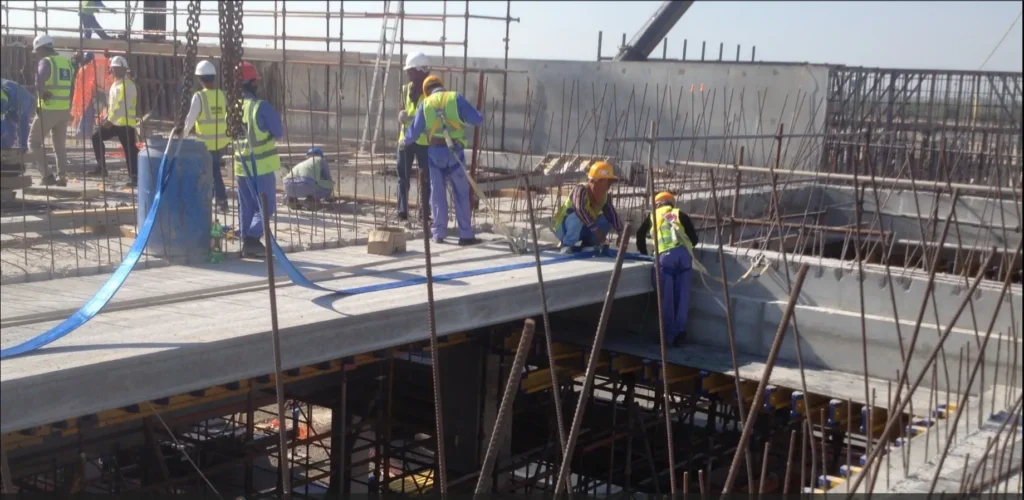
On a high-rise the structure sets the rhythm. Formwork, reinforcement, concrete, curing and striking repeat floor by floor, and floor N+1 cannot proceed until floor N has gained strength. While the frame is rising, that chain is the critical path and a day lost on a pour is a day lost on handover.
Finishing is a different matter, and it is often described wrongly. In the usual sequence the structure is completed first, installations and first-fix MEP follow, the building envelope is nearly closed, and only then do fittings, internal doors and finishes begin. Float in the finishing phase therefore does not come from working beneath an unfinished structure. It comes from parallel finishing trades of unequal duration, where a short trade next to a longer one has free float, and from the floor-by-floor finishing train, where floors that do not gate handover carry float relative to those that do.
The critical path also moves. It runs through the structure until the frame tops out, then it can shift to the envelope, to MEP installation, or to testing and commissioning. An activity may be critical for only part of its duration, so analysing delay against a single fixed critical path misses what actually happened. Three Dubai constraints show how float is spent in practice:
- Long-lead imports. Curtain walling, lifts, chillers and switchgear can take several months from order to delivery. Float on the installation activity fixes the latest safe order date, and zero or negative float on a procurement package is the signal to expedite.
- Authority inspections. Sign-offs by Dubai Municipality, Civil Defence and DEWA are hard constraints. Float around an inspection shows how much delay a review can absorb before energisation or occupation is affected.
- Summer conditions. The midday work restrictions from mid-June to mid-September and the effect of heat on concrete reduce productive hours, so float erodes quietly through the summer unless it is watched.
3. Who works with float on site
Three roles touch float, each at a different level. The planner calculates and maintains it in the scheduling software and reports where it is shrinking. The construction manager uses it on site, protecting zero-float work and moving crews from floated activities when something goes wrong. The project manager governs it commercially, deciding whether to crash, to fast-track or to claim, and owning the position with the client. My article on Construction Management vs Project Management describes how these two management roles differ in practice.
Practice is messier than this tidy relay in two ways.
- The construction manager helps build the plan. Besides running the site, the construction manager studies the project, estimates resources and works with the planner and the project manager on the final project management plan. That makes the construction manager partly responsible for the durations that float is calculated from, and decisions on subcontractors, change orders and plan changes are shared across the managers rather than owned by one.
- Organisation size collapses the roles. Large companies keep separate operations, project and construction managers. Medium companies have a project manager and sometimes a construction manager. In small companies the project manager does both jobs. On a 10-storey residential building the project manager may support a senior civil engineer with no construction management team at all, so one person calculates, spends and governs float, and keeping the program updated is often what suffers first.
A disruption walked through the three roles
Suppose the delivery of custom façade brackets is delayed by 15 days because the employer’s late approval of the shop drawings held up the order. The planner enters the delay into the current update, re-runs the schedule and reports that the delay consumes all 10 days of float on the envelope path and leaves 5 days of negative float on completion. The construction manager reassigns the framing crew, whose work carries 12 days of float, to the activities that now drive completion, and resequences so nothing else waits for the brackets. The project manager weighs the cost of weekend shifts against an extension of time, and issues a formal notice with a time impact analysis showing that the employer’s approval, not the contractor, caused the hold.
4. Natural float, deliberate contingency and padding
Two different things are called float. Natural float is a by-product of the network: it exists because parallel paths have unequal durations, and nobody inserts it. Deliberate contingency is time added on purpose against identified risks such as weather, approvals or procurement. The project manager normally authorises it, the planner builds it into the program as a visible buffer activity ahead of key milestones, and the construction manager and a risk analysis, often Monte Carlo, inform how much is justified.
Padding is the improper version: durations inflated quietly, without disclosure, to create private slack. It distorts the critical path, lengthens the programme without a reason anyone can defend, and gives the other side an easy argument that the baseline was never realistic when a claim is made. The same days of extra time are legitimate if they are visible, justified and owned, and improper if they are hidden, arbitrary and deniable.
5. Notice, records and communication in delay claim
Float helps only if the people who act on it know about it. In my article on the four critical roles of communication in project management, information moves at several levels: internally, top-down and bottom-up, and externally to support decisions, through formal reports and informal exchanges. Delay information follows the same chain, from the site to the construction manager, to the project manager and finally to the client as a formal notice.
Two practical points follow. First, many schedule reports show only total float. As this PMI article on saving time and money with float points out, without free float in the reports team members can interfere with each other’s schedules, and people who believe they have float they do not have disrupt the flow of work.
Second, the contract turns communication into entitlement. The 2017 FIDIC editions expanded the programme requirements, obliged the contractor to update the programme, and added an advance warning provision and a notice mechanism for extensions of time, as Fenwick Elliott’s overview of how the 2017 FIDIC contract deals with time explains. Notice periods are typically 28 days from awareness under the standard forms, but the Particular Conditions govern, and failure to notify in time can defeat a genuine claim. The 2017 forms do give the Engineer power to waive a missed time bar in some circumstances, which is a discretion nobody should plan around.
Records decide the outcome as much as method does: updated program, daily reports, instructions, minutes, correspondence and photographs. Approvals are a quieter source of delay. When a shop drawing or a concrete inspection needs sign-off from both the civil engineer and the project architect, each approval is a review loop, and a slow loop is a delay event on the employer’s side of the contract.
6. Delay analysis methods and how they treat float
Delay analysis is the structured investigation of why a project finished, or is forecast to finish, later than planned. It asks how much delay occurred, which events caused it, who is responsible for each, and what the entitlement is: more time, more money, both or neither. It underlies every extension of time (EOT) claim and most disputes over liquidated damages (LDs).
| Type of delay | Cause | Typical outcome |
| Excusable and compensable | Employer or its agents, such as late drawings, variations or late access. | Extension of time and money. |
| Excusable and non-compensable | Neutral events, such as exceptional adverse weather or force majeure. | Extension of time, no money. |
| Non-excusable | Contractor, such as slow mobilisation, low staffing or defective work. | No time and no money; exposure to LDs. |
Float and extension of time (EOT) claims
The central question is whether a delay event actually delayed completion. Take an employer’s design clarification that takes 10 days on an activity with 15 days of total float. The activity absorbs it, 5 days of float remain, completion does not move and there is no EOT. The same 10 days on a zero-float structural activity pushes completion by exactly 10 days and supports a 10-day claim.
Concurrent delay
Complications arise when employer-caused and contractor-caused delays overlap. In many contracts the contractor then has a case for time but not for money, and how concurrency is defined, in time and in effect on the critical path, often decides the dispute. Commentators note that earlier FIDIC editions were silent on the point, while clause 8.5 of the 2017 editions directs the parties to say in their Special Provisions how concurrent delay is to be dealt with.
Methods of delay analysis
| Method | How it works | Role of float |
| As-planned vs as-built | Compares the baseline programme with actual progress. | Shows where the critical path moved and float was lost, but is a crude tool. |
| Impacted as-planned | Inserts delay events into the unadjusted baseline. | Tests whether events consumed baseline float, but assumes the baseline was achievable. |
| Time impact analysis (TIA) | Models each event into the programme as updated just before it occurred. | Measures float absorbed against net critical delay at that moment. |
| Collapsed as-built (but-for) | Removes delay events from the as-built to see what would have happened. | Shows which delays were truly critical, but depends on the quality of the as-built logic. |
| Windows / time-slice | Divides the project into periods and analyses each with its programme update. | Tracks how float and the critical path migrated over time. |
Timing matters as much as method. Prospective analysis, usually a TIA, is done as events occur and supports the notice a contract requires. Retrospective analysis is done after the event or after completion, typically in a dispute. Relying only on a retrospective analysis is a weak position, because notice deadlines may already have passed and the evidence is harder to reconstruct. In practice the best approach is both: analyse as events occur, and be ready for a forensic analysis if the matter escalates.
Where theory meets reality
- Program are rarely maintained. The baseline is approved and then not updated for months, so the analysis has to rebuild the logic after the fact, and the rebuilding is itself argued over.
- Float is consumed quietly. Soft logic, constraints and padded durations can hide the true float, and everyone else finds out when the claim arrives.
- The choice of method follows the records. A sophisticated method built on poor records is weak, and a simple method built on good records can be convincing.
7. Who owns the float?
Float absorbs delay, so who may use it has real financial value. Three positions are argued in practice.
| Position | Argument | Consequence |
| The contractor owns it | It is created by the contractor’s own logic, resources and risk allowances. | Employer delay that erodes float may justify an EOT even if completion is not yet threatened. |
| The employer owns it | It lies within a contract period the employer has paid for. | No EOT unless completion is actually delayed. |
| The project owns it | Float is a shared resource used first come, first served. | Whoever reaches it first benefits. |
The Society of Construction Law Delay and Disruption Protocol and the AACE forensic scheduling guidance both lean towards the shared view where the contract is silent, and the Protocol says the parties should deal with the issue in their contract. As commentators note, the standard FIDIC forms do not settle float ownership expressly, so bespoke Particular Conditions often do. The shared view has a sharp edge: if an employer delay uses up the float first, a contractor can later pay LDs for a delay of its own that would not have been critical had the float still existed.
In a recent analysis, Dr Franco Mastrandrea of HKA argues that a binary ownership model is inadequate. He separates original float, built into the contractor’s programme for the original works, from emergent float, which appears once a critical delay occurs. On his proposal the contractor owns original float, the party that caused the delay owns the emergent float it generates, and emergent float from a neutral event belongs to the project. This is one expert’s proposal, not settled law, and the contract wording always comes first.
8. Using float to control cash flow and recover from delay
Controlling cash flow
A cost-loaded schedule can be plotted twice: once with every activity at its early start and once at its late start. The two S-curves enclose a band, and float is the room to shape cash flow inside it. Scheduling a payable activity or an equipment delivery later within its float defers the payment and saves interest. The PMI advice is to ask for early delivery without early payment, to schedule material deliveries close to when they are needed, and to monitor these nearly critical items by milestones.
Practice adds four cautions.
- Whose cash flow? Deferring what you pay out helps the payer. A contractor is paid as work is valued, so delaying work within float also delays its own receipts, and contractors often try to bring cash in earlier, for example by buying expensive materials in advance. A steep early curve can signal front-loaded billing.
- Deferral is not free. Deferring a non-critical activity may leave the completion date intact, but it can bring replanning costs, storage, price escalation and standing resources.
- It uses up the buffer. An activity pushed to the end of its float becomes critical. Any later slip, from whoever caused it, then reaches the completion date.
- Keep the calculated dates visible. If a procurement activity is held back with constraint dates rather than logic, late dates and float can be distorted. Planners advise keeping the true calculated dates and float in separate fields.
Turning a late critical task into an opportunity
When a critical task runs late, the activities in parallel gain extra float. Rather than only reacting, the team can analyse the new schedule and use that float: level resources, reduce crews on the floated work, and spend the savings on recovering time elsewhere. Spreading local work over a longer period with fewer resources can reduce learning-curve losses and congestion. Who may take the benefit depends on who caused the delay, as the emergent float framework above suggests, and the employer can use the same float, so the contractor’s advantage is not automatic.
9. A worked case: an owner asks to shorten the construction time
In my communication article I described a design-build school project for 1,000 high school students in the Middle East. By telephone, the owner said he wanted to reduce the construction time so the school could open earlier, and he decided that all floor slabs should change from cast in situ to hollow core. The questions raised at the internal meeting were these: how much time the change saves, what it does to cost, what it does to underground and above-ground services, whether the precast supplier can meet the project timetable, how long the structural design and detailing will take, and how long the authority approval needs.
Those are the questions a time impact analysis answers. The change is modelled into the current programme and the completion date is read off. The slab cycle matters only if it lies on the critical path: a saving on a floated activity buys nothing. The design, procurement and approval durations the change adds often cancel a good part of the time it promises to save. Because the instruction arrived by phone, it also shows the records argument. A verbal instruction should be confirmed in writing, with the agreed time and cost effects recorded and the programme updated.
A second project shows the opposite situation. A district cooling plant for an airport had a target of seven months from building permit, and the works met soil cavities and pile casting problems. A programme that short typically has little float to absorb such problems, so each one is likely to reach the completion date and needs a prompt notice.
10. What the architect and supervisor should do
The architect or contract administrator sits in the middle of this, and several habits keep float and delay provable later.
- Ask for the baseline and require regular updates. Check the logic and durations, not only the dates.
- Treat your own response times as delay events. Review submittals, answer requests for information and attend inspections within the contract period.
- Confirm instructions in writing. Record verbal instructions and their agreed effects on time and cost.
- Assess extension requests against the float that existed at the time. Ask which activity was hit, whether it was critical then, how much float it had, and whether contractor delay was running at the same time.
- Keep contemporaneous records. Programmes, daily reports, minutes and photographs are the evidence on which every method relies.
Conclusion
Float is the common language of the planner, the construction manager, the project manager and the supervising architect, and it connects scheduling with money and contract. Calculating it is mechanical. Using it well depends on a program that is kept honest and updated, on information reaching the people who can act on it, on notices sent in time, and on a contract that says who may use it. The projects that avoid disputes over float are not the ones with the best software. They are the ones where everyone knew what the float was and could prove it.
[…] a contractor may have changed the order of work, or a planned critical activity may have gained float while a different sequence became […]