Origins, application, decline and survival of the rational planning paradigm, with a Dubai case from practice and a comparison of planning systems
Few ideas in planning have been declared dead as often as the rational planning paradigm, also called the rational planning model, and few have survived so well. Theorists buried it in the 1970s. Yet any planner who prepares an evidence base, tests alternatives, appraises costs and benefits, or writes a monitoring report is still using its logic. This article traces where the paradigm came from, how it was applied, why it was attacked, and why it persists. It ends with a comparison of how different European planning systems use it, and why they differ.
Origins
The paradigm has several roots that converged in the middle of the twentieth century.
- Survey before plan. Patrick Geddes’s sequence of survey, analysis and plan (1915) gave planning an early scientific method: look first, then propose.
- Decision theory. Herbert Simon’s work on administrative decision-making (1947) set out the ideal of choosing among alternatives by weighing their consequences against goals. His own concept of bounded rationality already warned that real decision-makers cannot do this fully.
- Management and operations research. Scientific management and wartime operations research encouraged confidence that complex problems could be analysed and optimised by experts.
- Planning as a named model. Banfield and Meyerson’s Chicago study (1955) described the “comprehensive rational” approach: specify goals, identify all alternatives, predict consequences, choose the best.
- Systems thinking, regional science and computing. Cybernetics and general systems theory, Walter Isard’s regional science (1956), quantitative geography and early computer models, such as land-use and transport models in the 1950s and 1960s, gave planners tools that seemed to match the theory.
In Britain these ideas were translated into the systems view of planning by McLoughlin (1969) and Chadwick (1971). The city was now a set of interlinked systems, and planning a continuous loop of analysis, intervention and monitoring, not the delivery of a fixed master plan. Faludi (1973) then separated procedural theory, which concerns how to plan, from substantive theory, which concerns what to plan. Rational planning became the leading procedural theory.
The rational planning model: how it works
Stripped to its core, the paradigm runs through a repeating sequence:
- Define goals and objectives.
- Survey and analyse the system (the “city” and its region).
- Generate alternative courses of action.
- Forecast and evaluate the consequences of each, including effects on other parts of the system.
- Choose and implement.
- Monitor results and feed them back into the next cycle.
Two versions need distinguishing. The rational-comprehensive version aims at a complete, value-neutral analysis leading to the best plan. The systems version, the one on your slide, drops the end-state blueprint and treats planning as a continuous, monitored process. The second is far closer to how planners work today.
Rational planning in practice: how it was applied
The paradigm was applied most fully where the state had the capacity and the confidence to plan strategically.
- Britain. The Planning Advisory Group (1965) criticised the old development plans, and the Town and Country Planning Act 1968 created structure plans: strategic, policy-based, county-level plans resting on survey and forecast, with local plans beneath them. Regional studies such as the South East strategy of the 1960s and 1970s applied the same logic at larger scale.
- United States. Metropolitan transportation studies (such as the Chicago Area Transportation Study) used survey data and modelling to forecast travel demand and justify highway programs.
- Socialist Eastern Europe. State economic planning coordinated with physical planning was the most comprehensive form of the idea, though driven by political direction rather than open analysis.
- Nordic and Dutch welfare states. Post-war reconstruction and housing programs combined analysis, public land and strong municipalities or state agencies, and carried planning from analysis into delivery.
Rational planning model: criticism and limits
The criticism came from several directions, and it explains why the paradigm lost its status as the single accepted theory.
- Cognitive limits. Lindblom (1959) argued that real decisions are made by “muddling through”, comparing a few options incrementally, because complete analysis is impossible.
- Values and politics. Davidoff (1965) argued that planning cannot be neutral: there is no single public interest, and plans serve some groups over others. Advocacy planning followed.
- Wicked problems. Rittel and Webber (1973) argued that social problems cannot be defined, solved and tested the way the model assumes.
- Model failure. Lee’s “Requiem for large-scale models” (1973) criticised models as data-hungry, costly, opaque and poor at prediction.
- Power and implementation. Flyvbjerg (1998), in his Aalborg study, argued that rationality is often overruled by power, and that those with power may define what counts as rational.
- Practical and political change. Structure plans were slow. From the late 1970s the political mood moved against strategic planning, and in Britain the 1980s brought deregulatory instruments and a smaller strategic role.
Alternatives followed: Etzioni’s mixed scanning (1967), Friend and Jessop’s strategic choice (1969), and from the 1990s the communicative and collaborative turn associated with Healey and Forester, which treats planning as argument and negotiation among stakeholders.
Is rational planning still used?
The honest answer is both, depending on what is meant by “rational planning”. Three things need separating.
- The ideal of a comprehensive, value-free, expert-led analysis that yields the best plan is largely dead as a theory. Almost no one defends it in that form.
- The method of surveying, forecasting, comparing alternatives, appraising and monitoring is alive and widespread. It is the working routine of most planning systems.
- The procedural duty to justify a plan with evidence is alive in law. In England, plans are examined against a soundness test that asks, among other things, whether the strategy is justified by proportionate evidence and tested against reasonable alternatives. The EU strategic environmental assessment directive (2001/42/EC) likewise requires the assessment of reasonable alternatives.
So the paradigm did not die. It was demoted from a theory of what planning is to a tool within planning, to be combined with judgement, negotiation and politics.
Why rational planning continues
- Accountability and law. Public decisions must be reasoned and open to challenge. Evidence, alternatives and appraisal give planners and authorities something to defend before inspectors and courts.
- Large-scale problems need forecasting. Transport, water, energy, flood risk, housing need and climate cannot be handled without projection and systemic thinking. The systems insight that intervention in A affects B remains correct.
- Funding and appraisal regimes. Treasuries, development banks and EU programs require ex-ante appraisal, indicators and monitoring before they release money.
- Professional and institutional habit. Planners are trained in survey, analysis and plan, and planning agencies are built around plan-making cycles and monitoring reports.
- Technology. GIS, big data and digital twins revive the 1960s promise of understanding the city as a system, and this time with real computing power.
- Political usefulness. Technical evidence gives decisions legitimacy and can reduce open conflict. This is both a strength and a risk, because it can hide value choices behind numbers.
Continued use is not proof that the method works. In some systems it is partly ritual: the evidence base is compiled because the procedure requires it, not because it drives the decision.
| CASE FROM PRACTICE A forecast tested by the 2008 crisis and a long sales cycle: Legends of Arabia, Dubai (2006 onwards) The project. Legends of Arabia was a mixed-use development of about USD 2 billion, built around a world-class theme park in the desert. The developer, then trading as Legends, was in partnership with the landowner, a brother of the ruler, and its project management company was ADD Engineering of Riyadh. The scheme also included a mall with a large parking building, a five-star hotel and hotel apartments, five apartment buildings, twelve residential buildings of 8 to 12 storeys, about 500 villas around a nine-hole golf course and clubhouse, and a large road network with external car parks. It was phased: villas, golf course and residential buildings first; hotel and hotel apartments second; the theme park last. I joined the developer’s side before the launch. Goals and survey. The goal was a landmark attraction, and the vision came first. The first design consultant, Gensler (UK), was expected to provide a market study for the first phase, but offered only verbal advice. My manager and I therefore did the study ourselves: we collected data on demand for rental and sale units, and on price ranges in each zone of Dubai. The design was then withdrawn from Gensler and given to a second consultant, Sfarini, an established local firm, who proceeded with the design and assisted the study. Both consultants had been chosen through the assessment framework used for consultant selection, so the same rational logic of criteria and comparison had already been applied to the choice of designer. What the analysis changed. The market evidence led to a review of most of the design. The apartment buildings were redesigned, and the villas were reduced in size and redesigned. The master-plan concept did not change. What the forecast met. Before construction, the sales team sold about 50 of the larger villas, each with an advance payment of AED 250,000, roughly AED 12.5 million in all. When the financial crisis arrived, sales stopped. The design was restructured again and the villas became small-scale units. A third consultant, Al Burg, was assigned by the developer after the crisis. It was an established firm with its head office in Cairo and a prestigious office in the Dubai convention centre. My assessment had placed it far down the list. In my judgement the developer weighed the firm’s prestige, and the firm probably accepted a low fee in order to keep the project. The latest designs are in the project brochure. What was built and sold. The current sales brochure, issued under the name Tanmiyat (the same developer, which was called Legends at the time), presents the scheme as Living Legends at Dubailand. It describes a development of about 14.4 million sq ft with 500 villas in four types, from 2,800 to 6,500 sq ft; 12 residential towers with studios, one- to three-bedroom apartments and penthouses; a nine-hole golf course and clubhouse; and community facilities including a clinic, mosque, school and nursery, retail and a boutique hotel. It markets the product as “affordable luxury” and, at the time of printing, as 80% sold with limited units left. Units have been on sale since 2006. When I requested the brochure through an online enquiry, a sales agent followed up about Living Legends in October 2026, so the project is still being marketed twenty years after its launch. The brochure covers the residential and golf components and does not mention the theme park. To my knowledge, the five-star hotel phase and the theme park were not targeted for construction, but the project management contract with ADD Engineering has ended and the developer now handles everything, so I cannot confirm their status. What this shows about the paradigm. The method worked at the level of the product. Market evidence changed unit sizes and mix, which is the strongest argument for the continued use of rational method.It did not reach the level of the concept. The theme-park vision was a political and commercial goal, so analysis adjusted the product around it and did not test it. Later events suggest the market tested it instead: the theme park does not appear in the current marketing and, to my knowledge, was not taken forward. This is Davidoff’s point about values: goals are not technical findings.The assessment advised but did not decide. The third consultant ranked near the bottom of my assessment, yet the developer appointed it after the crisis, valuing its prestige, while the firm probably accepted a low fee to continue. Prestige and price after a shock are reasons an assessment framework may not capture. Evidence informs the decision-maker; it does not bind them. This is the gap between analysis and authority that Flyvbjerg describes.The forecast was a snapshot. Deposits for large villas looked like proof of demand, but they measured demand at one moment of the cycle. Without a review loop, nothing signalled the turn until sales stopped.The market set the pace of delivery. Units were still being marketed in October 2026, twenty years after the 2006 launch. The brochure, which appears to date from about 2014 to 2015, already advertised the remaining units. When sales run for this long, the absorption rate becomes the most important variable in the forecast, and it is the one a single study before design cannot fix.The study came late and from the wrong place. A written market study should come before design is committed, and it should be owned by the client, not delivered as a verbal opinion. Lesson. The rational process is, above all, a way of testing the market before building. It should show which price ranges have strong demand and which parts of a development sell easily and fast, so that revenue-generating parts come first. It should respond to local needs and help the market absorb every unit. And it should show that the developer’s loans can be repaid on schedule without damaging the capital. In practice that means phasing the project around what the evidence supports, and reviewing the forecast while the project is built, not once at the start. |
Rational planning in different countries
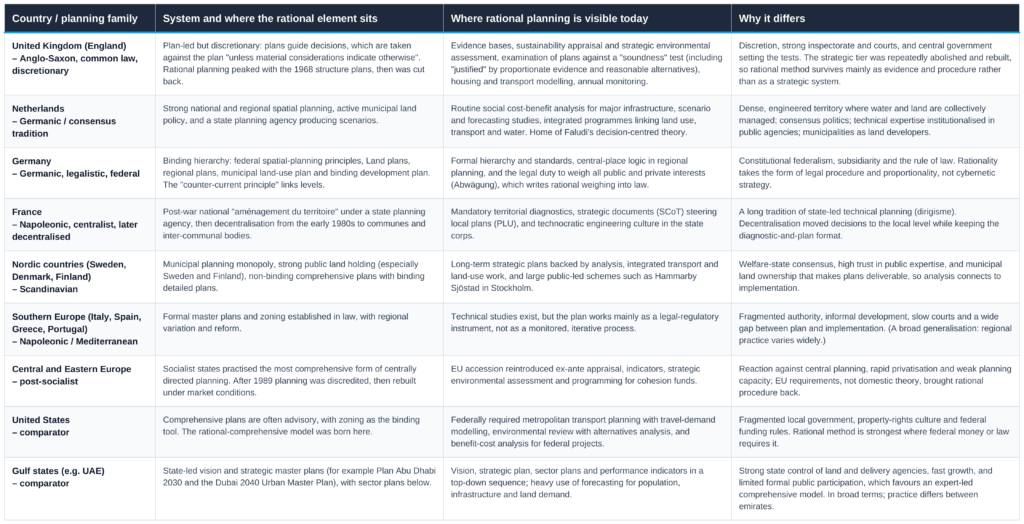
The table groups countries by planning family (following the legal and administrative classification used in comparative European studies by Newman and Thornley, 1996) and adds the United States and the Gulf as comparators. It is a set of broad generalisations, and practice varies by region and by period.
Why the differences?
Five factors explain most of the variation shown in the table.
- Legal and administrative family. Where planning is bound by law (Germany, France, Southern Europe), rationality appears as procedure and legal weighing. Where it is discretionary (Britain), it appears as evidence and justification.
- Land ownership and delivery power. Municipal land holding in the Nordic countries and active land policy in the Netherlands connect analysis to implementation. Without that link, plans stay advisory.
- Distribution of power. Federal Germany, centralised France and municipally strong Sweden each place the rational exercise at different levels.
- Political and economic history. Britain’s swings between strategic and local planning, the discrediting of central planning in Eastern Europe, and welfare-state consensus in the north each shaped how far rational method was trusted.
- External requirements. In places where domestic planning theory moved on, EU rules, federal funding conditions and international lenders kept the rational procedure in force.
Implications for practice
- Use the method as a discipline, not a doctrine: state assumptions, test alternatives, and monitor outcomes.
- Make values explicit. Say who set the goals and whose interests the appraisal counts.
- Match the depth of analysis to the decision. Proportionate evidence is stronger than exhaustive evidence.
- Combine analysis with participation and negotiation. The communicative critique complements rational method and does not replace it.
- Treat models as aids to judgement. Publish their limits and check them against outcomes.
Conclusion
The rational planning paradigm lost the argument as a complete theory of planning but won it as a working method. Its claim to neutrality and completeness failed. Its core habits of surveying, forecasting, testing alternatives and monitoring were absorbed into law, funding rules, professional training and software. The European comparison shows that the same method takes different forms depending on legal tradition, land power and political history. The practical question for planners is therefore not whether to use rational planning, but how far to trust it and how openly to state the judgements that sit behind it.
References
Banfield, E.C. and Meyerson, M. (1955) Politics, Planning and the Public Interest. Glencoe: Free Press.
Chadwick, G. (1971) A Systems View of Planning. Oxford: Pergamon.
Davidoff, P. (1965) Advocacy and pluralism in planning. Journal of the American Institute of Planners, 31(4).
Etzioni, A. (1967) Mixed-scanning: a “third” approach to decision-making. Public Administration Review, 27(5).
Faludi, A. (1973) Planning Theory. Oxford: Pergamon.
Faludi, A. and van der Valk, A. (1994) Rule and Order: Dutch Planning Doctrine in the Twentieth Century. Dordrecht: Kluwer.
Flyvbjerg, B. (1998) Rationality and Power: Democracy in Practice. Chicago: University of Chicago Press.
Friend, J.K. and Jessop, W.N. (1969) Local Government and Strategic Choice. London: Tavistock.
Geddes, P. (1915) Cities in Evolution. London: Williams and Norgate.
Healey, P. (1997) Collaborative Planning: Shaping Places in Fragmented Societies. Basingstoke: Macmillan.
Isard, W. (1956) Location and Space-Economy. Cambridge, MA: MIT Press.
Lee, D.B. (1973) Requiem for large-scale models. Journal of the American Institute of Planners, 39(3).
Lindblom, C.E. (1959) The science of “muddling through”. Public Administration Review, 19(2).
McLoughlin, J.B. (1969) Urban and Regional Planning: A Systems Approach. London: Faber.
Newman, P. and Thornley, A. (1996) Urban Planning in Europe: International Competition, National Systems and Planning Projects. London: Routledge.
Rittel, H. and Webber, M. (1973) Dilemmas in a general theory of planning. Policy Sciences, 4(2).
Simon, H.A. (1947) Administrative Behavior. New York: Macmillan.
Enjoyed this article? Our author book Experience: What Matters in Architecture, Urban Design and Planning shares his experience in professional practice. Read about the book or find it on Amazon.