
Amazon platform bot mechanisms change from time to time, and that affects Amazon Ads performance.
The following is a demonstration of what really happens on Amazon, so don’t be surprised. I will go through this in detail later on. The snapshot of the Amazon system shows what the search term I have put in the text see figure 1.
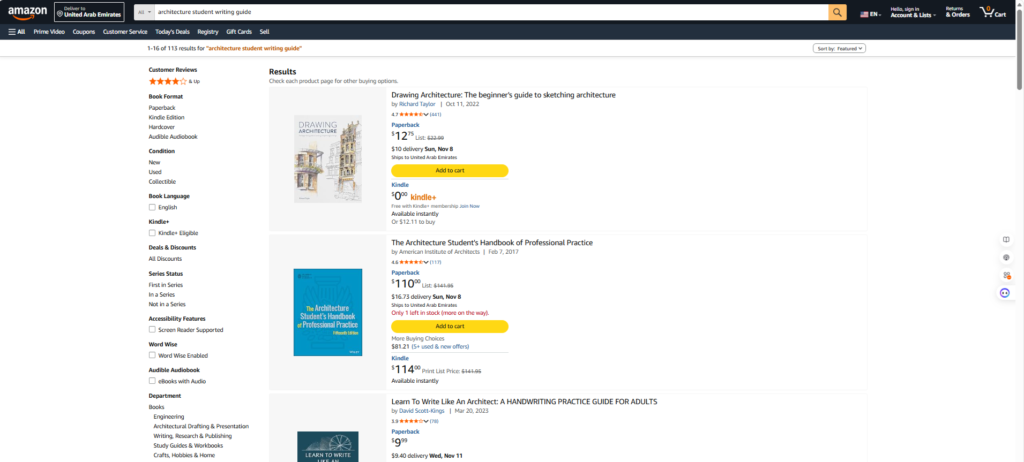
The search result is really surprising because it came out with books that do not relate to the search term in any means in the first page books appeared like the ones below.
- Drawing Architecture: The beginner’s guide to sketching architecture
- 101 Things I Learned in Architecture School
- Landscape Architecture Documentation Standards: Principles, Guidelines, and Best Practices
- Architectural Graphic Standards, Student Edition (Ramsey/Sleeper Architectural Graphic Standards Series)
- The Guide to Writing Fantasy and Science Fiction: 6 Steps to Writing and Publishing Your Bestseller!
Before You Publish
Publishing a book on Amazon is not an easy task. The book itself requires a lot of effort to build and write so that it serves its purpose. Then you need to find reliable people to audit it, proofread it, and give their opinion before you publish it.
In my personal experience, even reliable people may put you in a very bad position. One of my books was passed to a friend to give his opinion. He passed it on to someone else, who read it and did not give any opinion, but managed to hack the book and rewrite it by changing some sentences, and then gave it to a publisher to publish before the book reached Amazon.
Another book, which was passed to someone abroad to read and give her opinion, turned out to be hacked and translated into another language, carrying another author’s name. At the beginning, this is a first hit that brings an author down psychologically and makes them lose interest in continuing the journey. So, one must be careful in this matter. Before sharing a manuscript, send it in a protected format, ask the reader to agree in writing not to pass it on, and consider registering your copyright.
In order to serve its purpose, a book must provide knowledge that others do not have. A survey of the book market can give some signals about topics that are missing. Writing in the “zone of green ideas” may solve the problem See my article.
The Amazon platform requires someone to read the book (not mandatory) and then provides a service for that, which two of my books passed without a problem. This is another obstacle in writing a book, especially when you select someone who is a high-level academic. This needs to be considered at the beginning, when planning to publish with Amazon.
Authors and marketers writing in Favor of the Amazon platform and promoting Amazon Ads consider themselves experts, and they are revealing industry secrets that, from my experience from seven years ago, are totally false and misleading.
Understanding the Platform
The Amazon platform and Amazon Ads together are not easy to go along with if you are new to the market. Understanding Amazon Ads requires a lot of knowledge.
The book Let’s Get Visible goes through the platform as if the author was a former employee. He describes the process of uploading the book and making an author page. Putting the book in a category is also a hassle because of the number of competing books, so an author needs to know this in detail. Putting a book in the right place is the key to visibility and to getting the book seen.
Selecting a subcategory with fewer competing books is also a good choice that gives the book a chance to appear. Another element is how to build the keywords for your book. In my experience, none of the books on the market revealed this, and that is the challenge. Here, your book will be among millions of other books, so you need to start correctly.
The title of your book needs to be selected carefully, because it goes through the process of cross-referencing. Categories are the second element that you must select carefully, and third are the keywords that Amazon gives you in the bookshelf. All of them will work together if you study, plan, and select accurately.
Amazon decides which books to show for a search term mainly by how well they sell for that term, together with how relevant the book is to it. A new book with few sales has almost no sales history behind any keyword, so even a well-chosen list can fail to surface it. This helps to explain why keywords that work for a while can stop working, and why the platform seems to change its rules. The practical lesson is to treat keywords as experiments: check which ones really bring visitors and sales, and replace those that do not.
Promoting Your Book
Coming to advertising for the book, you will be overwhelmed by the amount of information about Amazon Ads and advertising for a book, starting with the use of social media such as Facebook, Twitter, and YouTube. Most of the Facebook books published for this purpose give you the same ideas: making a profile and joining groups. Then you join Kindle groups to publish and promote your book.
In promoting, you will face a problem: most Facebook groups do not accept self-promotion. On Twitter, the matter is similar but harder, because you have to find followers first – see my article. So, the best way is “follow for a follow,” and promoting there has no obstacles.
Putting your book link on your blog is another idea published by the books that promote Amazon. You will be surprised that Amazon may send you an email saying that if you do not bring sales within 6 months, they will cancel the subscription. Putting a link to Amazon on your blog will bring you some extra payment.
Joanna Penn, one of the bestselling authors on Amazon, and most others, if not all, who promote Amazon Select, recommend price matching. This is a way to let people read your book for free, because at the time of writing, Amazon allows only 5 free days in every 90 days if your book is in the Kindle Select program. So, you need to upload the book on another platform and inform Amazon of the price match to make it free. That is not all; it is only a small part of the effort you will make every day to let people know the book is free to read.
From personal experience, price matching will work for novel writers, not for other fields. One of my books received high download numbers and became the bestseller in free downloads in its niche.
There is also a risk of piracy. One day I searched for one of my books and found it on a website where a Brazilian man was promoting himself by using my book as a free gift. I informed the website, and they removed it. It is worth searching for your title from time to time.
Reviews
Price matching did not bring reviews for my book on Amazon. One of my books got 250 downloads but only one review. Putting a text at the end of the book asking readers to write a review on Amazon also did not bring much; from personal experience, it works only for novel writers.
I personally read more than 50 books about Amazon and Amazon Ads and book marketing through social media. Most of the books that work in Amazon’s favor only describe how to use the platform, and none of them gave the proper advice that worked. The only idea that really works was to ask a friend to write a review, so that Amazon Ads would start working for you (I did not do it).
You can get paid reviews on Amazon, and plenty of people offer them. At the beginning of my publishing, I received more than 100 offers on Facebook to write a review for $100. So if you are willing to pay, go ahead.
Amazon Ads
You can read a lot of books on the market about Amazon Ads. Most of them present their authors as experts in the industry. For example, Bryan Cohen, in his book on Amazon Ads, talks about how he worked with his clients to use and sell on Amazon using Amazon Ads. It is like a story; he is writing a novel about his success.
Most of the books also explain the systems of ads and how to use them. A section is reserved for every part, showing its pros and cons. At the end, they advise using the form of ads that makes Amazon Ads search for keywords that bring you sales, and then building your Amazon Ads process on that. He says in his book to always reduce the amount of money reserved for ads and to set a low CPC (cost per click) rate, for example, $0.25 to $0.50.
He indicates how to use the low-CPC advice. The idea is to let Amazon show you which search terms really sell your book. Start an automatic campaign with a small daily budget and let it run for a few weeks. Then read the search-term report, keep the terms that produced sales, and move them into a manual campaign with a low bid. Add the unrelated terms that cost money without selling as negative keywords.
Setting Realistic Expectations
Amazon works in favor of US authors because it is an American platform. You can check the bestseller list and see who the authors of these books are. Amazon also works in favor of bestsellers, free or paid, because it is a commercial platform. If you are new, you need a lot of time to reach that level, and the result is about 5,000 books sold over the whole life cycle of a book (this figure is from Amazon-related agencies- see NPD BookScan, Steve Laube Agency, and KBoards or Kindlepreneur.
How to estimate monthly sales from a book’s rank. A book’s Best Sellers Rank can be turned into a rough estimate of its monthly sales. Find the overall rank in the Product details, look it up in a published rank-to-sales table, and multiply the daily figure by 30. As an example, take a leading architecture reference from Wiley, ranked #39,644 overall, and also #5 in the Architecture category and #1 in Architecture Project Planning & Management. Published tables put the 10,000 to 50,000 band at about 3 to 15 copies a day, which is roughly 90 to 450 copies a month. Calculators that smooth the curve give about 7 copies a day at this rank, or about 200 a month, and one more cautious table gives only 30 to 100 copies a month. The honest answer is therefore a range, and my own reading of it is about 100 to 250 copies a month.
The same tables show how thin the market is further down. A rank between 50,000 and 100,000 means about one copy a day, or around 30 a month, and a rank above 100,000 means fewer than about 10 to 30 copies a month. A niche title ranked in that zone may sell only a handful of copies each month, which is why even a strong architecture book sells in the low hundreds at best.
Amazon platform, after reading my article here, presents evidence that no one can deny that the platform pushes the author, especially the new ones, to make Amazon ads. The platform and its system change from time to time and no expert knows how it works and all advice presented in the books mentioned here or other ones are descriptive only. The platform and Amazon Ads become without benefit when your book reaches the bestseller rank and that is very hard job that needs lots of efforts, money, and time consuming.
What I Would Do Differently
Looking back, I would plan the title, categories, and keywords before finishing the book, instead of treating them as an afterthought. I would protect my manuscript before sharing it with anyone. I would build a first group of honest reviews from friends and readers before spending money on ads, and I would start the ads with a small budget and a low cost per click.
Checklist for a First-Time Author
- Make sure the book offers knowledge or a topic that is missing in the market.
- Protect the manuscript before sharing it, and use reviewers you can truly trust.
- Choose the title, the categories (preferably a less competitive subcategory), and the keywords carefully.
- Check Amazon’s current rules before using Kindle Select or price matching.
- Collect honest reviews from friends and readers before starting ads.
- Start Amazon Ads with a low budget and a low CPC, and let the ads find keywords that bring sales.
- Search for your title from time to time to detect piracy.
A Final Word
In this article, I have revealed what most USA writers who promote for Amazon and Amazon Ads did not publish. I have disclosed what most marketing companies and individuals do not disclose. I have provided a valuable contribution for authors in my niche, and I wish them all the best in writing, publishing, and marketing their books.
Enjoyed this article? Our author book Experience: What Matters in Architecture, Urban Design and Planning shares his experience in professional practice. Read about the book or find it on Amazon.