Constructivist architecture appeared to celebrate the machine age and the mass production of architecture. Its drawings are full of steel frames, glass, concrete, radio masts and diagrams of movement, and its leaders spoke of the building as a tool, like a lathe or a locomotive. That image is true, but it is only half of the story. Constructivism was not only a taste for machines. It was a proposal to use design to build a new society after the 1917 Revolution, which is why it is remembered both as part of the modern movement and as a Russian utopia.
This article examines what Constructivism shared with the modern movement, how art shaped it, when it operated and what it built, why some of it failed, how criticism affected it, whether it survived, and what it achieved. The discussion of criticism draws on seven papers: Vronskaya, the OSA–ASNOVA essay, Tafuri, Lohtaja, Meerovich and Lidin, Murawski, and Udovički-Selb.
1. Constructivist architecture and the modern movement: shared principles
Constructivism and the Western modern movement grew in the same decade and from the same conditions: a devastated post-war Europe, a severe housing shortage, new industrial materials, and a belief that design should serve the mass of the population and not a private elite. Many of their principles were shared.
- Function before style. Moisei Ginzburg argued in Style and Epoch (1924) that a new architecture must grow from new conditions and new methods, not from a borrowed style. He read and admired Le Corbusier’s Vers une architecture. Gropius and the Bauhaus said much the same thing in Germany.
- The machine as a model. Le Corbusier called the house a machine for living in. The Constructivists described the building as an instrument or organism whose parts are justified by their work.
- Industrial materials and standardization. Both used reinforced concrete, steel and glass, and both worked on standard dwelling cells. Ginzburg’s Stroikom housing types (1928–29) are the Soviet counterpart of the Existenzminimum research in Frankfurt.
- Housing and public buildings for the masses. Housing, clubs, schools and factories, and not palaces, were the key commissions.
- A common formal language. Flat roofs, ribbon windows, free plans, pilotis and asymmetrical geometric volumes appear in both. Narkomfin, for example, uses most of Le Corbusier’s five points.
There was also direct exchange. Le Corbusier built the Centrosoyuz in Moscow (1929–36), and Ernst May, Hannes Meyer and Bruno Taut all worked in the Soviet Union in the early 1930s. Narkomfin is often cited as an influence on Le Corbusier’s later housing blocks.
Where the two differ
The main difference is the social program. In the West, the modern movement mostly worked for municipalities and private clients inside a market economy. The Constructivists worked in a state-owned economy and wanted architecture to change daily life itself (byt): collective kitchens, laundries and nurseries, and the end of the private household. Their key concept was the social condenser, a building whose spatial organization produces new social relations. Murawski argues that Koolhaas’s appropriation retained the concept’s form while discarding its political economy. Kopp and Lefebvre, by contrast, carried the idea to the West while stressing its public character, although Lefebvre recast condensation as an unplanned explosion rather than an engineered effect.
The OSA–ASNOVA essay adds that the same split existed in the West. The tension between functionalists and formalists appears in De Stijl (Oud against Mondrian), in van Doesburg’s attack on the “dogmatic functionalism” of the Bauhaus, and in the journal ABC. Constructivism’s internal quarrel was a local form of a general modernist problem.
Vronskaya argues that “Constructivism” was stretched in Western scholarship into a synonym for the whole Soviet avant-garde. For this reason, the term is used here for the architectural movement around OSA (the Union of Contemporary Architects) and its functional method, and not for Suprematism, Rationalism or the work of independent figures such as Melnikov.
2. The influence of art on Constructivist architecture
Constructivism began in art, and the route from art to architecture explains both its language and its character.
- Before the Revolution. Cubism and Futurism taught Russian artists to break the object into planes and to admire dynamism and the machine. Malevich’s Suprematism (1915) offered pure abstract geometry. Tatlin’s corner counter-reliefs (1914–15) made the material and its construction the subject of the work.
- 1920–21: from composition to construction. In the Institute of Artistic Culture (INKhUK), Rodchenko, Stepanova, Popova and Alexander Vesnin debated composition against construction. The First Working Group of Constructivists was formed in 1921, and the OBMOKhU exhibition showed spatial constructions of wood, metal and wire. Artists were asked to leave easel painting and make useful things (Productivism).
- Tatlin’s Monument to the Third International (1919–20). An inclined iron spiral with rotating glass volumes, meant to be taller than the Eiffel Tower. It was never built, but it became the symbol of art fused with technology and politics.
- Bridges between painting and architecture. Lissitzky’s Prouns, Malevich’s Arkhitektons and the stage sets of Popova and Vesnin tested three-dimensional abstract space. Alexander Vesnin was himself a painter before he became an architect.
- Teaching. At Vkhutemas (founded 1920), the basic course trained all students in abstract form, color and space.
Art supplied the vocabulary (geometry, exposed structure, dynamism), the experimental laboratory method and the ethic of honest construction. But the architects soon turned away from art. The OSA–ASNOVA essay, following Paperny, separates two roots. Constructivism (OSA) descends from zhiznestroenie, life-building, in which art merges with life and function governs form. Rationalism (ASNOVA, led by Ladovsky) descends from bespredmetnichestvo, non-figurative art, and works on the perception of form. Vronskaya adds that the West knew only the early sculptural phase (Rodchenko, OBMOKhU, Gabo) and so read Constructivism as a formal style, whereas the Constructivist architects never treated form as sculpture. Art opened the door, but the architects’ own method was functional and not artistic.
3. The period of operation in Russia
Constructivist architecture operated for about a decade, roughly 1923 to 1932, and built for even less.
- 1917–1921, War Communism. Almost no building. The work was done in art laboratories, studios and Vkhutemas.
- 1921–1925, the New Economic Policy. First architectural projects and theory: the Vesnin brothers’ Palace of Labour competition entry (1923) and Ginzburg’s Style and Epoch (1924).
- 1925–1930, the peak. OSA was founded in 1925 by Ginzburg and the Vesnins, and its journal Sovremennaya Arkhitektura (SA) appeared from 1926 to 1930. Most of the built work dates from 1926 to 1930.
- 1929–1932, pressure. The First Five-Year Plan brought new-town planning and the debate between urbanists and disurbanists. At the same time the party-backed society VOPRA attacked the independent groups. An April 1932 Party decree dissolved the independent artistic groups. The Union of Soviet Architects was organized later that year and held its first congress in 1937.
After 1932 the movement ceased to exist as a group. The Palace of Soviets competition (1931–33) ended in a monumental classical scheme, and the 1937 architects’ congress confirmed the new line.
4. What Constructivist architecture delivered, and where it failed
Constructivism produced new building types for a new society: the workers’ club, the communal or transitional house, the industrial and infrastructure building, the department store and the civic building. It also produced a large body of urban theory. The table lists the main Russian and Soviet examples.
| Project | Architect, date | Type and outcome |
| Monument to the Third International | Tatlin, 1919–20 | Monument. Model only. The structure and mechanical rotation were far beyond the technology and the resources of the time. |
| Palace of Labour, Moscow | Vesnin brothers, 1923 | Competition project. Not built. Influential on later work, but the new state had no funds for a building of this scale. |
| Mostorg department store, Moscow | Vesnin brothers; designed 1926, completed 1927–29 | Commercial. Built. A glazed, rational frame that shows the Constructivist approach to a modern public building. Sources differ on the completion date. |
| Dneprostroi hydroelectric station, Zaporizhzhia | Viktor Vesnin, Nikolai Kolli and a team, 1927–32 | Infrastructure. Built. A rare case where architecture and heavy industry worked together on a symbol of the Five-Year Plan. |
| Rusakov Workers’ Club, Moscow | Melnikov, 1927–29 | Club. Built. Three cantilevered auditorium volumes. Melnikov is usually placed outside strict Constructivism. |
| Zuev Workers’ Club, Moscow | Golosov, 1927–29 | Club. Built. A glass stair cylinder on a concrete block. Golosov also stands apart from OSA. |
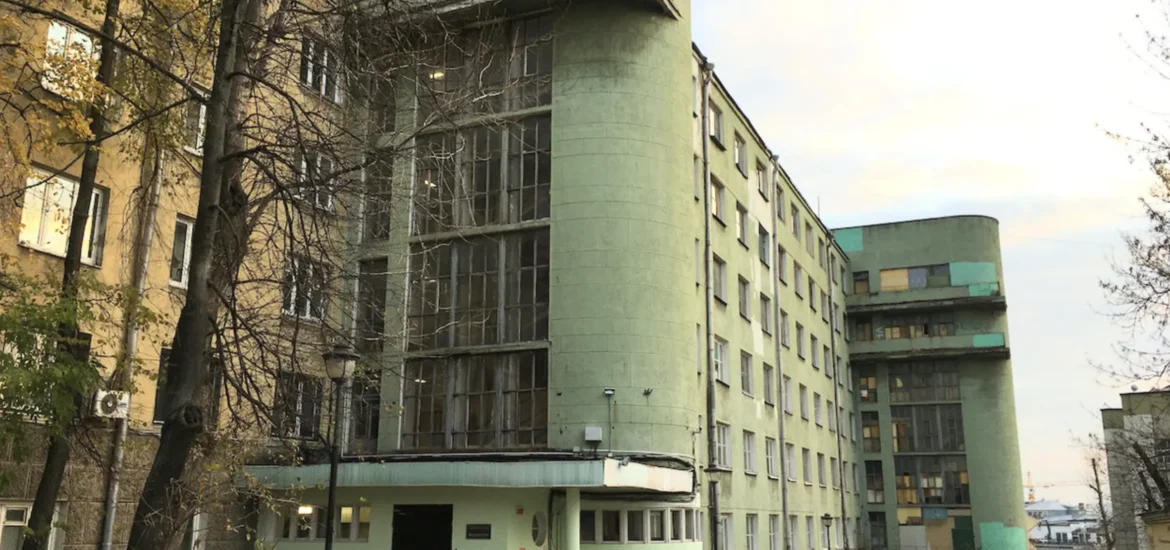
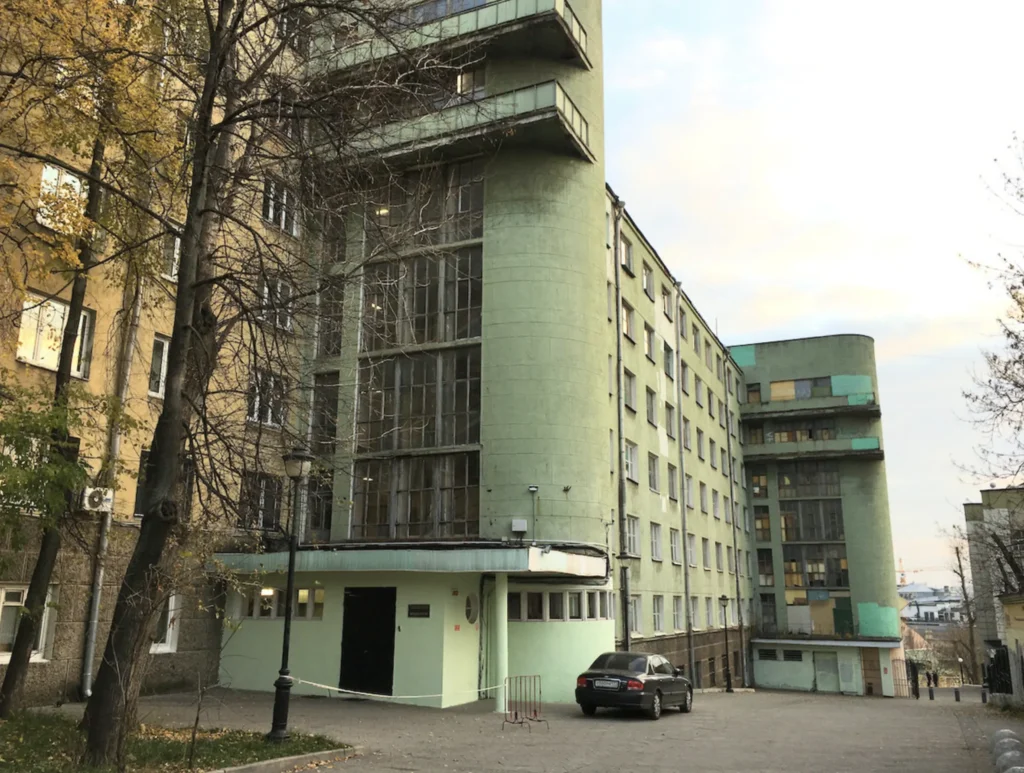
| Narkomfin Communal House, Moscow | Ginzburg and Milinis, 1928–32 | Housing. Built. A “transitional type” with split-level cells and shared services. Only two of four planned buildings were built. The collective services were never fully used, the building later decayed, and its restoration came decades later. |
| Government House, Alma-Ata | Ginzburg and Milinis, 1928–31 | Civic. Built. Constructivist method applied far from Moscow. |
| Lenin Institute of Librarianship | Leonidov, 1927 | Project. Not built. A radically abstract scheme of sphere and slab that remained a paper work, and one of the most influential drawings of the period. |
| Green City and disurbanist plans | Ginzburg and Barshch, 1929–30 | Planning. Not built. A decentralized settlement idea associated with the theorist Mikhail Okhitovich, defeated by the Five-Year Plan’s priorities and by party opposition to the abstract theory. |
| ZIL Palace of Culture, Moscow | Vesnin brothers, 1930–37, from competition to completion | Culture. Built. Shows Constructivism surviving in the 1930s while the official line changed. |
| Ordzhonikidze Sanatorium, Kislovodsk | Ginzburg, 1935–38 | Sanatorium. Built. A late work in a more tolerant building type. Sources give differing dates, including 1935–37 and 1938. |
Why some of it failed
The failures had several distinct causes, which are often mixed together.
- Resources and technology. The country was short of steel, cement and skilled labor. Large glazed walls and flat roofs suited a Western laboratory more than a Russian winter, and many buildings aged badly. Tatlin’s tower and several competition projects were simply ahead of what could be built.
- The social experiment did not match daily life. The communal-house idea assumed that residents would give up private kitchens and family routines. At Narkomfin the shared services were underused and the model was not widely repeated.
- The method had limits. Meerovich and Lidin criticize the Constructivists’ own diagrams as abstractions that could not model real life. They said nothing about culture and spiritual development, so mainly utilitarian processes were actually designed. Murawski adds the irony that the condensers were themselves deterministic about shaping the psyche.
- Politics. The decisive blow came in 1932, and it was not an aesthetic judgment (section 5).
5. How criticism affected its operation
The papers criticize Constructivism from different directions and at different times. Their effect on its operation differs accordingly, so they cannot be treated as one block.
| Source | What it criticizes | Effect on operation |
| ASNOVA attacks in the 1920s (Murawski; OSA–ASNOVA essay) | Formalism, “Westernism”, “mechanism” and the neglect of perception. | Mixed. It sharpened the debate (Leonidov replied with his “Criticism of Constructivism”), but it also weakened the movement from inside. Murawski cites Hudson’s claim that these attacks helped pave the way for repression, while cautioning that Hudson’s account tends to portray Ginzburg and the core Constructivists as individualistic and innocent of political entanglements. |
| VOPRA, “Leonidovshchina”, the 1932 decree (Udovički-Selb) | “Formalism” as a label against anyone to be removed. | Strongly negative and decisive. The attacks were tools of political control. VOPRA, created in 1929 after the 1928 Lenin Library controversy, helped lead to the single Union of Soviet Architects organized later in 1932. |
| Meerovich and Lidin (2018) | The ban was political, not aesthetic. They also criticize the abstract method. | Explains the ending. The state needed obedient civil servants producing standardized documentation, and independent groups did not fit that system. |
| Western critics: Taut, Meyer (Udovički-Selb) | Imitation of Le Corbusier and “purely artistic” play (Taut, 1929); attacks on the Centrosoyuz (Meyer). | Little direct effect that the papers can show. They reveal that the movement was judged by competing modernist standards, but the outcome was decided by the state. |
| Kaganovich’s instruction (Udovički-Selb) | Party architects were told not to attack Constructivists openly because they were still building. | Slightly positive. Practical skill gave temporary protection, and modernism survived late in sanatoria and palaces of culture. |
| Vronskaya, Tafuri, Lohtaja, Murawski (1969–2020) | The Western category, the ideology of the Plan, utopianism and the later use of the social condenser. | None on its operation, since they came after it. They changed its reputation and the way it was read. |
Taken together, criticism that came from the state and its party society had a negative and decisive effect and ended the movement as a group. Criticism from inside the profession was mixed and, in Hudson’s reading, helped the repression. Criticism from the West seems to have had little effect on events. The later scholarly criticism did not affect operation at all, but it matters for how Constructivism is understood. The positive effects appear limited and indirect: a sharper internal debate and a temporary protection because the architects could still build.
The later critics also disagree about what Constructivism was. Tafuri treats it as one more case of the avant-garde idealizing capitalist rationality as autonomous form, the “ideology of the Plan”, and blames capital and not Stalinism for the end of the avant-garde. Vronskaya warns that Cold War frames made it either a formal style or the victim of totalitarianism. Lohtaja, following Lefebvre, says its failure shows that new social relations demand a new space and that it failed because it did not go far enough beyond the possible. These readings point to the same idea from different sides: the movement’s political ambition is exactly what made it both important and fragile.
6. Continuation, reform and merger after 1932
Constructivist architecture did not continue as a movement, but it was not erased overnight and it did not disappear without trace.
- Late Constructivism. Works such as the ZIL Palace of Culture and the Kislovodsk sanatorium were completed after 1932. Modernism survived longest in sanatoria and palaces of culture, where the state was less watchful.
- Soviet functionalism. Meerovich and Lidin argue that Constructivism survived in a reduced form. Only the measurable and controllable parts of the method were kept, such as functional zoning and flow diagrams. Questions of form, rhythm and plasticity were dropped, and students were taught to design facades separately from plans.
- Merger with the official style. Many former Constructivists adapted to the new classical and Socialist Realist architecture. Khan-Magomedov used the term “post-Constructivism” for this transition, as Vronskaya notes.
- Prefabricated housing. The aim of standardized mass housing returned after Khrushchev’s 1954 rejection of architectural excess, in the industrialized housing programs. Murawski notes that the micro-district idea, reminiscent of the social condenser, was revived, but the social condenser itself was not. This arguably repeated the Constructivist technique but without its social program.
- Abroad. Constructivism returned as a style in MoMA’s Deconstructivist Architecture (1988) and as a concept in Koolhaas’s “patent” of the social condenser. Vronskaya argues that the Western reception often reduced Constructivism to form; Murawski criticizes Koolhaas’s appropriation for separating the condenser from its political economy. Murawski adds that many condensers are now privatized, so they no longer condense anything.
The problems it set out to solve
Constructivist architecture was meant to solve several problems: to house a population living in severe shortage, to industrialize construction in a country with little industry, to build the physical setting of a new socialist way of life, and to relieve the domestic labor of women through collective services. It solved these only in part. It produced prototypes, types and a method, but never the volume of housing the country needed, and the collective way of life it designed was not adopted by most residents.
7. Achievements and main strength
- A functional method. Ginzburg’s method designed from the program: the activities, their sequence and the flow of people, and then the form. It is one of the first systematic design methods in modern architecture.
- New building types. The workers’ club, the transitional communal house and the combined housing-and-services block were invented for a society that did not yet exist.
- Standardization. The Stroikom dwelling types and minimum cells were an early attempt at a complete housing typology.
- Spatial and structural invention. Cantilevered auditoria, split-level apartments, glazed stairs and the industrial architecture at Dneprostroi show real technical imagination under hard conditions.
- A professional culture. A school (Vkhutemas), a journal (SA), a society (OSA) and a large body of competition drawings that still teach designers today.
- A lasting concept. The social condenser is still used, even if it is often distorted, in current discussion of public and housing buildings.
The main strength
The main strength of Constructivist architecture was that it tied architecture to a social purpose through a rigorous method. A building was not designed from a style but from the question of what social life it should produce, and the form followed from the answer. That is the meaning of the social condenser, and it is the reason the movement is still studied. Its weakness lies on the same side: when the social purpose was abstracted into diagrams, it became deterministic and could not account for culture or for how people actually live, as Meerovich, Lidin and Murawski observe.
Conclusion: the utopia as an experiment
“Utopia” is the word most often used for Russian Constructivism, and the papers show that the word carries different meanings. For Vronskaya it became a condescending label in the 1980s. For Adorno, Bloch and Tafuri it is a “degenerate” utopia that served capitalist production. For Lefebvre it was an abstract utopia of technocrats, but one that points toward an experimental utopia that explores possibilities with continuing critique. Lohtaja adopts that last view and treats utopia as a method for expanding political imagination.
The evidence in these papers supports the experimental reading. Constructivism did not fail because its ideas were wrong in every respect. It was stopped by a political decision in 1932, limited by scarce resources, and partly weakened by the abstraction of its own method. What remained was an architecture of function, standardization and social purpose that later modernism inherited, in the Soviet Union in a reduced form and abroad often without its politics.
Sources
- Vronskaya (2017), “Deconstructing Constructivism”.
- OSA–ASNOVA essay, “The Soviet Avant-Garde” (following Paperny).
- Tafuri (1969), “Toward a Critique of Architectural Ideology”.
- Lohtaja (2020), “Architectural Utopias as Methods”.
- Meerovich and Lidin (2018), “Soviet Constructivism as Social-reforming Way”.
- Murawski (2017), “Introduction: Crystallising the Social Condenser”, The Journal of Architecture, 22(3), pp. 372–386. https://doi.org/10.1080/13602365.2017.1322815.
- Udovički-Selb (2009), “Between Modernism and Socialist Realism”, JSAH.
Enjoyed this article? Our author book Experience: What Matters in Architecture, Urban Design and Planning shares his experience in professional practice. Read about the book or find it on Amazon.