City in layers-part 3- An urban design concept is the third article of a series 1,2. In fact, this article aims to analyze and discuss several urban structure theories. Specifically, theories created by academics and practitioners, in certain cases, creating the urban form. In addition, I present my discussion of the failures of these theories, despite their widespread application in recent years. Moreover, connecting this discussion to the previous articles.
City in layers-part 3- An urban design concept, Urban structure theories
To start with, geographers examined various forms or blueprints of urban structure & growth; their studies focused on two countries in the world, firstly UK cities and also one of the biggest cities in the USA, the city of Chicago. For example, Cuthbert inquiry into the urban theory revealed that the Chicago school of sociology was the most significant. Certainly, it developed different types of typologies of urban structure in the twentieth century, propagated in the concentric theory, also the sector theory, and as well as the multiple–nuclei theory of Harris and Ullman. Figure 1 illustrates definitively how the urban structure theories create different urban forms or blueprints.
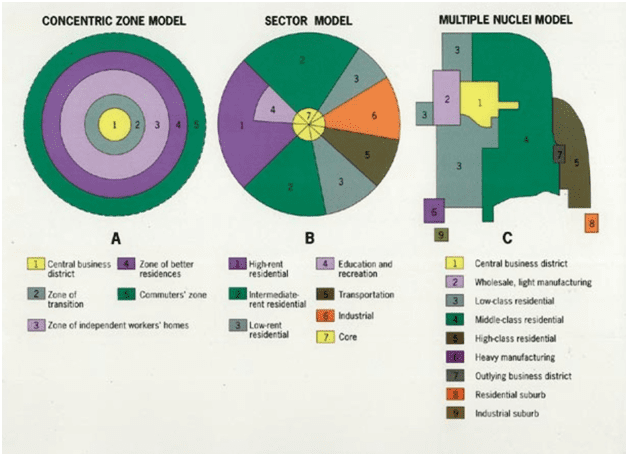
Burgess concentric Zones theory is rings of functional areas starting from the center, the high-density of business district, ring of light industry and low-quality residents, furthermore, ring of independent non-family workers, ring of better homes for families, and finally, ring of commuters.
Hoyt sector theory is developed from the first theory, the sectors are centered around the CBD in the middle, composed of six sectors, including but not limited to starting from high rent residential, intermediate residential, additionally, low rent residential, educational and recreation, transportation, and lastly industries.
Harris and Ulman nuclei theory is nuclei areas around a centric zone; specifically, the CBD is the core zone surrounded by wholesale and light manufacture, also low-class residential areas, middle-class residential areas, and other areas connected to the center through other zones such as high-class residential, heavy manufacture, residential suburban, and finally industrial suburban.
Major failure of urban structure theories
These theories were an outcome of socioeconomic studies of industrial cities in the world, specifically Chicago and major UK cities such as Sunderland. Indeed academic research spotted the immigrants to the USA living in industrial cities in poor living conditions. Additionally, targeted specific behavior, including alcoholism, homicide, suicide, psychoses, and poverty. Therefore, they computed rates based on census data.
Surely, these theories presented a blueprint of land use in cities that were criticized later for segregation and social isolation. As a result, leading to derelict areas, abundant places, and city deprivation. As a matter of fact, the theories introduced several important factors in urban planning and urban design for consideration: design and living conditions, efficiency of infrastructure, transit network availability, and affordability. In addition to tackling environmental issues.
In conclusion, laying out a blueprint of an area or a city without considering urban design principals as well as best practices is a major catch in these theories. Here, surely, transport planners are in isolation when these theories were introduced, as many factors in urban transit affect urban design and vice versa. In fact, mass transit design had and still makes positive impact on the city layout as weel as the design. To illustrate the discussion here, Part 1, 2 connect the discussion and give a holistic view of the city in layers concept. For more details, click here.
Article Series:
Part 1: Urban Form Transformation into the Metropolis — traces how urban form transformed into the metropolis, covering regeneration paradigms in Central London.
Part 2: Urban Design Methods & People Movement — reviews urban design methods including linkage theory, and argues that people’s movement is a missing layer shaping urban form.
Part 4: London Transport Development (1900-1935) — examines London’s early transport proposals, inner city problems, and where these efforts failed.
Part 5: London Urban Renewal & CIAM (1945-1970) — explores inner London’s post-war renewal and the influence of the CIAM planning code.
Part 6: London Urban Systems (2000-2015) — traces London’s shift from urban sprawl to mixed-use development.
City in Layers – Urban Design in Practice — applies the city-in-layers concept to a real urban development project in the Middle East.
Following, I inserted a list of references that supplied the research. In addition, a reference list for further reading.
- Trancik,Roger.(1986) Finding lost space .New York-USA : Van Nostrand Reinhold
- Cuthbert, R.Alexander. (2011) Understanding Cities method in urban design. Oxon-UK ,Routledge (Taylor & Francis group).
- Shane, David Grahame. (2011) Urban design since 1945. West Sussex-London: Wiley & Sons Ltd.
- Lynch, Kevin. (1960) Image of the city .London-UK: MIT Press.
- Tallon, Andrew. (2013)Urban regeneration in the UK. Second edition.Oxon-Uk: Routledge (Taylor & Francis group).
- Lang, Robert. (2003) Edgeless Cities are exploring the elusive metropolis. Washington-USA: Brookings Institution’s press.
- Wallinger, Mark. (2014)Labyrinth a journey through London’s underground .London-Uk: Arts book Publishing.
- Carmona et al .(2003)Public places , urban spaces – the dimensions of urban design .Oxford-Uk : architectural press.
- Laurie, Micheal. (2002)Introduction to landscape architecture. New jersey –USA: PTR prentice hall.
- Czerniak, Julia&Hargreaves, Jeorge. (2007)Large Parks. New York-USA: Princeton Architectural Press.
- Turner, Tom. (1998)Landscape Planning and environmental impact design.London-Uk: UCL Press.
- Osborn, F.J. (1946) Garden cities of tomorrow. London-UK: Faber&Faber.
- Cherry, Gordon E. (1972) Urban change and planning – a history of urban development in Britain since 1750.Oxfordshire-UK: GT Foulis & CO LTD.
- Liversedge, Jamie&Holden, Robert. (2014)Landscape architecture an introduction. London-UK: Laurence King LTD.
- OC, Taner&Tiesdell, Steven.(1997)Safer city centers reviving the public realm . Liverpool-UK: Paul Champon Publishing.
- Evans, Alun Sylvester. (1980) urban renaissance a better life in towns.England-UK: Robert stockwell LTD.
- Longley,Paul&Batty,Michael.(1994)Fractal Cities a geometry of form and function .London-Uk: Academic Press
- Greeves, Ivan .S. (1980) London Docks 1800-1980 a civil engineering history. London-UK: Thomas Telford Limited.
- Trench, Richard.Hillman, Eliss. (1985)London under London a subterranean guide.London-Uk: John Murray LTD.