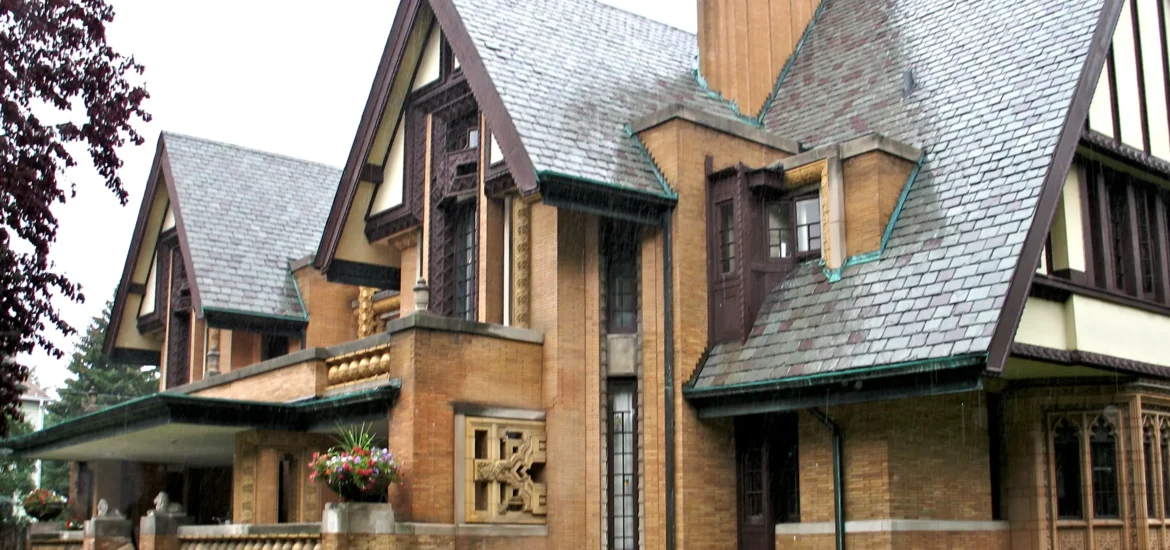

Introduction
Frank Lloyd Wright never gave organic architecture one fixed definition. He explained it in essays, lectures and books from the 1890s to the 1950s, rewording it each time, and treated it as an ideal to approach rather than a doctrine to complete. The result is less a style than a demand for wholeness: a building should develop from within outward, from the life lived inside it, its site, its materials and its way of being built, with nothing merely applied.
What “organic” means
Wright’s shortest definition comes from his 1914 essay in Architectural Record: organic architecture develops from within outward, in harmony with the conditions of its being, as opposed to one applied from without. Most of what he wrote afterwards elaborates that sentence, and three points follow from it.
It is about wholeness, not curves. In 1908 he described each building as cut from one piece of goods, every formal element derived from a single basic idea. His early prairie houses relied on plain walls and straight-line patterns, so “organic” never meant organic-looking.
Nature is a teacher, not a model. In Modern Architecture (the 1930 Kahn Lectures at Princeton) he warns that the word, taken too biologically, becomes a stumbling-block. Nature means the principle at work in everything that lives and gives life its form and character. It has nothing to do with realism and refers to the essential reality of things, so one may speak of the nature of tin or of a chromatic seventh. Organic applies to a “living” structure whose parts are so organized in form and substance that, applied to purpose, they are integral. Everything that lives is organic; the unorganized cannot live.
It is a discipline, not a license. In 1914 he called the organic ideal a standard in itself and mocked those who recited “form and function” like a slogan learned by rote. By 1943 he conceded that “natural” or “integral” might serve better than “organic.”
Where the idea came from
Wright credited Louis Sullivan with reviving principles that were almost lost, Laozi with the idea that a building’s reality lies in the space within to be lived in, and Thoreau and Japanese art with the sense of growth from within.
In Modern Architecture he also places himself inside a wider movement. He recalls meeting the Vienna Secession in the winter of 1910, with Wagner, Olbrich, Klimt and Metzner as its soul, alongside the work of Sullivan and himself. The book’s 2008 introduction calls it his first real book. It appeared the year before the International Style exhibition and set an individual, spiritually liberated and democratic design against a collective “machine aesthetic.”
The same lecture gives the philosophy its emotional core: true romanticism in art is simply liberalism in art, the essential joy of living, and it wants no narrow conventions or intolerant “modes.”
The core principles
Wright kept returning to the same handful of ideas, set out most fully in the six propositions of his 1908 essay (which he said he drafted in 1894) and the “resources” of modern architecture in his 1943 Autobiography.
- Space is the reality of a building. Unity Temple (1906) was his first conscious expression of this: inside and outside stop being separate things.
- Form and function are one. This revises Sullivan’s slogan: the two become one when materials, method and purpose are in unison.
- A building grows from its site. On the prairie that meant low proportions, gently sloping roofs, sheltering overhangs and long terraces, with the ground treated as part of the building.
- Honor the nature of materials. Stain wood rather than varnish it and let plaster, brick and stone show what they are. A wood building will not and should not look like a steel one.
- Continuity and plasticity. Steel in tension lets supports and what they carry merge the way a branch grows from a trunk, which is the logic behind his cantilevers. Glass dissolves walls so that garden and building become one.
- Simplicity as unity, not bareness. Everything meaningless is removed, leaving few rooms, built-in furniture and openings that are themselves the ornament.
Ornament and the machine
Wright did not reject ornament or the machine. He rejected ornament that was added on, and machines used to copy the past.
Ornament, he wrote in 1908, should be constitutional, beginning with the ground plan and always “of the surface, never on it.” By 1943 he called this integral ornament, the structure’s own natural pattern made visible, as in a tree or a lily.
His position on the machine surprised the Arts and Crafts audience at Hull House in 1901, where he called it the great forerunner of democracy. It frees people from drudgery, teaches honesty about materials and lets the poor as well as the rich enjoy clean, strong forms. In Style in Industry he describes the machine as a mathematical automaton contrived in brass and steel to multiply man-power, “the brainless craftsman of a new social order.” He admits he is accused of inconsistency for praising both Nature and the Machine, but argues that each word, properly understood, needs little correcting. In 1943 he added a warning: the machine would confirm the new principles at every point but destroy them if not checked by a new simplicity.
Against the box, and how he differed from classicism
Wright attacked two targets at once. The classical and Beaux-Arts tradition cut interiors into box-like compartments and only ever stacked one element on another, a logic that steel, concrete and glass have made obsolete. The “internationalist” modernists, whom he attacked without naming, offered a new superficial aesthetic chasing the look of the machine; a plain flat surface cut for its own sake, he argued, is as ornamental in the objectionable sense as classical egg-and-dart molding.
A fair question, raised in the critical commentary, is that classicism is itself built on primary forms and the superposition of abstract shapes, so what was actually different? The commentary gives four answers.
- Ornament. His geometric ornament was “of the surface not on the surface”: it usually resulted directly from the construction rather than being applied afterwards as a conventional sign.
- Method. It was more “democratic” than the classical or International Style because it was open at all ends rather than closed, “like a box on stilts,” and made of many geometries, “more suited to human to and fro than the right angle.”
- Individuality. It grew out of the individual situation, so its style expressed a personal character rather than an impersonal, dead convention adopted without reflection.
- Purpose. As in Sullivan’s organic architecture, it did not hide, constrain or coerce the purpose of the building.
Democracy and the city
Wright presented organic architecture as a social idea. The subtitle of his 1939 London lectures is The Architecture of Democracy. In 1908 he wrote that there should be as many kinds of houses as there are kinds of people. The Usonian houses of the late 1930s were his attempt to bring standardization’s economies to ordinary families.
Broadacre City carried the logic to the scale of society. It took full form in 1932, in reply to Le Corbusier’s Radiant City, and was later revised into The Living City (1958). It treated the city as a society in action, with decentralization replacing what he called petty agglomerations. It was never built.
Tensions and limits
Wright’s claims hold up unevenly against the record.
- Definition. The critical commentary notes that trying to grasp his exact meaning of “organic” is as difficult as understanding all his multifarious work.
- The circle. The same commentary observes that in his late projects Wright loses control of his geometry and lets it contradict function, material, construction, structure and freedom. It adds that the many definitions of organic architecture (the book counts fifty-one) are usually based on the circle. The Guggenheim is the test case: twenty-one artists protested that its sloping ramp would throw their canvases askew. Yet the commentary also defends it, arguing that its contrast with the city gives it the symbolic place usually held by a city hall or temple, a consistent fit between form and meaning.
- Structure and nature. Fallingwater’s cantilevers deflected from early on,, reaching about seven inches at the edge of a fifteen-foot cantilever in a 1995 survey. A fractal analysis did not support the claim that the house visually resembles its landscape.
- Society. Planners rejected Broadacre City as individualistic and wasteful, and writers caution against overstating the Usonian houses’ affordability.
Wright anticipated part of this. In 1914 he complained that imitators had turned the cause into noise, and in 1943 he warned that it is as easy to cheat with simplicity as with classical form.
Conclusion- Theory
Read in his own words, organic architecture is a demand that a building be whole: developed from the space people live in, the site, the materials and the method of building, with ornament that grows from structure and a form that serves its purpose. That demand stayed constant while his vocabulary moved from “organic” to “natural” and “integral.” His claims about nature, structure and democracy are where the record is most contested, so the philosophy and the buildings are best weighed against each other rather than treated as one.
The Case Against Organic Architecture: What the Critical Literature Says
Organic architecture is usually admired before it is examined. The phrase carries a moral glow: buildings that grow from their sites, tell the truth about their materials and serve human life rather than machine efficiency. Yet a reading of eight papers on the subject shows that the sharpest criticism does not come from hostile modernists. It comes from sympathetic scholars who set out to rescue the idea and, in doing so, document where it fails. Their findings gather into four charges: the concept is empty, its claim about nature is unproven, its principles have been reduced to shape, and its social promise was not delivered.
Charge one: nobody can say what it means
The most repeated criticism is definitional. Hynynen states it bluntly: organic architecture, the most common framework for analysing Alvar Aalto, could not be considered a real theory but is a fuzzy concept with almost as many interpretations as there are writers. Naturalness is read by some as the imitation of natural forms and by others as the imitation of natural processes, and at its loosest the word covers any free form that departs from the rectangle.
The founders did not help. Zbašnik-Senegačnik and Kitek Kuzman record that Wright failed to define his own term in words, and that the tradition splits into three strands (nature incorporated into design, geometry drawn from natural law, and biomimicry) whose borders are unclear and which overlap in practice. Aalto, according to Hynynen, never explained the concept consistently and later fell back on the claim that his works speak for themselves.
Gartner shows what filled the vacuum. Giedion thought Wright’s attempts at clarification were futile and called the organic a mere trend with neither history nor theory. De Zurko treated it as a poetic metaphor and equated organic with functional. Zevi called it a tendency rather than a program and warned against a “biological fallacy”. Gartner’s summary is that the critics supplied the explanation themselves, sometimes in direct contradiction to what Sullivan and Wright actually wrote. Hynynen makes the same observation and adds two fallacies taken from Zevi: the naturalistic fallacy, which reads organic architecture as imitation of plants, and anthropomorphism, which treats buildings as extensions of the body and slides toward expressionism. Civelek adds an etymological twist: following Rykwert, “organic” and “mechanical” were once near-synonyms, which hardly gives the word a stable opposite. Bulatović and Bunjak, citing Robinson, note that the word now means curved to some, natural materials to others, and individualistic or holistic to still others.
The criticism is therefore historiographical. “Organic” works as rhetoric rather than as an analytical category, and the secondary literature cannot be trusted to define the term it claims to analyse.
Charge two: the bond with nature is asserted, not shown
Vaughan and Ostwald attack the central empirical claim directly. For decades writers repeated that the form of Fallingwater mirrors its setting, yet nobody had measured it. Using fractal-dimension analysis, the authors compared the house with its surroundings. Of fifteen natural views, only one fell inside the range of the house’s views; of four natural plans, none did. Differences ran from roughly 5 to 23 percent, with rock and tree plans rated unrelated. The house proved generally less visually complex than its landscape, and the celebrated echo between cantilevered terraces and boulders found little support. The authors conclude that the proposition could be considered disproved, and they side with Frampton’s reading of deliberate juxtaposition and with Aguar and Aguar’s charge that the house overwhelms nature.
Gartner supplies a reason why the claim resists testing. The American doctrine rests on Emerson’s organicism, which itself borrows from Coleridge, German Idealism and older mystical strands. Sullivan’s “vital something” behind every form, the infinite creative spirit, is a metaphysical proposition rather than an observable property. Gartner concedes it might be a metaphor for environmental forces, but the architects’ discussions keep implying a unifying spirit that animates living things. A doctrine presented as rooted in American soil is thus an import of European literary theory, and its foundation cannot be falsified. Civelek reaches a related point: European organic theory made nature the teacher of architecture while largely ignoring where the building stands within nature, and the whole doctrine was born from an unresolved clash between romantic and scientific readings of nature, leaving Wright’s version an erratic mixture.
Charge three: the principle was lost, the shape survived
Bulatović and Bunjak state this most sharply. Contemporary criticism and practice discuss mainly the organic form, reducing the architecture to mere form and breaking the relation between house and person. The principles Wright set out (simplicity, site, honest materials, spiritual integrity) become detached from the curves being built, producing work whose purpose is to be noticed rather than to express anything essential. They also point to a contradiction in materials: the doctrine asks for natural materials, yet contemporary interpretations use concrete, glass and steel to obtain the organic shape, and since material properties dictate form, honest expression becomes a logical trap.
Bacon shows that historians did this first. In the 1930s organic work was absorbed into the International Style as a set of qualities (human-centred forms, local materials, sensitivity to site), and Mock’s account of a “humanization” of modernism describes a fusion in which the look of the organic survives while its doctrine disappears. Civelek traces the same dissolution from representation of nature, to its regulation, to mechanical reproduction. The romantic impulse drains away as environmental technology becomes the specialists’ domain and the architect turns into an applier of ecological techniques. The cost, he argues, is the poetic distance between nature and artefact.
Hynynen reaches the same endpoint by another route: form alone tells us nothing. If the true criterion is the architect’s method and mentality, then calling a building organic because it looks organic is simply wrong.
Charge four: the promise went unfulfilled
Civelek judges that Neutra’s theory promised more than his practice delivered, and that the hoped-for synthesis of science and art stayed an unfulfilled desire, eventually negated by Banham’s demand for a mechanically controlled environment. Wise provides the social evidence. Wright’s Broadacre City was refused in 1943 as too radical and impractical, despite a petition signed by Dewey, Einstein, Moses and Rockefeller. Its partial realisation, she shows through Squires and Lopez, produced the reverse of its aims: car dependence, heavy land consumption and distance from food, rather than independent farmers living in harmony with nature. Farmland is lost to development at roughly 50 acres an hour, and the share of Americans living on farms fell from over a third to under two percent. Hynynen adds a conceptual blow: Wright’s dictum that organic architecture means organic society would, if literally true, make Aalto’s work impossible, since Aalto saw planning as an independent and even emancipatory activity.
How strong is the case?
Unevenly. Vaughan and Ostwald is the strongest because it is quantitative and falsifiable, but it tests one building and one claim. Bulatović and Bunjak is a position paper, and its critique partly serves the authors’ own “symbiotic architecture”. Civelek is solid historiography, but his judgements about poetry and the architect’s role are interpretations rather than findings. Gartner and Hynynen are reconstructive: each rescues coherence, Gartner by reading the doctrine as a consistent theory of poetic expression and Hynynen by redefining it as a design method. That rescue has a price, because Hynynen’s method-based definition turns attacks on form or on nature into attacks on a misunderstanding, while leaving the concept almost unfalsifiable. Wise targets the planning model rather than the design doctrine, and relies mostly on secondary sources. Hynynen’s paper also criticises functionalism, prefabricated housing and Porphyrios’s reading of Aalto, and reports that Aalto was called a turncoat over Villa Mairea, but those criticisms are aimed at other targets, not at organic architecture itself. Zbašnik-Senegačnik and Kitek Kuzman is descriptive; its only critical content is the concession that definitions blur.
What is still missing
Cost, buildability, weathering and thermal performance are not addressed by any paper. Nor does any examine structural honesty in built work, or the charge that organic architecture is individualist, anti-urban or elitist. And none of the papers is a hostile monograph: the strongest attacks sit inside sympathetic texts, so a reviewer may call them selective quotation. Banham or Scully, or a critical-heritage assessment of a listed organic building, would close that gap.
Reading the charges together
The four charges support one another. If the concept has no stable meaning, its claim about nature cannot be tested; if the claim cannot be tested, the doctrine survives as a look rather than a method; and a doctrine that survives as a look cannot be held responsible for, or credited with, any social outcome. The best-evidenced criticisms are the first two, instability of the concept and the unproven nature claim, followed by form-reduction, which three independent sources support. Social failure rests on a single paper, and cost and performance on none.
Summary table of the criticism
| # | Criticism | Core argument | Papers |
| 1 | The concept is fuzzy, not a real theory | As many interpretations as writers; naturalness read as imitating forms or processes; any free form called organic | Hynynen; Gartner; Zbašnik-Senegačnik & Kitek Kuzman; Bulatović & Bunjak; Civelek |
| 2 | Founders never defined it; critics invented the definition | Wright and Aalto did not explain the term; Giedion, De Zurko and Zevi defined it incompatibly, sometimes against Sullivan and Wright | Hynynen; Gartner; Zbašnik-Senegačnik & Kitek Kuzman |
| 3 | Fallacies in the literature | Naturalistic fallacy, biological fallacy and anthropomorphism lead to expressionism | Hynynen (after Zevi); Gartner |
| 4 | The nature claim is empirically unsupported | Fallingwater’s form does not resemble its landscape; claim never tested; proposition “disproved” | Vaughan & Ostwald |
| 5 | The nature claim is metaphysical and imported | Rests on an untestable indwelling spirit inherited from Emerson, Coleridge and German Idealism; location within nature ignored | Gartner; Civelek |
| 6 | Romantic and scientific halves are incompatible | Doctrine born from contradictory readings of nature; Wright’s version an erratic mixture | Civelek |
| 7 | Organic reduced to form | Shape survives while principle dies; absorbed as a look by the International Style; form alone proves nothing | Bulatović & Bunjak; Bacon; Civelek; Hynynen |
| 8 | Material honesty is contradicted | Concrete, glass and steel used to obtain organic shape; material properties limit form | Bulatović & Bunjak |
| 9 | Loss of the architect’s role and of poetry | Environmental technology passes to specialists; poetic distance between nature and artefact is lost | Civelek |
| 10 | The promise was not delivered in practice | Neutra’s theory promised more than his practice; negated by Banham’s mechanical environment | Civelek |
| 11 | The social program was rejected and then inverted | Broadacre City refused as impractical; its partial realisation produced sprawl, car dependence and farmland loss; “organic society” fails on Aalto | Wise; Hynynen |
| 12 | Criticism aimed at other targets, not the doctrine | Attacks functionalism, prefabricated housing, a scholarly reading of Aalto and Aalto’s conduct (Villa Mairea) | Hynynen (2014) |
Organic Architecture: A reasoned assessment of the critical literature against Wright’s own philosophy
1. Finding
The criticism lands hard on how the theory is used and tested, and on the distance between Wright’s principles and his buildings. It mostly misses the theory itself. Much of the case attacks the popular reception of “organic” (nature-mimicry, curvy shapes, natural materials) rather than what Wright wrote.
Four of the criticisms survive as real weaknesses: the idea has no failure condition; Wright’s practice breaks his own principles; Broadacre City’s land logic is flawed on its own terms; and the claim that organic architecture implies an organic society overreaches. Most of the rest is either misdirected at critics and imitators, or rests on one study or one secondary source.
2. Summary table
| Criticism | Verdict | Reason in one line |
| Concept is fuzzy, has no failure condition | Valid | Regulative ideal with no test for violation; invites “not truly organic” escapes. |
| Practice contradicts principles | Valid | Cantilever deflection, Guggenheim ramp, control versus democracy, Usonian cost. |
| Broadacre land logic | Valid | Car-based, an acre per family: land-hungry whatever the intent. |
| “Organic society” totalises | Valid | Hynynen’s Aalto point; the architectural core can stand without it. |
| Nature bond unproven (Fallingwater) | Partial | Refutes the folk claim of mirroring, not Wright’s harmony-through-principle; one building, one metric. |
| Metaphysical, imported foundation | Partial | True as genealogy, but origin does not invalidate; falsifiability is the wrong standard. |
| Form survived, principle lost | Partial | A fate of reception, foreseen by Wright; his rhetoric and late curves did invite it. |
| Nobody can define it | Mostly not valid | True of the secondary literature; Wright gave working definitions and criteria. |
| Naturalistic fallacy, anthropomorphism | Not valid vs Wright | Wright states nature is a teacher, not a model to copy. |
| Materials paradox (concrete, glass, steel) | Not valid vs Wright | He required honest expression of each material, and welcomed these three. |
| Neutra, Banham | Not valid vs Wright | Different architect; rival thesis rather than refutation. |
| Broadacre caused sprawl | Not valid | Never built; sprawl had other drivers; rests on one paper. |
3. Where the criticism is valid
3.1 The idea has no failure condition
Wright did define organic architecture: it develops “from within outward” in harmony with the conditions of its being, as opposed to being applied from without (1914), supported by the six propositions of 1908 and the five resources of 1943. But he described it as an ideal that can be approached and never fully reached, and by 1943 he was willing to rename it “natural” or “integral.” A standard that can never be fully met, and whose violations are labelled “not true organic architecture” (as he did with internationalist building), is very hard to falsify.
This is a legitimate and serious charge. It is a no-true-Scotsman risk built into the doctrine. Hynynen’s rescue, which redefines the concept as a design method, makes the problem worse: attacks on form or nature become attacks on a misunderstanding, and nothing remains that could count against it.
3.2 Wright’s practice breaks his own principles
This is the strongest critique, and the Wright document supplies evidence that the criticism document says is missing. Cost, buildability and performance are not addressed by any of the eight papers, yet the Wright document records the following:
- Structure. Fallingwater’s cantilevers deflected from early on; sources report continuing downward movement and about seven inches of deflection at the edge of a fifteen-foot cantilever. Wright’s analogy of steel in tension as a branch growing from a trunk is a persuasive image but a poor engineering model.
- Form and function. He claimed form and function are one, yet twenty-one artists protested that the Guggenheim ramp would throw their canvases askew, and critics read the building as form over function.
- Democracy versus control. The 1908 essay argues that the conceiving individual determines every detail, down to the glass, and defends this with the portraitist analogy. That sits uneasily with “democracy,” and with the idea that the building grows from the client’s life.
- Cost. He admitted that plain custom designs needed extra drawings beyond the standard fee, and writers caution against overstating the Usonian houses’ affordability.
These are not attacks on a misreading. They test Wright against his own stated criteria, and they are the findings an advocate would find hardest to deflect.
3.3 Broadacre City’s land logic
Planners at the time rejected Broadacre as individualistic and wasteful, and the premises explain why: an automobile-based, decentralised plan with a plot per family consumes land and creates distance whatever its intentions. This holds on the plan’s own terms, without needing to claim it caused anything.
3.4 “Organic society” overreaches
If, as Wright put it, organic architecture means an organic society, then work such as Aalto’s, which treats planning as an independent and emancipatory activity, becomes impossible. This is a fair internal criticism of his totalising move from building to society. It also suggests a repair: the architectural core (space, site, material, continuity, integral ornament) can be held without the social programme.
4. Where the criticism is only partly valid
4.1 The nature claim and the Fallingwater study
Vaughan and Ostwald’s fractal analysis is the most rigorous item in the criticism file, and it does undermine the long-repeated claim that Fallingwater’s form mirrors its landscape. But the claim tested is the imitation reading, which Wright disowned: nature “is never right ready-made”; it is a teacher, and what he wanted was an understanding of natural law. His third 1908 proposition speaks of harmony and of a building appearing to grow from its site, and harmony can be achieved by contrast. The study’s own sympathy with Frampton’s juxtaposition reading illustrates this. Fallingwater is also a wooded-ravine house, not the prairie type for which Wright wrote that proposition.
Two limits apply. The study covers one building, a limited set of views and one metric (visual complexity), so “disproved” is stronger than the evidence. And the real residue is that Wright offered no way to verify “harmony” beyond the architect’s assertion.
4.2 The metaphysical, imported foundation
Gartner is right that Sullivan’s “vital something” is a metaphysical proposition and that the doctrine descends from Emerson, Coleridge and German Idealism. But two points weaken the conclusion. First, origin does not decide truth (a genealogical fallacy). Second, Wright himself cited Laozi, Thoreau, Sullivan and Japanese art, so the picture of a doctrine “rooted in American soil” is partly the critics’ framing. More importantly, falsifiability is the wrong standard for a normative design theory. Functionalism also rests on untestable premises. The fair tests are coherence, and whether the principles produce architecture that can be judged. Civelek’s romantic-versus-scientific tension is plausible, but it is an interpretation, not a finding.
What does stand is a slippage between descriptive and normative claims (“this is how nature works, so architecture should…”), and from biological analogy to engineering fact, as the cantilever evidence shows.
4.3 “The shape survived, the principle was lost”
Three sources agree, and the history is sound: the International Style absorbed organic qualities as a look, and contemporary practice often delivers curves with no underlying logic. But this describes reception. Wright warned about imitators in 1914 and about cheating with simplicity in 1943, and his early houses used straight lines. Hynynen’s point that form alone proves nothing is in fact Wright’s own position. The valid residue is that his vocabulary (trees, growth, edaburi) and his later curvilinear work, the Guggenheim above all, made the formal reading easy.
5. Where the criticism is not valid against Wright
- “Nobody can define it.” True of the secondary literature. Giedion, De Zurko and Zevi defined it incompatibly, and Gartner shows they sometimes contradicted Sullivan and Wright. That is a charge against the critics. Wright’s criteria do discriminate: applied versus constitutional ornament, derivation from a single idea, space as the reality of the building.
- The naturalistic fallacy and anthropomorphism. These fit the imitators. Wright wrote that a wood building should not look like a steel one, which is an anti-mimicry rule.
- The materials paradox. Bulatović and Bunjak say the doctrine demands natural materials yet is built in concrete, glass and steel. Wright never required natural materials; he demanded honest expression of each material’s character and welcomed steel, concrete and glass. A blob poured in concrete violates his rule, so the paradox belongs to contemporary practice.
- Neutra and Banham. A gap between Neutra’s theory and practice is not Wright’s. Banham’s demand for a mechanically controlled environment is a rival position rather than a refutation.
- Broadacre as the cause of sprawl. It was never built. Sprawl had other drivers, including highways, mortgage policy and zoning. Wise’s causal link rests on one paper and mostly secondary sources.
- Hynynen’s other targets. His attacks on functionalism, prefabrication and Porphyrios’s reading of Aalto are not aimed at organic architecture.
6. A flaw in the critique’s own logic
The criticism file argues that the four charges support one another: a concept without stable meaning cannot be tested; an untestable claim leaves the doctrine as a look; a look cannot be credited or blamed for social outcomes. The chain does not hold. A doctrine surviving as a look is a fate of reception, not a consequence of untestability. And Wright’s core principles can be judged by ordinary architectural criticism: does the space read as the building’s reality, is the ornament integral, does each material express itself, does the structure behave as the form implies? The last question is where Wright’s buildings are most vulnerable, which is why Section 3.2 matters more than the conceptual charges.
7. Strength of evidence
The criticism document’s own caveats should be kept in view. Its strongest attacks sit inside sympathetic texts, so selective quotation is a fair worry. Vaughan and Ostwald is quantitative but narrow; Bulatović and Bunjak is a position paper that partly promotes the authors’ own “symbiotic architecture”; Civelek is solid historiography whose judgements are interpretations; Wise relies mostly on secondary sources and targets the planning model rather than the design doctrine. No hostile monograph (Banham, Scully) is included. The Wright document, for its part, is built largely from secondary sources and admits it did not read several primary texts, so the evidence on both sides is thinner than the tone of either suggests.
8. Net ranking
- Strongest: the gaps between Wright’s principles and his buildings (structure, function, cost, client control).
- Strong: unfalsifiability and the no-true-Scotsman risk.
- Partial: the nature claim, the metaphysical foundation, form-reduction, and Broadacre’s land logic.
- Weakest: “empty concept,” the fallacy charges, the materials paradox, Neutra and Banham, and the sprawl attribution.
Taken together, organic architecture survives as a demanding ideal of wholeness, but not as a verified claim about nature or society. The fair conclusion is that it should be judged by its buildings against its own principles, not by whether its metaphors can be proven.
References
Journal articles
- Civelek, Y. (2024). Organic and ecological: An assessment of the transformation of “organic” architecture into mechanically controlled environment. International Journal of Social and Humanities Sciences (IJSHS), 8(1), 157–182.
- Vaughan, J., & Ostwald, M. J. (2022). Measuring the geometry of nature and architecture: Comparing the visual properties of Frank Lloyd Wright’s Fallingwater and its natural setting. Open House International, 47(1), 51–67. https://doi.org/10.1108/OHI-01-2021-0011
- Wise, E. (2013). A gradual reawakening: Broadacre City and a new American agrarianism. Berkeley Planning Journal, 26, 133–149.
- Zbašnik-Senegačnik, M., & Kitek Kuzman, M. (2014). Interpretations of organic architecture. Prostor: Znanstveni Časopis za Arhitekturu i Urbanizam, 22(2[48]), 290–301. UDC 72.01.
Conference papers and proceedings
- Gartner, S. (2003). The influence of transcendentalism on American organic architectural theory. In Contribution and Confusion: Architecture and the Influence of Other Fields of Inquiry. Proceedings of the 91st ACSA International Conference, Helsinki, 27–30 July 2003 (pp. 299–305). Association of Collegiate Schools of Architecture.
- Bacon, M. (2003). Modernism in America: From Hound & Horn to an Americanized “International Style.” In Contribution and Confusion: Architecture and the Influence of Other Fields of Inquiry. Proceedings of the 91st ACSA International Conference, Helsinki, 27–30 July 2003 (pp. 9–14). Association of Collegiate Schools of Architecture.
- Hynynen, A. (2014). A deep organic re-reading of Alvar Aalto’s design approach. In Proceedings of the 6th Annual Architectural Research Symposium in Finland 2014 (pp. 28–38). Peer-reviewed article.
Unpublished conference paper
- Bulatović, K., & Bunjak, K. (n.d.). Symbiosis – A response on contemporary organic architecture [Conference paper]. Studio Cubex, Zemun, and Faculty of Architecture, University of Belgrade.
Chicago variants for the ACSA papers
- Gartner, Scott. “The Influence of Transcendentalism on American Organic Architectural Theory.” In Contribution and Confusion: Architecture and the Influence of Other Fields of Inquiry, 299–305. Proceedings of the 91st ACSA International Conference, Helsinki, July 27–30, 2003. Washington, DC: Association of Collegiate Schools of Architecture, 2003.
- Bacon, Mardges. “Modernism in America: From Hound & Horn to an Americanized ‘International Style.'” In Contribution and Confusion: Architecture and the Influence of Other Fields of Inquiry, 9–14. Proceedings of the 91st ACSA International Conference, Helsinki, July 27–30, 2003. Washington, DC: Association of Collegiate Schools of Architecture, 2003.
Enjoyed this article? Our author book Experience: What Matters in Architecture, Urban Design and Planning shares his experience in professional practice. Read about the book or find it on Amazon.