Architects, professionals and academic researchers have criticised the architecture modern movement since the 1920s, and the argument has not stopped. This article draws on two directions of research. The first looks at the factors of criticism related to the movement’s design and its core ideology. The second looks at how criticism changed through history, and at what actually changed in the world that affected it.
It opens a series of coming articles on the theory of architecture and criticism.
Background
The modern movement has no single birth date and no single inventor. Its roots lie in the nineteenth century, when iron, steel, plate glass and reinforced concrete gave builders structures that older masonry could not match, and in the pioneering buildings of the 1900s and 1910s. Historians date its start differently (Curtis, 1996; Frampton, 2020). This article takes 1920 as a working date, by which time the ideas had gathered into a recognisable movement.
Several pressures pushed the same way. Industry offered new materials and mass production. After the First World War, European cities needed housing on a large scale. Many architects wanted to leave historical styles behind and build something that expressed their own age, and some, following Adolf Loos, treated ornament as waste (Buras et al., 2025).
Peter Behrens and Adolf Loos prepared the ground. Walter Gropius, who opened the Bauhaus in 1919, Ludwig Mies van der Rohe and Le Corbusier gave the movement its best-known form, and J. J. P. Oud, Gerrit Rietveld and Alvar Aalto developed it in their own ways, while Frank Lloyd Wright, who rejected the label “modern” for what he called organic architecture, stood apart. In 1928 architects founded the Congrès Internationaux d’Architecture Moderne (CIAM) to turn shared ideas into a programme. In 1932 an exhibition by Henry-Russell Hitchcock and Philip Johnson at the Museum of Modern Art in New York gave the movement’s look a name: the International Style.
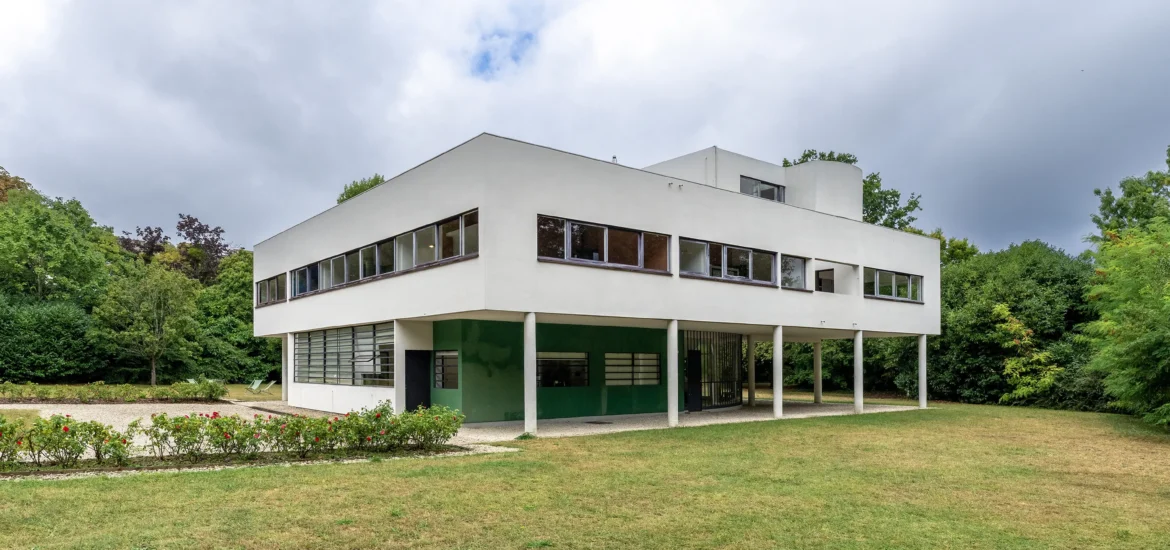
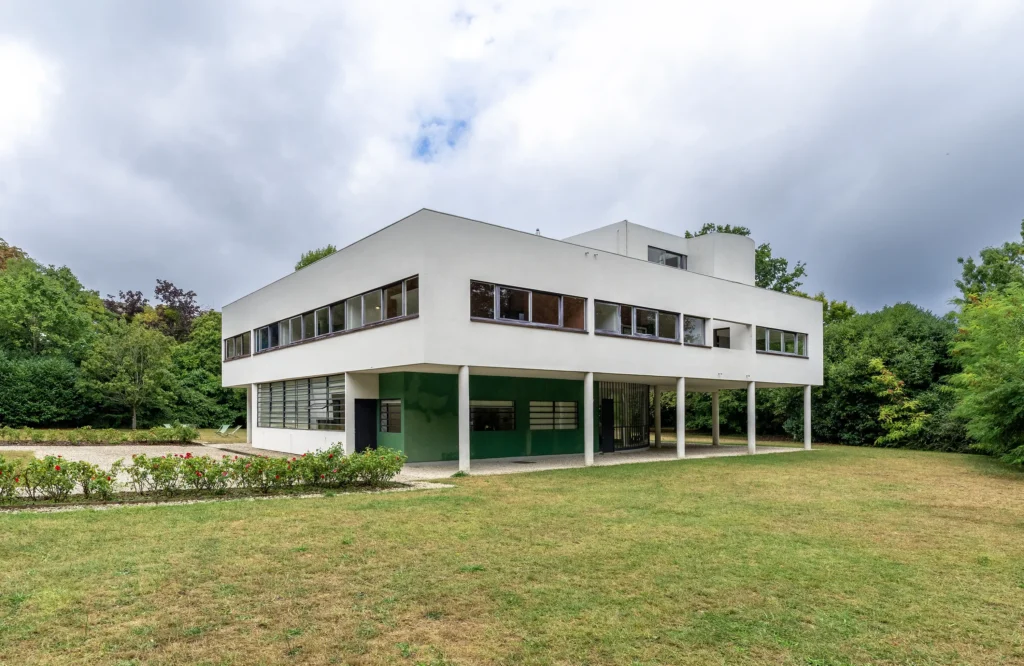
The core idea was simple: architecture should answer the conditions of the industrial age, not copy the past. From it came a set of principles. Form should follow function. Structure and materials should be shown honestly. Ornament should go. Buildings should be standardised and made industrially, with open, flexible plans. Le Corbusier gave the clearest statement in 1927 in his five points of a new architecture: a building raised on slender columns, a free plan, a free façade, long horizontal windows and a roof terrace. His concrete frame of 1914, the Dom-ino house, made the free plan and façade possible, because the structure no longer had to carry the wall. At the scale of the city, CIAM’s 1933 meeting in Athens proposed separating living, working, recreation and circulation, a doctrine later published as the Athens Charter. For housing, the 1929 congress in Frankfurt debated the minimum dwelling, the smallest home that could still be decent (Kallis, 2023).
A few buildings show the principles at work. Gropius and Adolf Meyer’s Fagus Factory (1911–13) wrapped a steel frame in glass at its corners. Rietveld’s Schröder House in Utrecht (1924) turned a house into an arrangement of planes and sliding partitions. Gropius’s Bauhaus at Dessau (1925–26) put workshops, classrooms and studios in one asymmetrical glazed complex, and the 1927 Weissenhof Estate in Stuttgart, organised under Mies, showed model housing by leading European architects. Mies’s German Pavilion at the 1929 Barcelona exhibition used a free plan, steel columns, glass and stone in flowing open space; it was taken down in 1930 and rebuilt in the 1980s (Pastor Vila, 2025). Le Corbusier’s Villa Savoye at Poissy (1928–31) applied his five points in a white concrete house on columns, and after the Second World War his Unité d’Habitation in Marseille (1947–52) put a whole housing neighbourhood inside one concrete block. The movement’s late statements were the glass towers of Lever House (1952) and the Seagram Building (1958), whose curtain walls became models for office towers worldwide (Curtis, 1996; Frampton, 2020).
Architecture Modern Movement Criticism: The Two Directions
The article and the research have two aims. The first concerns the modern movement’s design and its core ideology: which design problems critics found, which principles they attacked and what ideology they saw behind the buildings. The second concerns how criticism changed through history: what changed between 1920 and 2026 in technology, environment, living conditions, building types, clients and building systems, and how those changes affected the criticism.
The research was built gradually. I selected 25 papers and read their abstracts, and cancelled them because they were not relevant. I chose another 20 articles and read their abstracts and summaries. I selected these and refined the list from a further 115 papers drawn from different sources, including Google Scholar, Web of Science and Scopus. For each paper I verified its content and relevance, and reached a final list of 34 papers. Papers that provide pre-modern-era criticism were left out. The papers are placed by the timeline they discuss, not by their year of publication, because a paper written in 2025 can describe the 1950s. The findings are intended to serve professionals and researchers who want to identify spots in the history of modern architecture criticism for further detailed study.
Direction One: The Design and the Ideology
The literature on this direction is reviewed below against five elements that I have defined : the design problem each critic found, the principle they attacked, the ideology they saw, the version of modernism they meant and the context in which they wrote. Table 1 lists every paper.
The design problem: buildings that did not fit the people inside
The first design problem critics found was that buildings did not fit the people who used them. As early as 1931 Aronovici argued that the pioneers of the new architecture had forgotten that houses are for human habitation, and that tower-city schemes rested on weak social and economic foundations. In 1932 Teige argued from the left that celebrated modernists were designing new versions of baroque palaces for a financial elite, while workers needed a different kind of dwelling. Later critics made the same point about mass housing. Kidder (2021) reports the failure of the modern idiom to cure the city’s ills, with Pruitt-Igoe as the emblem. Heynen (1999) places the contradictions of modernity in daily life and dwelling. Glogar (2026) writes of post-war housing and a modern project that must turn towards use, appropriation and inhabitation by the people who live in it.
The second problem was a poverty of meaning and place. Nia and Rahbarianyazd (2020) find a lack of sense of place and a cultural detachment. Suvorov et al. (2024) find the buildings poor in imagery and artistic quality. Rifkind (2016) reports a perceived homogeneity in Western architecture and results that fell short of utopia.
The third problem was physical. Pastor Vila (2025) describes the material decay of the Villa Savoye, one of the movement’s icons, and the debate over how to restore it. Buras et al. (2025) add that modernist building has had a detrimental impact on built and natural environments.
The principles: the universal style under attack
The principles attacked are the ones that made the movement universal. Buras et al. (2025) attack the Zeitgeist argument, the claim that the spirit of the age demands one style, and the doctrine built on it. Frank (1949) rejected eternal forms, arguing that styles are short-lived and that “modern” can mean fashionable or well adapted to use. Nia and Rahbarianyazd (2020) target the Machine Age philosophy and its neglect of cultural values, and Rifkind (2016) adds technological determinism and the loss of the meaning and order that ornament had carried. Suvorov et al. (2024) attack the rejection of historical heritage.
Others question the movement’s frame. Mehta (2017) challenges a definition of modernism drawn from Europe, and the binary of modernity and modernism. Jung (2022) shows how Frampton’s history keeps a narrow Western frame while crediting critical regionalism as a counter-current, and Szacka (2023), reviewing Giamarelos, shows critical regionalism reacting against the International Style. Curtis (1996) points to the same targets in chapter titles on functionalism and ornament.
The ideology behind the style
Several sources look behind the principles to the ideology. Buras et al. (2025) trace it to industrial progressivism and to Loos’s rejection of ornament. Heynen (1999) reads the movement as a discourse and tests it against critical theory and the Venice School, and Jung (2022) draws on critical theory and on capitalism’s constraints on building. Rifkind (2016) argues that capitalism and the state absorbed modernism. Mehta (2017) points to an ideological and metaphysical core that non-Western thought challenges.
The attack came from the right as well. Krier, interviewed by Samalavičius (2013), sets neo-traditionalism against radical modernism, and Kidder (2021) places the later critique in postmodern theory, with ironic historicism and deconstruction. Teige (1932) is a case of the movement’s ideology criticising itself: the abstract shows him attacking celebrated modernists from the standpoint of class and collective dwelling.
Which modernism?
The sources do not agree on what the modern movement is. Behne (1923), writing from inside German modernism at its start, already separated functionalism, rationalism and utilitarianism. Buras et al. (2025) treat Modernism, with its Neo-Modernist and Post-Modernist variants, as one thing, while Szacka (2023) isolates the International Style. Rifkind (2016) separates Team X, an internal critique, from Post-Modernism, an external one, and sees three reactions: non-Western forms, the vernacular and ornament. Al-Abed (2014) defends the movement as established thought and blames its opponents, including New Brutalism and Archigram, for the chaos after CIAM collapsed. Suvorov et al. (2024) see modernism, neo brutalism and structuralism as a sequence of revenges, and Jencks and Kropf (1997) record a late-1990s split into critical-ecological Post-Modernism, High-Tech Late Modernism and a deconstructive New Modernism, with traditionalists opposed to all three.
The consequence matters. A critique of “the modern movement” always targets one version of it, and the verdict of failure depends on which.
Context: where and when the critics wrote
Context shifts too. Peisch (1965) shows that in the United States of 1929–1939 the public was not ready for the International Style and authoritative critics were few. Rifkind (2016) and Glogar (2026) place the break in the 1950s and 1960s, amid social and political crises, and Al-Abed (2014) puts the collapse of CIAM in the 1960s. The 1970s brought Pruitt-Igoe, whose demolition became a symbol of failure (Kidder, 2021) and which Bristol (1991) argues is partly a myth. After 1980 the debate widens: Szacka (2023), Jung (2022), Mehta (2017), Agarez (2020) and Zhang et al. (2026) bring in regionalism, non-Western voices and the question of how the history itself is told. Since the 2010s sustainability and the climate emergency have become reasons to revisit the movement (Samalavičius, 2013; Buras et al., 2025; Glogar, 2026).
Table 1. The research papers: design problem, principle or ideology attacked, and context
| Source | Kind | Design problem | Principle or ideology attacked | Context |
| Teige (1932; English 2002) | First-hand book | New versions of baroque palaces for a financial elite; housing not designed for workers | Bourgeois dwelling models; the family-centred plan | 1929–1932; CIAM housing debate |
| Aronovici (1931) | First-hand article | Weak social and economic basis of the tower city; habitation forgotten | Tower-city schemes; large-unit construction | United States, 1931 |
| Frank (1949) | First-hand article | “Modern” confused with fashion | Eternal forms; stylistic dogma | 1949 |
| Behne (1923; English 1997) | First-hand text, from inside the movement | Not stated in the abstract | Separates functionalism, rationalism and utilitarianism; criticised the Bauhaus | German modernism at its start |
| Peisch (1965) | Historical study | Public unready; few authoritative critics | None attacked | United States, 1929–1939 |
| Buras et al. (2025) | Advocacy essay | Harm to built and natural environments; unmet social and cultural benefits | Zeitgeist argument; industrial progressivism; rejection of ornament | Sustainability; challenge to current design |
| Frampton (2020) | Critical history | Not stated in the abstract | Positive principle: bodily experience and critical regionalism (per Jung) | Twentieth-century architecture and its origins |
| Jung (2022) | Book review | Eurocentric and transatlantic bias; gender, race and environment under-covered | A narrow, Western, theory-heavy history | Global turn |
| Curtis (1996) | Survey | Not stated | Functionalism and ornament (chapter titles only) | Late-century turn to history and local identity |
| Heynen (1999) | Theory | Contradictions of modernity in daily life and dwelling | The gap between movement discourse and theories of modernity | Dwelling as the test |
| Mehta (2017) | Essay collection | Not stated in the abstract | Eurocentric definition; modernity and modernism as a binary | Non-Western critique |
| Nia and Rahbarianyazd (2020) | Literature review | Lack of sense of place; cultural detachment | Machine Age philosophy | A gap in the literature |
| Rifkind (2016) | Book chapter | Homogeneity; results short of utopia | Technological determinism; loss of the meaning ornament carried | 1950s–60s crises |
| Samalavičius, interview with Krier (2013) | Interview | Flaws of current practice (abstract cut off) | Radical modernism | Environmental concerns |
| Szacka (2023) | Book review | Enduring crisis of modern architecture | The International Style | 1980 Biennale; critical regionalism |
| Agarez (2020) | Historiography | A flattened historical narrative | Linear action-and-reaction plot; Western categories | Portugal, 1920s–1970s |
| Kidder (2021) | Book chapter | Narrow modern idiom; the city’s ills uncured | Exceptionalism; rationalism | 1970s; the Ground Zero debate |
| Bristol (1991) | Revisionist article | Pruitt-Igoe as a symbol of failure | The myth that Pruitt-Igoe proved modernism failed | The 1972 demolition |
| Glogar (2026) | Historical-conceptual article | Post-war mass housing designed without regard for use and inhabitation | Practices that ignore appropriation by users | 1950s–1980s; climate emergency |
| Pastor Vila (2025) | Conservation study | Material decay of the Villa Savoye; authenticity of rebuilding | Restoration practice | Late 1920s–1980s |
| Jencks and Kropf (1997) | Anthology | Not stated in the abstract | Traditionalists opposed to every modernism | Late-1990s snapshot |
| Suvorov et al. (2024) | Historicist critique | Poor imagery and artistic quality | Rejection of historical heritage | Soviet viewpoint; twentieth century to now |
| Al-Abed (2014) | Historical essay, a defence | Chaos after the collapse of the movement | None; defends the movement | 1960s onward |
| Zhang et al. (2026) | Study of 40 keynote speeches | Whether modernism caused a cultural crisis in Asia | Finds a generative challenge, not a rupture | ARCASIA, 2010s–2026 |
Table 1 lists the sources that criticise or discuss the movement directly. The technical and historical sources used in Direction Two are set out in Table 2 and the References.
Direction Two: What Changed Between 1920 and 2026
Criticism did not change in a vacuum, I have identified six changes to be the base of this direction for the study: technology and materials, the environment, living conditions, new building types such as the tower, the incomes and expectations of clients, and building systems. Table 2, at the end of this section, places the sources by the period they discuss. It adds a seventh row for culture, place and identity.
Technology and materials
The movement was built on new technology. Bernardo (2023) argues that the invention of reinforced concrete made the modern movement possible and also began the conflict between construction and the environment. The concrete frame explains the free plan and the free façade (Curtis, 1996). But the technology did not stay with concrete. New materials gave architects a wide range of solutions, and a house can now be built without concrete at all. The glass curtain wall, an industrial product hung on a frame, became the standard envelope of the postwar tower, and later buildings combine concrete, steel, aluminium and glass. Critics followed the technology. Rifkind (2016) lists technological determinism among the targets of the 1950s and 1960s, Nia and Rahbarianyazd (2020) the Machine Age philosophy, and Buras et al. (2025) the industrial progressivism behind the doctrine. Pastor Vila (2025) shows that even the icons had material problems.
It is sometimes said that the founding material could not carry the movement to supertall heights. The Burj Khalifa suggests a more complex picture. Its structure is a reinforced-concrete “buttressed core” topped by a structural steel spire, and its envelope is a glazed curtain wall of glass, aluminium and stainless steel designed for Dubai’s summer heat (International Code Council, n.d.). The height came from combining systems, not from the early concrete-frame model alone.
Environment
Environmental criticism arrives late in these sources. The earliest, White (1993), reports that the rejection of modernism was both aesthetic and pragmatic: tower blocks proved an unsatisfactory “machine for living in”, especially for the poor, and Leon Krier denounced monofunctional zoning as anti-ecological and a consumer ideology as destructive of nature. Samalavičius (2013), Szacka (2023), Buras et al. (2025) and Glogar (2026) link the critique to sustainability and the climate emergency. Brielmann et al. (2022) add a perceptual argument about fractal patterns and stress. That paper shares two authors with Buras et al. (2025), so the two should be read as one research programme, and Buras et al. themselves note that defenders have dismissed the critics as “ignorant populists”. The position is contested.
There is also a counter-position. Bernardo (2023) argues that the movement’s own architects paid close attention to passive systems for comfort, and so anticipated energy saving. No source gathered here criticises the movement on environmental grounds before 1993. Either environmental criticism is a late development, or the earlier sources have simply not turned up.
Living conditions
Living conditions changed the criticism more than any other factor in these sources. The minimum dwelling was a response to the housing crisis: CIAM’s 1929–31 congresses debated how to make low-cost housing affordable and socially transformative (Kallis, 2023), and Teige (1932) attacked the result as still bourgeois. By the 1950s and 1960s the argument concerns mass housing (Rifkind, 2016; Glogar, 2026). Jacobs (1961) attacked large modernist projects and wide streets for destroying neighbourhood life. Pruitt-Igoe became the symbol of the failure (Kidder, 2021; White, 1993), though Bristol (1991) argues that much of that story is myth. Heynen (1999) makes daily life and dwelling the test of the architecture, and Glogar (2026), two generations on, asks the same of the post-war estates now that the climate is changing.
New functions: the high-rise tower
The movement planned for towers but had no tested answer to what tall buildings do to cities and to the people in them. Three things sit inside the phrase “high-rise”. The first is the tower-in-the-park housing block, the main target in these sources (Kidder, 2021; White, 1993). The second is the commercial skyscraper city, which Aronovici (1931) already questioned on social and economic grounds. The third is the supertall tower. No source in the set criticises the supertall as a type, so the Burj Khalifa discussion above rests on a technical source, not on criticism. That is a gap.
Clients and incomes
Clients and money enter the sources indirectly. Teige (1932) already saw modern architecture serving a new financial elite, and Aronovici (1931) suspected that large-unit construction was favoured because it was easier and more profitable than designing good homes. Peisch (1965) reports that the US public was not ready for the new architecture, and Rifkind (2016) argues that capitalism and the state absorbed modernism. As incomes rose, Feraboli (2019) describes a reversal after the modern movement years, from the standard type to the house made to measure for its owner. White (1993) quotes Krier calling the consumer ideology that underlies modernism anti-ecological. No source shows that rising income by itself drove the criticism but the modern postmodern transition is discussed as tied to broader social/political-economic shifts (Madsen, 1990).
Building systems
Building systems are the least discussed change in the criticism, although the histories show how much they mattered. Siry (2021) traces air conditioning in modern American architecture from 1890 to 1970, including the first air-conditioned tall buildings of 1928–32 and the air-conditioned glass buildings of the mid-century. Barber (2020) treats the climate design that came before air conditioning, around the Second World War, and Bernardo (2023) describes the passive systems the movement’s own architects used. Elkady and Goubran (2022) study Egyptian modernism before heating, ventilation and air conditioning (HVAC) as a source of sustainability lessons, and report Barber’s argument that air conditioning turned modernist internationalism into a tool for concentrating wealth. These are histories and reappraisals, not criticisms of the movement. The link between the sealed glass box and its energy use is a reasonable reading, but no retained source makes that criticism directly.
Table 2. What changed, and when the sources place it
| Change | 1919–1939 | 1945–1960s | 1960s–1980s | 1990s–2000s | 2010s–2026 |
| Technology and materials | Bernardo (2023) | Rifkind (2016) | Pastor Vila (2025) | No source | Nia and Rahbarianyazd (2020); Buras et al. (2025) |
| Environment | No source | No source | No source | White (1993) | Samalavičius (2013); Szacka (2023); Brielmann et al. (2022); Buras et al. (2025); Glogar (2026) |
| Living conditions and mass housing | Teige (1932); Kallis (2023) | Rifkind (2016); Glogar (2026) | Jacobs (1961); Kidder (2021); Bristol (1991) | Heynen (1999); White (1993) | Glogar (2026) |
| Culture, place and identity | No source | Frank (1949); Rifkind (2016) | Szacka (2023); Curtis (1996) | Jencks and Kropf (1997) | Nia and Rahbarianyazd (2020); Mehta (2017); Agarez (2020); Jung (2022); Zhang et al. (2026) |
| New functions (high-rise) | Aronovici (1931) | No source | Kidder (2021) | White (1993); Kidder (2021) | No source |
| Clients and incomes | Teige (1932); Aronovici (1931); Peisch (1965) | Rifkind (2016) | Feraboli (2019) | White (1993), quoting Krier | No source |
| Building systems | Siry (2021); Barber (2020); Bernardo (2023) | Siry (2021) | Siry (2021) | No source | Elkady and Goubran (2022) |
“No source” means that none of the 34 sources used here covers that change in that period.
What the timeline shows
The 1919–1939 column is thinly covered, with first-hand evidence only on housing, clients and the tower city (Teige, Aronovici, Peisch). Housing and culture are the best-covered rows. Housing criticism begins early, with Teige in 1932, and becomes central in the 1950s and 1960s. Criticism of culture and place begins with Frank in 1949 and builds up mainly after 1980. Environment appears only from 1993, and building systems enter the criticism mainly through histories.
The pattern fits a sequence: disputes inside the movement over dwelling, function and monumentality; a broader humanist and social critique in the middle of the century; cultural and environmental critique from the 1980s. That sequence is a working claim, not something the sources prove, because it rests on few voices in the earliest periods.
Why the Architecture Modern Movement Failed
The sources use the word “failure” in different ways, and some deny it. Drawing on both directions of this research, the architecture modern movement did not fail as a technology or as a language of building. It spread worldwide, its icons are conserved and rebuilt (Pastor Vila, 2025), and recent sources reappraise it as a generative force (Bernardo, 2023; Zhang et al., 2026) or defend it outright (Al-Abed, 2014). It fell short as a social and cultural project: the promise that standard, industrial, universal buildings would fit the people who use them. Five reasons emerge.
It designed for an average person, not for inhabitants. Critics found the same design problem from 1931 to 2026: buildings that did not fit use and habitation (Aronovici, 1931; Teige, 1932; Heynen, 1999; Kidder, 2021; Glogar, 2026). It shows most clearly in living conditions, from the minimum dwelling to Pruitt-Igoe and the criticism of renewal in the 1960s.
It treated culture and place as secondary. The principles under attack include the Machine Age philosophy and a Eurocentric definition of modernism (Nia and Rahbarianyazd, 2020; Mehta, 2017; Jung, 2022; Agarez, 2020). Critical regionalism after 1980 is the best-documented reaction (Szacka, 2023).
It claimed permanence and universality. Frank (1949) argued that styles are short-lived, and Buras et al. (2025) attack the claim that the spirit of the age requires one style. A doctrine that presented itself as the form of its age could not easily adapt when the age changed.
The world moved faster than the doctrine. Technology and materials, building systems, new functions such as the tower, environmental awareness and rising expectations all changed after the founding years. The movement’s founding model of the concrete frame, the minimum dwelling and functional zoning did not cover them. The sources show these changes mainly through histories and reappraisals (Siry, 2021; Barber, 2020; Bernardo, 2023) rather than through direct criticism, so this reason rests partly on inference.
It was absorbed by capital and the state. Teige (1932) already saw a financial elite as the client, and Rifkind (2016) argues that capitalism and the state absorbed modernism. White (1993), quoting Krier, links the consumer ideology behind modernism to ecological harm. The evidence here is thinner and more indirect than for the first two reasons.
The verdict is also contested. Bristol (1991) argues that the story of Pruitt-Igoe as proof of failure is partly a myth. Jung (2022) and Agarez (2020) show that the history of the movement has itself been told as a simple story of action and reaction. A critic who attacks the movement and a historian who questions the story of its failure are not making the same argument, and the sources often mix the two.
Table 3. Summary of the conclusion: the reasons at a glance
| Why it fell short | What critics found (Direction One) | What changed in the world (Direction Two) | Main sources | Strength of evidence |
| It designed for an average person, not for inhabitants | Buildings did not fit use and habitation | Living conditions: mass housing, Pruitt-Igoe, urban renewal | Aronovici (1931); Teige (1932); Jacobs (1961); Heynen (1999); Kidder (2021); Glogar (2026) | Strong: several sources agree across the whole period |
| It treated culture and place as secondary | Machine Age philosophy; Eurocentric definition | Globalisation and non-Western reappraisal after 1980 | Nia and Rahbarianyazd (2020); Mehta (2017); Szacka (2023); Jung (2022); Agarez (2020) | Strong for what critics found; for what changed, only after 1980 |
| It claimed permanence and universality | Zeitgeist argument; eternal forms | Technology changed the material basis | Frank (1949); Buras et al. (2025); Rifkind (2016); Bernardo (2023) | Medium |
| The world moved faster than the doctrine | Not a direct target | New functions, building systems, environment | Siry (2021); Barber (2020); White (1993); Aronovici (1931); Glogar (2026) | Medium for building systems; weak for high-rise and for environment before 1993 |
| It was absorbed by capital and the state | Ideology of progress and capital | Clients and incomes | Teige (1932); Rifkind (2016); White (1993); Feraboli (2019) | Weak to medium; partly inferred |
| The verdict of failure is contested | Defences and reappraisals | Revisionist history | Bristol (1991); Al-Abed (2014); Bernardo (2023); Zhang et al. (2026); Jung (2022) | Medium |
Related articles in the series
These four articles from the Paradigm shift in architecture series cover the styles and movements discussed above in more detail.
- Modern Architecture styles-1: the International Style and Expressionism, including the opposition to Mies van der Rohe and the Seagram Building.
- Modern Architecture styles-2: Constructivism in the USSR and the origins of Brutalism, from Asplund and Banham to Park Hill.
- Modern Architecture styles-3: organic architecture and Futurism, from Wright’s rejection of “modern architecture” to Sant’Elia’s manifesto.
- Post-Modern Architecture: Jencks, the demolition of Pruitt-Igoe and the causes of the crisis of modern architecture.
References
Agarez, R. C. (2020). A self-conscious architectural historiography: Notes from (post)modern Portugal. The Journal of Architecture, 25(8), 1089–1114.
Al-Abed, B. (2014). Modern Movement and the architectural situation in the sixties of the twentieth century. Historical Kan Periodical, 24, 164–176. https://doi.org/10.21608/kan.2014.110581
Aronovici, C. (1931). Zoning and the home. The Annals of the American Academy of Political and Social Science. https://doi.org/10.1177/000271623115500218
Barber, D. A. (2020). Modern architecture and climate: Design before air conditioning. Princeton University Press.
Behne, A. (1997). The modern functional building. [Publisher to add]. (Original work published 1923)
Bernardo, G. (2023). The new building components of the modern architecture. VITRUVIO – International Journal of Architectural Technology and Sustainability. https://doi.org/10.4995/vitruvio-ijats.2023.18830
Brielmann, A., Buras, N. H., Salingaros, N. A., & Taylor, R. P. (2022). What happens in your brain when you walk down the street? Implications of architectural proportions, biophilia, and fractal geometry for urban science. Urban Science, 6(1), 3. https://doi.org/10.3390/urbansci6010003
Bristol, K. G. (1991). The Pruitt-Igoe myth. Journal of Architectural Education. https://doi.org/10.1080/10464883.1991.11102687
Buras, N. H., Katona, V., Mehaffy, M. W., & Salingaros, N. A. (2025). A critical history of architectural modernism. Journal of Architecture and Urbanism. https://doi.org/10.3846/jau.2025.21776
Curtis, W. J. R. (1996). Modern architecture since 1900 (3rd ed.). Phaidon.
Elkady, & Goubran. (2022). [Full title to confirm]. IOP Conference Series: Earth and Environmental Science, 1026, 012046.
Feraboli, M. T. (2019). The made-to-measure house: From an ideal home to a palace between the 19th and 21st centuries. Politecnico di Milano.
Frampton, K. (2020). Modern architecture: A critical history (5th ed.). Thames & Hudson.
Frank, J. (1949). Modern architecture and the symbols of statics. Synthese. https://doi.org/10.1007/bf00485919
Glogar, I. (2026). The everyday in architecture – Modern architecture in transition: Changing architectural practices towards use, appropriation and inhabitation. Architecture, 6(3), 98. https://doi.org/10.3390/architecture6030098
Heynen, H. (1999). Architecture and modernity: A critique. MIT Press.
International Code Council. (n.d.). A tall adventure: The Burj Khalifa, the world’s tallest structure. Building Safety Journal. https://www.iccsafe.org/building-safety-journal/bsj-technical/a-tall-adventure-the-burj-khalifa-the-worlds-tallest-structure/
Jacobs, J. (1961). The death and life of great American cities. Random House.
Jencks, C., & Kropf, K. (Eds.). (1997). Theories and manifestoes of contemporary architecture. Academy Editions.
Jung, H.-T. (2022). Review of Modern architecture: A critical history (5th ed.), by K. Frampton. Ardeth, 10–11, 344–345. https://doi.org/10.17454/ARDETH10-11.19
Kallis, A. (2023). The minimum dwelling revisited. Bloomsbury. https://doi.org/10.5040/9781350346215
Kidder, P. (2021). Postmodern postludes. In Minoru Yamasaki and the fragility of architecture. Routledge. https://doi.org/10.4324/9781003111566-10
Mehta, J. (2017). Critiquing the modern in architecture. Routledge. https://doi.org/10.4324/9781315536729
Nia, H. A., & Rahbarianyazd, R. (2020). Aesthetics of modern architecture: A semiological survey on the aesthetic contribution of modern architecture. Civil Engineering and Architecture, 8(2), 66–76. https://doi.org/10.13189/cea.2020.080204
Pastor Vila, S. (2025). The critical nature of the reconstruction of modern icons. Restauro Archeologico. https://doi.org/10.36253/rar-19010
Peisch, M. L. (1965). Modern architecture and architectural criticism in the U.S.A., 1929–1939. Journal of the Society of Architectural Historians. https://doi.org/10.2307/988288
Rifkind, D. (2016). Post-modernism: Critique and reaction. In E. G. Haddad & D. Rifkind (Eds.), A critical history of contemporary architecture: 1960–2010. Routledge. (Original work published 2014)
Samalavičius, A. (2013). Modernity and its discontents: An interview with Leon Krier. Journal of Architecture and Urbanism. https://doi.org/10.3846/20297955.2013.859445
Siry, J. M. (2021). Air-conditioning in modern American architecture, 1890–1970. Penn State University Press.
Suvorov, A., Sidorova, V., Volkova, N., & Zhivica, V. (2024). Structuralism is an unfinished stage of the search for modern architecture. Construction and Industrial Safety. https://doi.org/10.29039/2413-1873-2024-34-15-24
Szacka, L.-C. (2023). Review of Resisting postmodern architecture: Critical regionalism before globalisation, by S. Giamarelos. The Journal of Architecture. https://doi.org/10.1080/13602365.2023.2213561
Teige, K. (2002). The minimum dwelling (E. Dluhosch, Trans.). MIT Press. (Original work published 1932)
White, R. R. (1993). Convergent trends in architecture and urban environmental planning. Environment and Planning D: Society and Space. https://doi.org/10.1068/d110375
Zhang, Kim, et al. (2026). Reflection on modernism in contemporary Asian architectural thought. Archnet-IJAR. https://doi.org/10.1108/arch-07-2025-0323
[…] answered a particular modernism, so it helps to say which one. I use the definition in Architecture Modern Movement: A Century of Criticism, 1920–2026: the modern movement of the 1920s, with Le Corbusier’s five points (pilotis, free plan, free […]