Existing plan-making approaches have weaknesses. An examination of these weaknesses leads to a different way of thinking about planning. So, the alternative approach is structured around Resources, Needs, and Funding for local development plan-making.
Introduction
The study of local development plan-making in England and some other EU countries inspired me to write this series of articles. The plans typically range from 5 to 15 years and take approximately 1 to 2 years to develop. The plan guides development in the country and is designed to define the resources for the proposed internal projects. Importantly, the private sector aligns with the direction of the plan; however, there are many opportunities where they overlook significant locations for development. My study revealed various weaknesses and defects in the traditional approach to plan-making. This is evident as areas in the center of the study have remained undeveloped for many years due to these defects.
The Problem with Conventional local development Plan-Making
Population growth statistics—such as birth rates, death rates, and fertility rates— linked to housing needs by plan builders. In the EU context, population growth does not necessarily indicate a need for family housing. Due to European cultural norms, youth often attend university or move as couples to other locations. Economic studies focus on creating businesses. The lack of quality surveys and planning for business creation leads to defects. For example, who will fund the creation of businesses, and what happens if they fail in the short term? Additionally, plans link this aspect to population growth and employment. Losing a job does not mean the business is declining, as many companies seek better employees and restructure their operations. Population, Housing & Economy Defects details the defects and problems in local development plan-making
Three Areas of Plan-Making That Need Reconsideration
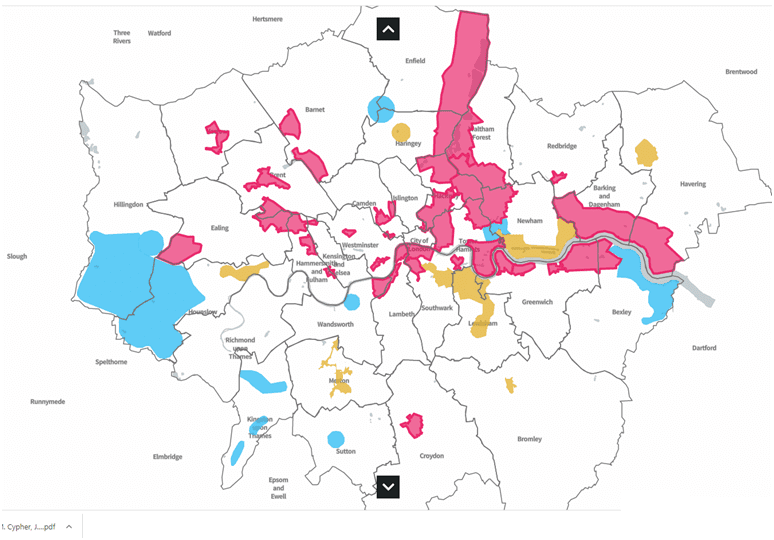
This study focuses on the London Plan (2015-2016) and three areas of concentration in plan-making: City Structure, Environment, and Mobility. City structure is studied through administrative categories rather than physical urban form. Plans divide cities into areas such as inner city, outer city, town centers, green belts, and opportunity areas. The critique is that this does not adequately examine the city’s actual physical structure, urban design, public realm, or spatial relationships see figure 1. In analyzing the city structure, we consistently find common concerns in all previous and current local development plans.
These concerns include the decline of businesses, shifts in business, and the creation of new businesses. Why is it always about business? Why is it always about employment? The study reveals that there is indeed a constant struggle to obtain funds for authority development projects. You can find further details on the problems within local development plan-making in City Structure, Environment & Mobility Defects.
From Identifying Defects to Developing an Alternative Approach
The purpose of studying the EU plans, specifically the London Plan, was not to criticize them but to lead to a new approach. For example, planners cannot separate a city’s development strategy from the country’s wider economic cycle. Poor forecasting can damage the real estate market and the economy. Inaccurate forecasts of future development demand can lead to oversupply, such as too many apartments or industrial units. This oversupply can weaken the construction and property markets and contribute to broader economic instability. Market shocks can lead to recessions. Financial stocks, including stock market crashes and banking liquidity crises, can affect all industries and interrupt the funding needed for development.
The Three Elements of the New Approach
The proposed planning framework consists of three pillars for local plan-making:
- Resources: The inputs needed to sustain competitive industries. What resources does the area possess, and how can they influence development? You can read full details in Resources & Endowment Approach.
- Needs: Accurately forecasting genuine market and development demand. What do the population, economy, and urban area actually need? You can read full details in Needs & Alternative Approach.
- Funds: Maintaining the financial capacity—public and banking—to finance development. How can the required development realistically be funded? You can read full details in Funding & Alternative Approach.
How Resources, Needs, and Funding Work Together
Based on the provided text, Resources, Needs, and Funding work together to create a self-sustaining, resilient local development plan that stabilizes the city’s economy and reduces reliance on limited public funds. Here’s how they interact (the core cycle):
- Resources feed local industries to maintain continuous economic activity and generate steady tax revenue.
- Needs Assessments ensure public money is not wasted on massive conventional projects; instead, policies and minor interventions support resource-based clusters.
- Funding Strategy utilizes private and institutional partnerships to cover development costs, liberating the public sector from financial overhead.
Conclusion
This series of articles was not intended to criticize existing plans but to highlight the problems and defects that lead to an alternative approach to local development plan-making. This three-stage approach ultimately allows public sector planners to prioritize which developments to fund, maximize revenue generation, and minimize operational risk across the economic cycle.
[…] This article is part of a 5-part series examining defects in local development plan-making. For the complete alternative framework, see Rethinking Local Development Plan-Making. […]
[…] This article continues a 5-part series on local development plan defects. For the complete alternative framework — Resources, Needs, and Funding — see Rethinking Local Development Plan-Making. […]
[…] This article begins the alternative approach within a 5-part series on local development plan-making. For the full framework overview, see Rethinking Local Development Plan-Making. […]
[…] This article is the fourth in a 5-part series presenting an alternative approach to local development plan-making. For the full framework overview, see Rethinking Local Development Plan-Making. […]
[…] This article concludes a 5-part series presenting an alternative approach to local development plan-making. For the full framework overview, see Rethinking Local Development Plan-Making. […]
[…] In recent years I have conducted research on the theory of urban design and the urban design process. the case studies were on three cities which include similar characteristics of industrial era London, Barcelona, Berlin. These cities are couple of similar in the developed countries world and also Latin America. In London case the aim to research the evolution of land-use policy in central London. What I found in the archives was not a story of steady progress, but a documented history of failure: development schemes built by architects that were severely criticized, followed by a retreat from physical-form planning altogether into vague, general text-based policy. That research, and the alternative approach it led to, is set out fully in Rethinking Local Development Plan-Making. […]