Scenario planning analysis is an article that analyzes two urban development projects in two countries. That leads to the differences in the way planning is done.
Table of Content
Scenario planning in France and USA projects: Background
The Scenario Planning Analysis
The Goal of the project or research
What was studied in the project or research?
Findings and outcomes of the studies
It’s the approach that includes in the process of planning future Uncertain ends when it comes to decision-making about current problems. It considers using advanced methods of analysis, such as CA and MCM in addition to Multi criteria analysis.
Scenario planning in France and USA projects: Background
In this article, I have analyzed two distinct projects from two countries. From USA, the project is mainly centered in Boston. The project studied the effect of this type of planning practice work and several plans. In addition, the study analyzed several plans from different areas, and the team conducted interviews with officials. Across the USA, agencies embraced scenario planning in their work.
The second project from France ile-de-France (Paris region) studied scenario planning for urban development. The project studied land use Dynamics trying to specify the future uncertainty status of urban change. The project also created a state of development for 2015. A study used combined research to analyze the data, such as the VA and FR.
The following video identifies how uncertainty relate to scenarios in general in business and planning.
The Scenario Planning Analysis
The USA project area Golden Triangle, is an intersection of Express way commercial area. that led to severe traffic problems. Upon interviewing officials, they reported issues with climate change. Stakeholders also reported transportation demand, natural systems, and land use problems. In addition to open space, political issues and public health problems.
The French Project of the Paris region showed emerging issues for the planning officials to evaluate. These issues include deforestation and the loss and decrease of Greenland and space. Also reports of pollution problems. In addition to non-controllable population growth. Non focus on understanding the Urban growth interaction with adjacent areas and relation to the socio-economic and environmental context.
Scenario planning analysis for the two projects here revealed that they focused on the economic, environmental, and political issues that affected urban development.
The goal of the project or research
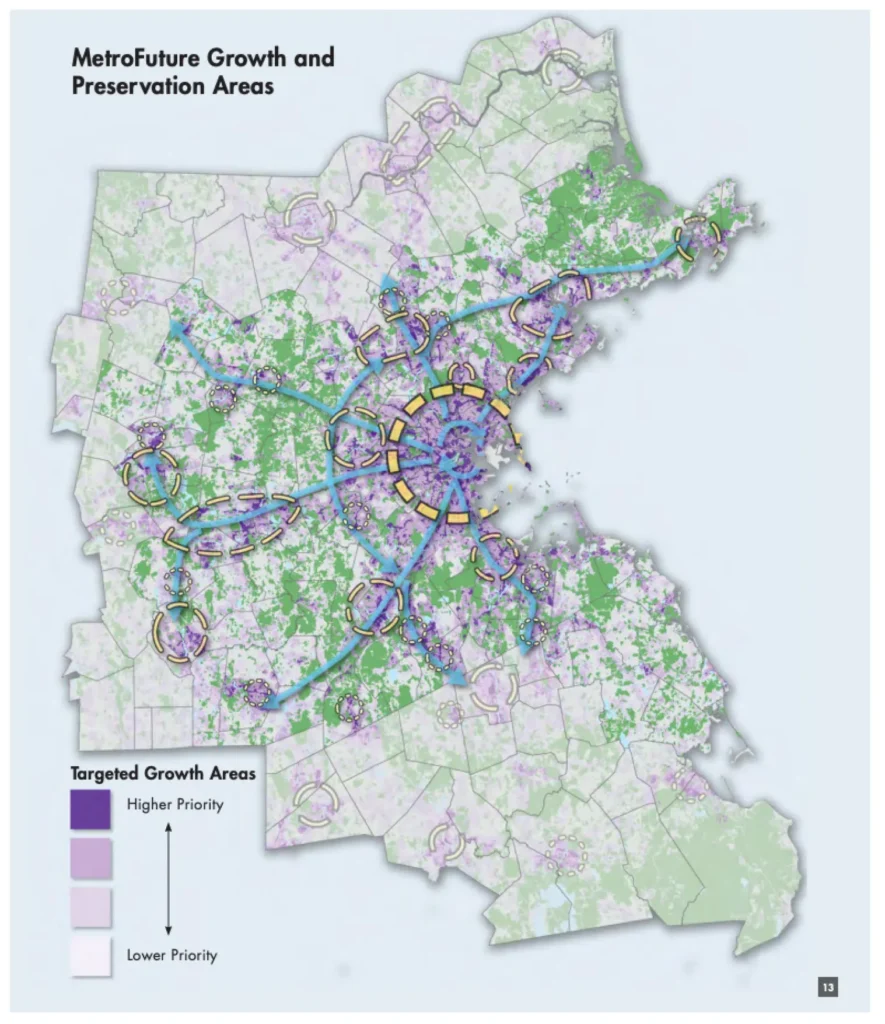
The USA project study aimed at defining strategies (goals) for use by planning professionals and scenario planning. That to ensure that the scenario efforts have measurable, discrete, and positive impacts on planning practice. In addition to ensuring the positive development outcomes. Figure 1 shows the scenario planning on one of the projects (Boston).
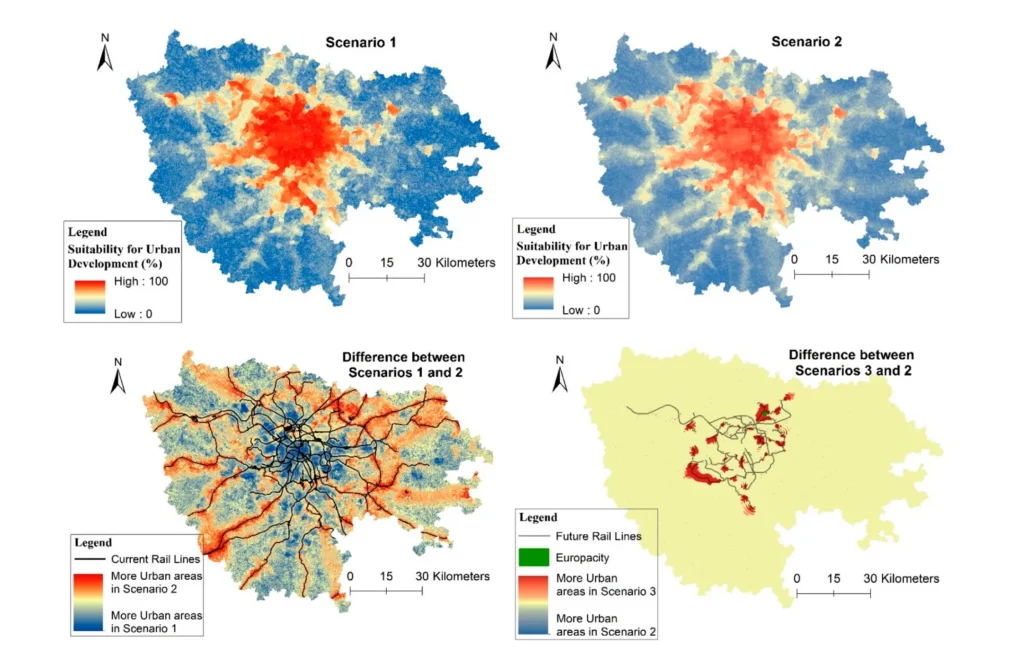
The French project study aimed at developing a new approach (goal) for use in scenario planning. So, it can estimate and stimulate the dynamic evolution of land use classes and the evolution of urban attractivity. Surely, all the former depend on several driving factors. These include the oil price and the wealth decrease. Also, local spatial changes like the provision of new rail lines and the development of new activity zones.
The two projects’ goal aimed at creating a structured procedure for use by professional planners. In addition to using, it in scenario planning.
The USA project includes studying the scenario efforts and selected plans of six regions. The analysis of the six documents. In addition to interviews with key and informant and planning officials. Stakeholders were added as well to these interviews of three selected regions from the six.
The French project had a different way of studying. The study combined two methods, the CA and MCM. That is to provide decision makers a guiding tool to use within the planning process. Furthermore, this method mainly relies on quantitative measures and benchmarks. See Figure 2, method of study by mapping urban areas.
The USA study focused on knowing the planning process of planning from the documents and interviews. Here, they conducted a mixed-method qualitative and quantitative procedure analysis. In the France Project using a new method combined from two methods include quantitative procedure analysis.
What was studied in the project or research?
My scenario Planning Analysis for both projects revealed:
| USA Project | France Project |
| The project study focused on the planning process rather than outcomes. | The anticipation of global changes as an increase in oil prices and a wealth reduction |
| how scenario efforts can affect local planning practice”, rather than “Do scenario efforts affect local plans. | Local spatial changes as the provision of new rail lines and the development of new urban zones |
| Identifying metropolitan areas that employed scenario process and dividing them into large, medium, and small regions. | Assuming that new urban development will take place in proximity to existing urban development (contiguity effect). |
| Identified and accounted for different key variables in reviewing the regional scenario efforts of the plans | |
| Understanding the key parties involved in the sicario efforts, like regional municipalities, state government, In addition other regional policy makers | |
| The future contingencies in the different scenarios are built on finance, climate change, location, and the extent of regional growth. Also, how these plans used the different scenarios |
The USA project study sequence included: Planning process, Scenario effect on practice, dividing areas into sizes, defining key variables (to analyze outcomes), Key parties involved, and finally, future contingencies (uncertainties). This shows that it relies on the bottom-up approach.
The French project study sequence included: developing three hypotheses, anticipating climate change, anticipating spatial change, assume new urban development based on several sizes, use several factors, identify indicators, run analysis. This shows that it relies on the top-down approach.
In conducting Scenario planning analysis, what revealed for both projects is:
| USA Project | French project |
| In all plans, Finance appear near consistently as a future contingency. | An increase in the urban areas and the green urban areas, as well as the areas of roads and rail lands by 18%, 1%, and 5%, respectively |
| In all plans, scenario planning focuses on where the growth occurs, not the land development process. | A decrease in the areas of green non-urban and bare soil lands by 4% and 25%, respectively, compared to the year 2018 |
| Many plans follow the normative preferred scenario section format, that select one of the scenarios through public engagement. | The existing transit lines have a much more attractive effect on urban developments than the new ones in this simulation. |
| Plans are mostly from within the past 5 years, which qualifies how we measure their long-term impact. | From the three scenarios, the new urban development attraction is to be near the public transport nodes and highways, but not in green non-urban areas. |
Analyzing the two findings, I can conclude that the two projects are consistent in two findings. locating the role of funds in urban development and locating growth. The USA identified funds as a future contingency, meanwhile the French found that Growth mostly preferred in existing development and near public transport hubs. Surely That because of the high cost of infrastructure. I have identified this matter in my research on local plan defects in the UK planning system and the alternative approach.
Certainly, the two USA and French projects did not follow a standard scenario planning procedure (I will come to that in a future article). And from my scenario planning analysis in the USA followed the bottom-up approach because they are analyzing existing urban development. while the French followed the top-down approach because they were analyzing a possible future urban development for Paris.