Scenario-based strategic planning is an article that analyzes and summarizes this approach, which many relevant individuals have attempted to build an approach for use in research and also in Urban Planning practice.
Table of Content
The Approach
Trend and Uncertainty Analysis
Many related experts have used a scenario-based strategic planning approach actively for decades. This approach allowed many planners in private and public sectors to predict future uncertain urban change. They apply it in various field such as, detecting urban growth also climate change. The approach that gained wide acceptance and usage by comprehensive planning bodies in USA.
Although the scenario planning approach was used in the late 1960s but continued to date. One of the first attempts to use the approach was by Royal Dutch Shell. in the academic field, researchers attempted to develop and analyze several approaches used in other Industries. Rather than oil, it spread in sustainable urban development, software, electronics, energy, logistics, and in business fields also.
Definition of scope: It’s the phase where a planner relies on a framework. The framework checklist covers various aspects of the process. These include surely specifying the goals of the planning, the strategic level of analysis, type of participants. In addition to specifying the time horizon and stakeholders involved. It includes five questions that a team must get an answer to from team management to proceed to the planning process.
Framing Checklist
STRATEGIC LEVEL OF ANALYSIS
Should the scenario planning process be conducted for the macroeconomic, industry, corporate or business level?
DEFINITION OF STAKEHOLDERS
Which key stakeholders should be involved In 360° stakeholder feedback?
PARTICIPANTS
How closely is top management involved in the process?
Which members of the various departments participate in the workshops?
TIME HORIZON
What time horizon does the planning process cover (1, 2, 5 years or longer)?
The other approach to this planning, step 1
| Identify key drivers of change |
| by scanning the external forces that could reshape the business. This includes market trends, regulation, technology, customer behaviour, and supply-chain volatility. This step extends attention beyond today’s work. It creates the factual base for later choices. The aim is not to predict one future but to notice the forces most likely to matter across several plausible futures. Also, to separate background noise from real strategic signals early enough for action. |
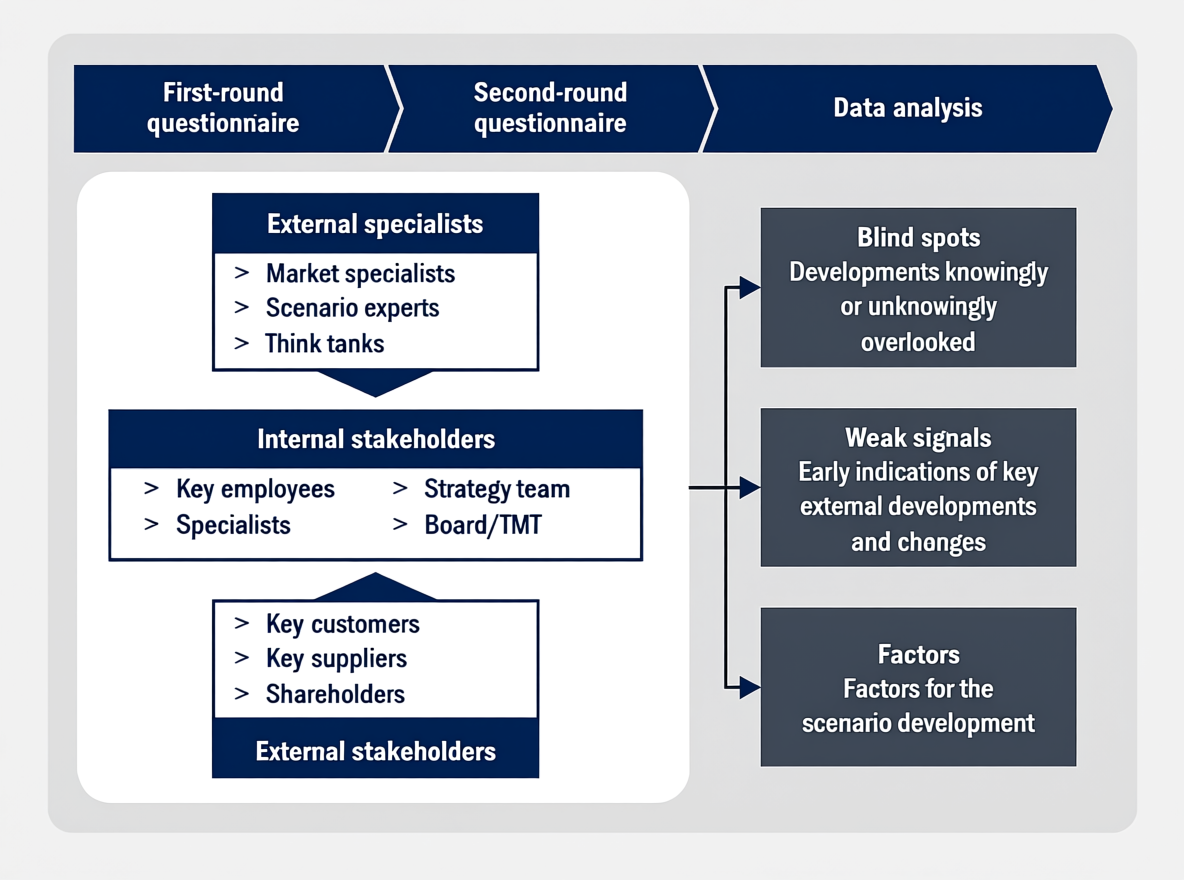
Perception Analysis: It’s the second Phase to examine all stakeholders’ inside or outside views of future development. The internal ones, anticipation and mental models (Top planners), are challenged by confronting them by the external stakeholders’ views. Certainly, this will lead to several potential factors that affect the future of the subject of planning. Within the process of evaluation, the team will identify blind spots.
The framework for this step includes 360⁰ stakeholder feedback. The planning team analyses the perceptions of internal and external stakeholders. Thats by using PESTEL and blind spot analysis (porter 5 forces analysis). See Figure 1, which explains the way it works in practice.
The other approach to this planning, step 2
| Determine critical uncertainties |
| by ranking the drivers that could most change strategy and are least predictable. These are the factors with both high impact and high uncertainty, such as pricing power, demand patterns, costs, or channel shifts. The step narrows the field to the variables that deserve serious attention because they can alter strategic choices in meaningful ways. It keeps the exercise focused on the few uncertainties that could truly redirect the company’s future trajectory. |
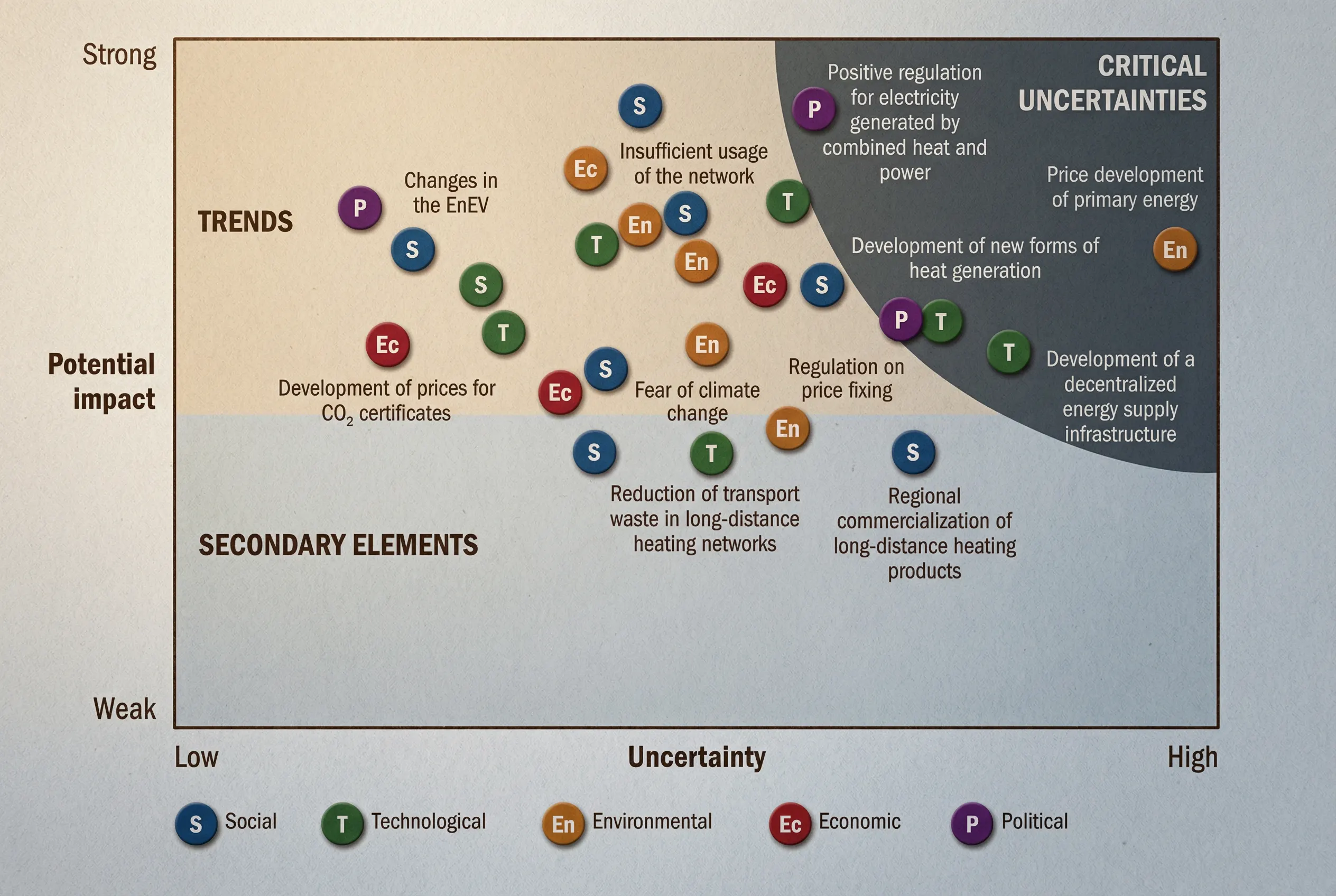
Trend and Uncertainty Analysis: it’s the phase where the team analyzes the key drivers affecting the planning subject or industry. Planners rank these by the degree of uncertainty and potential impact on industry or planning. Decision makers need guidelines to make reliable decisions on their strategic planning and investment. Planners analyze three dimensions of uncertainty, which include Volatility, Complexity, and Ambiguity.
Here, planners make structuring and prioritizing factors in the framework, which contain the Impact/ Uncertainty grid. See Figure 2 shows uncertainty analysis.
The other approach to this planning, step 3
| Develop plausible scenarios |
| by a mix of the critical uncertainties into a small set of coherent future worlds. Each scenario should be realistic, consistent, and different enough to test them in distinct ways. The goal is not fantasy, but to prepare several believable futures. Surely including favorable, unfavorable, and mixed outcomes. Good scenarios stretch thinking without losing credit. They help leaders train how the business might perform if conditions turn out very differently than expected in practice. |
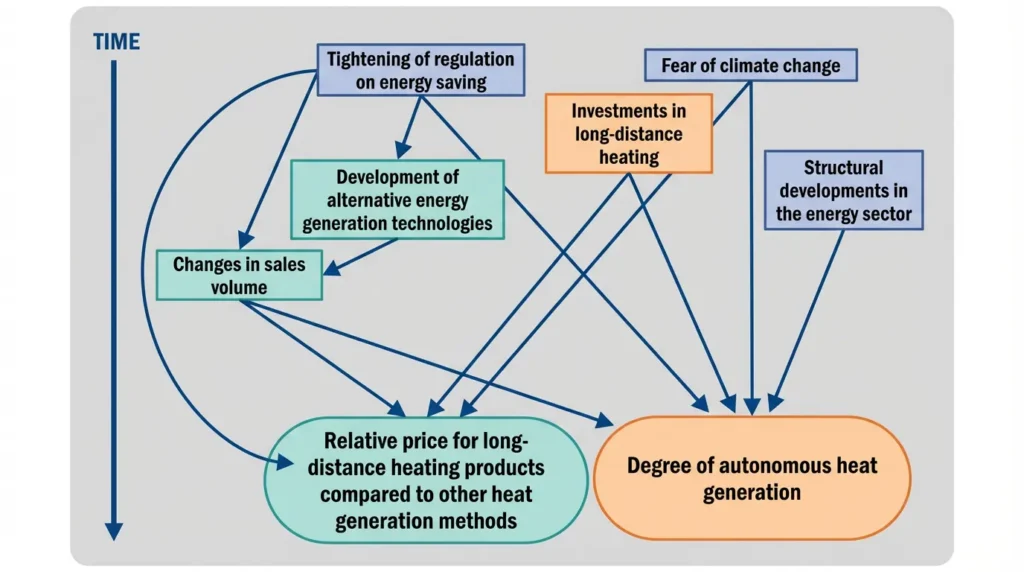
Scenario Building: It’s the fourth phase of the approach. Specifically, planners convert the uncertainties identified in the previous step to distinct scenarios that describe different future states. In addition to other driving forces to create consistent, plausible stories about the future similar to doing multi criteria analysis. Furthermore, Potential developments are also considered, linking the present to a specific picture of the future.
In this step in our framework, planners develop scenarios by using the scenario matrix. And adding detail by using an influence diagram to show cause and effect leading to different situations. See Figure 3, the influence diagram setup.
The other approach to this planning, step 4
| Analyze strategic implications |
| by asking what each scenario would mean for operations, finances, competition, performance, and key metrics. This is where the exercise becomes strategic rather than merely imaginative. Comparing implications across scenarios reveals which assumptions are fragile, which capabilities are robust, and where the current plan would strain or fail. The step helps leadership see the real consequences of uncertainty, so they can judge the risks of staying on the current path with confidence. |
Strategy Definition: It’s the fifth phase of this approach. Also known as option planning. Here, planners test strategic options against various scenarios that they have built. Surely, to make the team build a strategy applicable to several potential future states. The team go further to creating strong action plans rather than thinking about the future. The framework here is the strategy manual. The planners derive strategic recommendations for each scenario, then identify common elements.
When the planning cycle is short, transfer them to the core strategy. The entity can implement it whenever required.
The other approach to this planning, step 5
| Define strategic responses |
| by deciding what the organization should do under each scenario. Responses may include investment shifts, product changes, operational adjustments, partnerships, hedges, or go-to-market pivots. The value of this step is preparation: leaders prethink actions before pressure hits, so the response is faster and less reactive when conditions change. It turns scenarios into practical playbooks, not abstract stories, and gives teams a clearer sense of which moves belong in which future best aligned. |
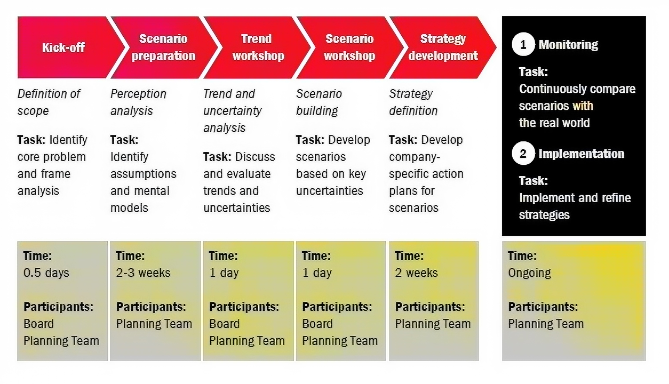
Monitoring: it’s the sixth phase of this approach. Here, the entity defines a number of indicators and monitors them to check whether strategic changes are required. Our framework for this step is the Scenario COCKPIT. When the key identified indicators change, the planners check the indicators closest to the development taking place in the world. See Figure 4, the scenario-based strategic planning process.
Then the team upon that selects the related strategy to implement alongside the core one.
The other approach to this planning, step 6
| Integrate scenario planning |
| with decision frameworks so the work actually shapes choices, timing, and accountability. Scenarios matter only when they are linked to planning cycles, governance, and trigger points that tell leaders when to act. This step makes scenario planning a living part of strategy rather than a one-time workshop. It helps organizations monitor signals, recognize which future is unfolding, and move at the right moment with a pre-agreed response instead of improvising under pressure. |
I have given today a mix approach invented by the German business and academy. In addition the another approach developed by an academic entity for research. The first approach widely used and favored in practice because it’s a mix of practice and theory.