
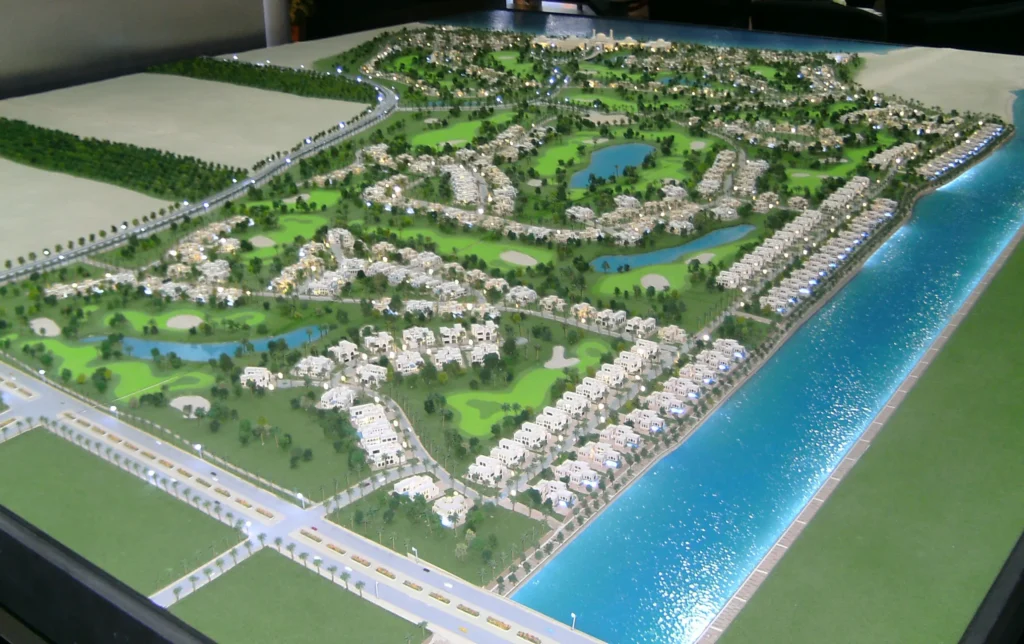
This article starts from an example in practice. On the Legends of Arabia and Business Bay projects, a client representative worked between two entities: the developer, Legends, and a project management company owned by the same group. The representative spoke for the client, and the PMC and did not represent any consultant. That arrangement is the starting point for this article.
The article builds on several questions, what a client representative is, who holds the role in the USA, European countries, Asia and the writer from the Gulf, and what a developer should decide before appointing one. It leaves out the detail of site supervision, which I cover elsewhere in the website as series of articles why architects do supervision.
What the role is and who holds it
A developer carries the money and the risk but often has no technical team of its own, so it hands part of its authority to someone else. That person or firm is the client representative. The research describes the role through its relationships, its selection and its tasks, and not through one fixed list of duties.
Walker (1998) reviewed the literature and two studies and concluded that the quality of the relationship between the client representative, the design team and the construction management team is a major factor in construction time performance. He also proposed that a representative should be chosen for the ability to gain the confidence of the project team, and he wrote of appointing “the person or team”, so the role can be held by an individual or a group. His evidence concerns time performance only; it does not say which type of representative performs best.
Kurokawa, Schweber and Hughes (2017) add a second point: a client is rarely a single individual and its expectations are rarely fixed. The representative therefore speaks for a group of interests, not one voice.
Jawahar-Nesan and Price (1997) give the most direct definition. The owner’s representative, also called the client’s representative, may be an architect, engineer, surveyor, project manager or contracting firm, in-house or external. Whatever the title, the role is to make sure the owner’s needs are met and to act as the contact point between the owner and the other project teams, with delegated authority to advise, decide, resolve disputes and coordinate the parties.
Tanaka (2020) separates two kinds of holder. An internal representative is a shareholder, director or employee of the client, bound by an employment contract and company law. An external representative is an outside professional firm under a professional services contract, bound by a duty of care and covered by professional indemnity insurance. He finds no fundamental difference in the work the two actually do. In contracts the external representative is often titled development manager or director, or client-side project manager.
Mizukawa and colleagues (2005–2007) describe the same split from the client’s side, as self-managed and commissioned project management. Lopes and Ribeiro (2001) add a legal point: in Portugal the functions of the client’s representative are not clarified in law, and clients and other parties poorly understand the role.
Two theses show the same role in other settings. A Malaysian study of briefing treats the quality of the client’s representative as one of three client attributes and concludes that strong leadership, experience of the construction process and commitment matter most. A Ghanaian study of public projects assesses how well the client or its representative performed against the roles expected of them.
The equivalent role in the West
USA: the owner’s representative. The role has a standard contract. The AIA’s standard agreement between owner and owner’s representative describes the representative as advising the owner across the project and sets explicit limits on the role. An American Bar Association article on the topic describes the owner’s representative, like the CM advisor, as a fee-based consultant who does not hold the design or construction contracts. It also warns that titles vary: the AIA publishes separate forms for a construction manager as advisor and for a program manager, so “owner’s rep”, “CM advisor” and “program manager” overlap without being one job.
Industry sources say the owner’s representative has no delivery role, and that this is what allows an independent assessment of the construction manager and the design team. They also say a developer may bring the representative in before the architect, to help set the programme, budget and site feasibility criteria. These claims come from firms that sell the service, so I treat them as practitioner claims, not research findings.
Germany and Austria: Projektsteuerung and Bauherrenvertretung. In Germany the equivalent function was defined as taking over client functions that can be delegated. It sat in §31 of the HOAI fee regulation until the 2009 amendment removed it. The AHO commission had first drafted its own service profile in 1996, because the §31 list was too general to serve as a specification, and it has kept that profile up to date since. The AHO model splits project management into Projektleitung (project leadership) and Projektsteuerung (project control), and the Projektsteuerer is described as an advisory party to the client. In Austria, an industry guide uses the term Bauherrenvertreter directly and describes the commercial version as the CFO of the “temporary enterprise” that a project represents.
For more detail, see the publications of these bodies: the AIA and the American Bar Association in the USA, and the AHO and the IG Lebenszyklus Bau in Germany and Austria.
Real people in the role
Three published company biographies show who holds the role on the developer’s side, one each from the USA, Germany and Singapore. Table 1 , shows the break down and characteristic of client representative in practice.
Table 1, client representative characteristics in practice
| Employer and title | Education | Credentials | Experience | Documented scope | |
| Joel Wage (USA) | VanTrust Real Estate; Vice President, Development Services, Phoenix office | BS Civil Engineering, Purdue; MBA, Arizona State | LEED Accredited Professional | Over 20 years in commercial development, design and construction; earlier at Opus West and Ryan Companies | Delivers the company’s projects in the Western Region; ensures budget, quality and schedule targets are met through design and construction |
| Benjamin Johansson (Germany) | GIEAG Immobilien AG; Member of the Management Board (earlier Head of Projects) | Diploma in Civil Engineering and Master’s in Project Management, Biberach University of Applied Sciences | Certified Real Estate Project Developer, EBS Executive School | From 2010: Turner & Townsend (junior project manager), WSP, Aurelis (developer), MEAG (asset manager), ehret+klein; GIEAG from 2022 | Head of Projects: project development and realization, with signing authority |
| Dennis Woon (Singapore) | Mapletree; Group Chief Development Officer | BA Architecture, NUS; Master in Architecture, University of Glasgow | Registered architect, Singapore Board of Architects | Over 20 years in Asian development: project architect, founding partner of a design studio, Head of Project Management at Ascott (CapitaLand), Head of Development & Project Management at Lendlease Malaysia | Leads the group’s development management team and development strategy across mixed-use, commercial, residential, industrial, logistics, data centre and serviced apartment projects |
All three are senior in-house executives, so they illustrate the in-house individual and not the independent firm. Each holds a technical degree in civil engineering or architecture, and each has moved between consultancy, contracting and development employers. The biographies give titles and scope but not daily tasks, so what these people do in practice is similar to the task lists in sections 4 and 5: briefing, consultant selection, design review, and control of budget and program.
Why developers appoint one
The clearest evidence comes from Japan. In the first paper of the Mizukawa series (2005), ten private building projects in the Kansai region all used a paid client supporter: nine because the client had no in-house architectural expertise and one because it lacked capacity. The 2007 paper generalises the point. Clients increasingly lack the in-house expertise to procure design, supervision and construction and to communicate their intentions through briefing. Designers and contractors used to fill that gap informally and without charge, and owners now pay specialists instead.
The same series shows why the work comes early. For business and investment buildings, 44–66% of the client’s work items were done by the time the internal decision on the business plan was taken, against 21–49% for owner-occupied buildings. Owners try to secure tenants, contractors and managers during planning. The authors note that committing early shifts cost and quality control to the supply side, which the client then bears as business risk, so support is needed to manage that risk.
Firms that sell the service give further reasons: construction is not the client’s core business, the client builds only occasionally, an independent voice is useful, and a permanent in-house team is expensive. These are interested sources and I cite them as claims, not findings. My own reading, which no source documents, is that a developer with a large in-house team, as in the three biographies above, will usually appoint an outside firm only for an unfamiliar project type, a new market or a peak in workload.
What the research says
The evidence is thin and spread across countries. Two of the papers below (Jawahar-Nesan and Price, and Tanaka) draw on British projects. I use them for what they say about the role, not as evidence of UK practice.
Effect on performance. A University of Wisconsin thesis on owner’s representatives in the USA notes that the literature on the role is limited and biased. Comparing projects with and without a representative, it found no significant overall difference in performance, although particular roles and characteristics of representatives did matter, and budget performance was better on design-build projects. Walker’s finding, noted in section 1, concerns time performance and relationships.
What the role consists of. Jawahar-Nesan and Price list twelve tasks, from project definition and procurement to design management and a project postmortem. In their survey of owner’s representatives, 38 of 110 questionnaires were returned, and over 90% rated the early-stage practices as very important. That measures opinion, not outcome. Tanaka (2020) found 25 task items across five stages (land, planning, procurement, construction and operation) in ten London projects financed by overseas developers. The representative performed some items directly and passed others to specialists. Mizukawa and colleagues define 133 client work items from inception to the start of works. When the client managed the project itself it handled about 36–65% of them, against 11–17% when it commissioned a third party, and client supporters covered between 37.6% and 93.2% of the work depending on the client’s capability. A Chilean study of owner’s representatives during construction identifies quality control, cost control, schedule tracking, owner and contractor relations and productivity verification as the most important activities.
Definition and law. In Portugal, a pilot of five interviews found the functions of the client’s representative undefined in law. It also found two models in one country: on ordinary public works the representative acts mainly as a supervisor of works, while in the POLIS urban renewal programme a project management company acted as an executive structure that coordinated services, selected participants and controlled budgets.
Theory. Several papers treat delegation to a project manager as a principal–agent relationship, with the owner as principal and the manager as agent, and examine delegation of authority and asymmetric information between them. Note that “principal agent” in contract language is a different thing from the theory.
Gaps. I found no study that compares in-house, independent and affiliated representatives directly. I found no research specific to the Gulf or to German developers, and no Australian paper that fitted. Samples are small: ten cases in the Japanese series and in Tanaka, 38 returned questionnaires in the British survey, five interviews in Portugal.
The Gulf case, first-hand
From 2006 to 2008 I worked on a portfolio of about $5 billion across three projects: Legends of Arabia, Business Bay towers and a housing project. The developer, Legends, builds large-scale housing in Riyadh and had moved into the UAE about four years before the global financial crisis. The developer himself was a former member of the Saudi parliament.
My position was lead architectural engineer and urban designer. I hold a degree in architectural engineering and had 12 years of consultancy experience and a few years with contractors. The developer used a project management company from Saudi Arabia, specialising in construction and value engineering, which was a sister company in the same group and was bound to the developer by a contract on a cost-plus basis. I acted as the client representative, sitting between the developer and the project management company.
My own work fell into five groups.
- Setting up capability. I ran a feasibility study on whether the developer should open a consultancy or a construction company, which meant approaching the authorities at each project location and checking the legal requirements for opening an office and in which areas.
- Briefing. I prepared urban design briefs and project briefs on the company’s behalf for the developer to hand to consultants, and advised on how the project programme related to marketing, sales and market study requirements.
- Selecting and contracting consultants. I prepared an assessment framework for choosing international consultants (size, location, staff, specialty, previous work), evaluated bid proposals and reported on them, kept a list of consultants and sub-consultants with an assessment of their capabilities, and wrote consultancy contracts to international standards or reviewed the ones submitted to the developer.
- Design control. I carried out design review and design development with the consultants, produced independent concept designs for the projects, and built a database of each authority’s approval procedures and required submittals.
- Market and performance. I researched demand for apartment units in the UAE market and wrote evaluation reports on consultants, sub-consultants and contractors.
These tasks describe the pre-construction part of the work, done before the crisis hit and all work stopped for about four years. They are not the full scope of the affiliated firm, which focused on construction and value engineering.
Comparison and what it shows
The table uses the same columns for each region. Cells without a documented source are marked. Table 2 comparison of the different countries’ settings of client representative.
Table 2, comparison table of different countries client representative settings
| Region | Who holds the role | Independence | Scope documented | Source |
| USA | Owner’s representative: an outside, fee-based consultant to the owner; in-house executives such as Wage fill the function inside developers | Described as independent because there is no delivery role (practitioner claim) | Advises the owner across the project, within limits set by the agreement; does not hold design or construction contracts | AIA standard agreement; ABA article; practitioner glossaries; Wage biography |
| Germany / Austria | Projektsteuerer (outside advisor) and Projektleitung; in Austria, the Bauherrenvertreter; in-house example: Johansson | [Not documented in the sources found] | Delegated client functions; the AHO profile splits project leadership from project control | AHO Heft 9; Austrian Bauherrenvertretung guide; Johansson biography |
| Asia | Japan: a paid client supporter (commissioned project management) or the client’s own staff (self-managed). Singapore: in-house executive such as Woon | Tanaka: external representatives carry a duty of care and indemnity insurance, internal ones an employment contract. Otherwise not documented | Japan: 133 items from inception to start of works, with supporters covering 37.6–93.2%. Singapore: leads a group development management team | Mizukawa et al. 2005–2007; Tanaka 2020; Woon biography |
| Gulf (author) | An individual client representative (the author) sitting between the developer and an affiliated project management company | The project management company belongs to the developer’s group and works under its own cost-plus contract, so it is not independent of the client | Pre-construction tasks in section 6; the firm’s full scope is not covered | First-hand practice, 2006–2008 |
Three models emerge: an in-house individual, an independent firm, and an affiliated firm. The first two appear in the literature, in Tanaka’s internal and external split and in the Japanese series’ self-managed and commissioned modes. The third, the affiliated firm, comes from my own observation in the Gulf and I found no source that names it. In my reading it sits between the other two, because the developer delegated to a separate company that belonged to its own group. Contractually the firm resembles Tanaka’s external representative, since it held its own cost-plus contract; by ownership it resembles an internal one. In the Gulf case the representative sat between the developer and the affiliated firm. It matters because the independence argument made for outside representatives does not apply to a firm owned by the client’s own group.
What to decide before appointing one, and the limits
- Appoint early. The Japanese evidence shows that most of a developer’s work on a business building happens before the plan is approved, and British survey respondents rated early-stage practices as very important. Practitioner sources add that the representative can be brought in before the architect, so that the brief, budget and feasibility criteria are set first.
- Define the scope in the contract. The AIA form sets explicit limits on the role, titles vary between countries and forms, and Portuguese law leaves the functions undefined. The Japanese cases show the scope ranging from about a third to over 90% of the client’s work, so the contract should say what the representative may decide and what stays with the developer.
- Check independence where the firm is affiliated. If the representative belongs to the developer’s group, the developer should not expect the outside view that an independent firm is said to give. Under a cost-plus contract, as in the Gulf case, the developer should also consider how the fee basis affects the firm’s incentive on cost; I found no source that examines this.
- Match the model to the developer’s own capability. In the Japanese cases a client able to manage itself needed only limited support, while a client that commissioned project management generally needed comprehensive support as well. The Wisconsin study cautions that appointing a representative does not by itself improve performance, and that the roles and characteristics of the representative matter.
The limits of the evidence are these. Walker’s findings concern construction time performance, not the choice of model. I found no study that compares in-house, independent and affiliated representatives. The Japanese series and Tanaka rest on about ten cases each, and the Japanese cases are small business buildings that use one client supporter. The US sources are mostly practitioner and trade material. The Gulf case is a single first-hand example, limited to the pre-construction period.
References
- Walker, D.H.T. (1998) “The contribution of the client representative to the creation and maintenance of good project inter-team relationships”, Engineering, Construction and Architectural Management, 5(1), pp. 51–57. doi:10.1108/eb021060.
- Kurokawa, M., Schweber, L. and Hughes, W. (2017) “Client engagement and building design: the view from actor network theory”, Building Research and Information, 45(8), pp. 910–925.
- Jawahar-Nesan, L. and Price, A.D.F. (1997) “Formulation of best practices for owner’s representatives”, Journal of Management in Engineering (ASCE), 13(1).
- Mizukawa, T., Furusaka, S., Kaneta, T. and Fujimoto, S. (2005) “The client’s task in a construction project: project process for the client”, Journal of Architecture and Planning (AIJ), No. 598, pp. 165–170.
- Mizukawa, T., Furusaka, S., Kaneta, T. and Fujimoto, S. (2006) “The client’s task in a construction project for business: construction process of the client, Part 2”, Journal of Architecture and Planning (AIJ), No. 605, pp. 167–173.
- Mizukawa, T., Furusaka, S. and Kaneta, T. (2007) “The client’s support task in a construction project for business: construction process of the client”, Journal of Architecture and Planning (AIJ), No. 615, pp. 179–184.
- Tanaka, K. (2020) “A study on management methods for building development projects in the UK (Part 1): case study on structure and task of client representative”, AIJ Journal of Technology and Design, 26(63), pp. 729–734.
- Tanaka, K. (2021) “A study on management methods for building development projects in the UK: case study on the obligation and liability of the client’s contracts”, AIJ Journal of Technology and Design, 27(66), pp. 997–1002.
- Lopes, J. and Ribeiro, F.L. (2001) “Working out a rational institutional framework for the development of the construction industry”, in Proceedings of the 17th Annual ARCOM Conference, University of Salford, vol. 1, pp. 765–773.
- Endres, T.J. (2018) “Assessment of the role of owner’s representatives on construction project performance”, MS thesis, Department of Civil and Environmental Engineering, University of Wisconsin–Madison (advisor: A.S. Hanna). MINDS@UW: http://digital.library.wisc.edu/1793/77765.
- Forcael, E., Rodríguez, C., Vargas, S., Álvarez, P. and Ponce, L. (2020) “Role of the owner’s representative within the construction industry: case study of Chile”, Iranian Journal of Science and Technology, Transactions of Civil Engineering, 44(1), pp. 197–208. doi:10.1007/s40996-019-00327-2.
- Turner, J.R. and Müller, R. (2004) “Communication and co-operation on projects between the project owner as principal and the project manager as agent”, European Management Journal, 22(3), pp. 327–336. doi:10.1016/j.emj.2004.04.010.
- Ceric, A. (2014) “Minimizing communication risk in construction: a Delphi study of the key role of project managers”, Journal of Civil Engineering and Management, 20(6), pp. 829–838. doi:10.3846/13923730.2013.802739.
- Schieg, M. (2008) “Strategies for avoiding asymmetric information in construction project management”, Journal of Business Economics and Management, 9(1), pp. 47–51. doi:10.3846/1611-1699.2008.9.47-51.
- Darov, A.M. (2018) ‘Owner’s Representatives—Emerging Roles, Responsibilities, and Legal Issues’, Under Construction, American Bar Association, 1 April. Available at: https://www.americanbar.org/groups/construction_industry/resources/under-construction/archive/owners-representatives-roles-responsibilities-legal-issues/ (Accessed: 28 October 2026).
- AHO (2020) Heft Nr. 9: Projektmanagement in der Bau- und Immobilienwirtschaft – Standards für Leistungen und Vergütung, 5th edn, AHO-Schriftenreihe, March 2020.
- Thewanger, E. and Fida, C. (2015) Leistungsbild für den Chief Financial Officer (CFO) des Bauprojekts: Kaufmännische Bauherrenvertretung. Vienna: IG Lebenszyklus Hochbau. Available at: [Insert URL] (Accessed: 28 October 2026).
- Ahmad, N. (2008) The Influence of Client Attributes on Project Success: A Focus on the Briefing Stage. PhD thesis. Universiti Teknologi MARA.
- Kwame Nkrumah University of Science and Technology, thesis on client involvement in public construction projects, GETFund projects, Ghana.
- Wage, J. (n.d.) Profile, VanTrust Real Estate, RevereCRE: platform.reverecre.com/user/joel.wage; and “VanTrust Real Estate hires Joel Wage as Vice President of Development Services”, Real Estate Daily News: realestatedaily-news.com/vantrust-real-estate-hires-joel-wage-as-vice-president-of-development-services/ (both accessed 29 October 2026).
- Sheffield, B. (n.d.) Profile, VanTrust Real Estate, RevereCRE: platform.reverecre.com/user/bret.sheffield (accessed 29 October 2026).
- Johansson, B. (2024) Curriculum vitae, GIEAG Immobilien AG: gieag.de/en/company/benjamin-johansson-gieag-immobilien-ag/ (CV dated 7 June 2024; accessed 29 October 2026).
- Woon, D. (n.d.) Biography, Mapletree Industrial Trust Management, “The Manager”: mapletree.com.sg/MIT/The-Manager/Property-Manager.aspx; and Mapletree Group Senior Management: mapletree.com.sg/uploads/sites/11/2025/07/Group-Senior-Management.pdf (accessed 29 October 2026).