Theory of planning vs Theory in planning is an article that defines planning in two contexts. Shows the current and previously debate of planning Theory in urban Planning . In addition, stands on the distinctions and debate of the two fields in the academy and practice. providing examples from practice and interview of key figure in planning.
Table of content
Planning is defined in different ways; to some planners it means socialisms to others the layout and design of cities. So, Planning is the process by which an actor selects a course of action ( a set of means ) for the attainment of his ends.
What is theory of planning?
The theory of planning refers to the procedural theory that includes many categories. Surely, it focusses is on how the planning should be. It deals with building and analyzing processes, methods, techniques, and frameworks for creating plans and managing development. Also deals with the decision-making process and planners’ role in planning.
The theory of planning includes several categories.
- Rational comprehensive planning
- Incrementalism
- Advocacy planning
- Communicative planning
- Strategic planning
Theory in planning refers to the substantive theory that includes many categories. Certainly, it focusses on what is being planned, the content rather than the form. Also, it focuses on the Socio-economic and spatial aspects of planning. Further, it borrows the knowledge from other Fields like urban ecology, economics, and geography.
Theory in planning categories include:
- Spatial planning
- Social planning
- Environmental planning
- Economic planning
Current and previous debates in the theory of planning
The theory of planning vs. theory in planning was first coined by Andreas Faludi as well as to show the differences between the theory of planning (procedural theory) and the theory in planning (substantive Theory). He defines various areas of defects in the procedural Theory specially the comprehensive approach.
- One of the key concepts of comprehensive planning is the public interest.
- How do groups arrive at what their interest? Besides is there a coherent, identifiable group interest?
- Political scientists have since reasserted the supremacy of politics over the rationalism of planning.
- Public interest does not provide any guidance for decision-making, and further the ideas only circulate in the political arena.
Also, he hints to the role of planners and what they ought to do and practice.
- The planner’s role is to identify the distribution of values among people and how values are weighed against each other. Also, planners must determine relevant to client groups. the immediate client and the ultimate clients.
- Individuals do not express the values of the institutions. Thus, it implies that the planner should not search for the interest of The Entity for which he works, be it Philadelphia, General Motors, or the United States.
- We plan in a world of limited knowledge, a world in which facts are probabilistic and values debatable. Thus, under such circumstances, correct decisions do not exist.
In the following video conversation, we listen to the inventor of the term’s theory of planning vs theory in planning. Certainly, he talks about the planning field and the key differences between procedural and substantive theories.
Theory of planning in academy and practice
As I have shown in the previous paragraph that theory of planning deals with building and analyzing processes. So, we define this category of planning as a process for determining appropriate future action through a sequence of choices.
The choices that constitute the planning process are made at three levels.
- First, the selection of ends and criteria.
- Second, the identification of a set of alternatives consistent with these general prescriptions and the selection of a desired alternative.
- Third guidance of actions toward the determined ends.
The theory of planning also includes three prerequisite sets of propositions.
- The first set refers to the subject matter of planning and its environment.
- The second proposition describes the purposes for which planning is employed.
- The third identifies elements which in their interrelations, compose the planning act and distinguish it from other forms of behavior.
Theory in planning in academia and practice
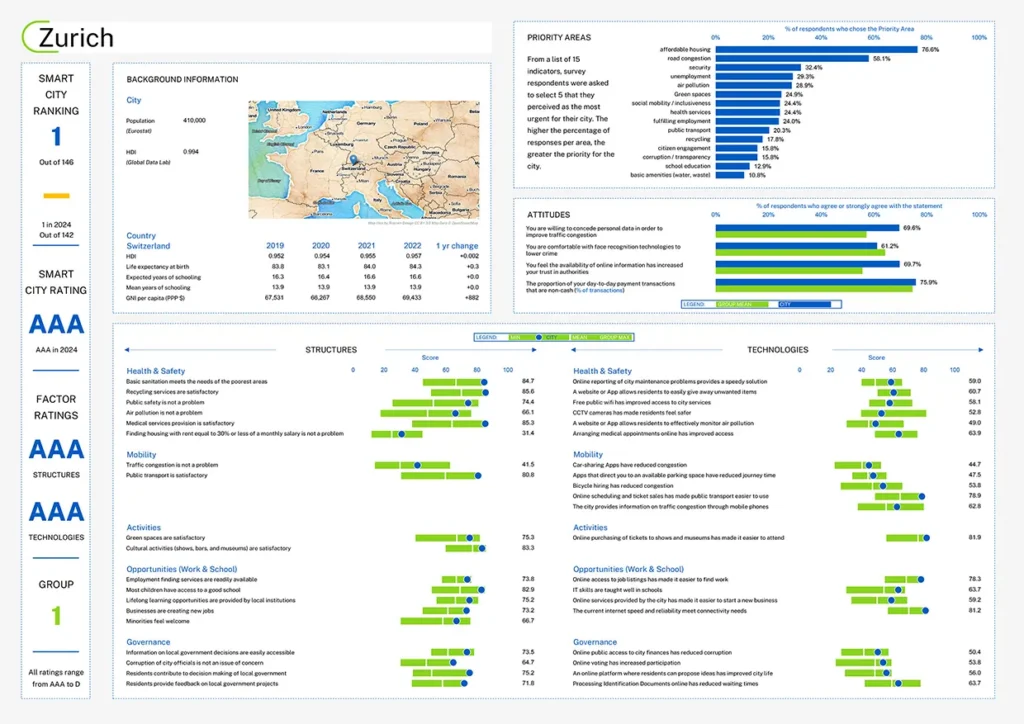
The category of planning that relates to the content or subject matter of planning. Surely, the content includes the Urban form, social welfare planning, urban renewal, and harmonious land use relations. In addition, subject matter includes cities, regions, facilities, housing, land use zoning, and transportations, and others. In modern urban planning nowadays the smart city concept reflects the theory in planning perfectly. Also, it presents a vision, a concept, and an idea of how the smart city works for the betterment of human life. See Figure 1, Zurich number 1 smart city ranking table for 2025.
There are three main ideologies in theory in planning.
- The main task of planning here is to make competing claims agreed by all groups to provide balanced land uses. Unfortunately, land use development has not worked for the public interest in the UK planning context.
- The central function of planning is to provide a good quality of life and a better physical environment. The contradiction of planning work here is that social spatial pattern rise from other mechanisms.
- Planning here is responsible for a better urban community life. The main ideals are the provision of low-density residential areas, the fostering of local community life, and finally the control of conurban growth.
The following table 1 shows the dimensions of planning theory for both the substantive and procedural theories.
Table 1: Dimensions of Planning Theory
| Dimensions of Planning Theory | Substantive | Procedural |
| Descriptive | Describing the planning object (city, community, etc.) | Describing the planning process in various local and national contexts |
| Normative | Developing norms and ideals for planning objects (ideal cities, functional regions, etc.) | Developing the planning process (managing the process, including stakeholders, making convincing argumentation, etc.) |
Theory in planning, as well, refers to substantive dimensions of sustainable urban development. I have shown full details of these dimensions in my previous article.
Related Topics
Andreas Faludi – A Reader in Planning Theory, Strategic Planning, Scenario-Based Strategic Planning, City in Layers articles 1,2,3,4,5,6,7