Environmental planning in the holistic approach background
The Environmental planning process
Environmental planning definition: The field that deals with protecting the planet from human-damaging interventions to the environment. To achieve economic stability and growth, and the status of human well-being.
Environmental planning in the holistic approach background
Environmental planning comes as one part of a whole of building governance. Officials take into account various political, economic, and social conditions. Certainly, taking into account the major priorities across multiple needs and policy areas. In addition, the distribution of resources fairly. Also, putting officials in a position to act on future problems and challenges. It’s a part of a whole to achieve success in official work.
Economic governance also takes into account environmental matters that directly impact sustainable development. For example, a degradation in an environmental area, like the area pollution, water bodies like marshes, lakes, and rivers. Furthermore, these problems could lead to environmental development projects, and the list continues. It’s a plan of taking into account all related issues to human and their well-being.
Environmental planning process: step-by-step
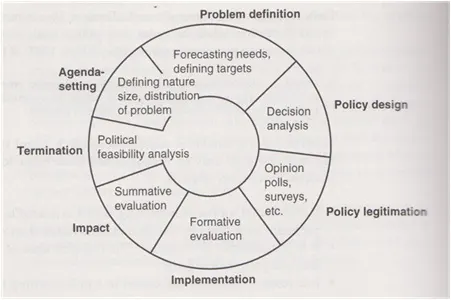
It’s the process of building a policy in the same way as building political policy in practice. If it’s a public work or private work, the process includes several steps. The model used in practice commonly includes these steps. Defining the nature of the problem. Forecasting needs and defining targets. A full analysis of decisions. Taking opinion polls and surveys into account. Forming and evaluating cycles. The team gathers to make an evaluation. A political feasibility analysis is the last step. Figure 1, describes Antonino Palumbo’s modified model of policy-making in the environmental planning process in practice.
In a simpler form, the environmental planning process within public works includes the following stages:
- In the first stage of environmental planning, natural and man made conditions are ascertained, and then general plans for improvement are made along with the formulation of a system of controls.
- In the second (definitive) stage, conditions, plans, and controls are dealt with in a more detailed way, and for a specific area.
- In the third (ways-and-means) stage, controls are put into legal form, and public environmental improvements are incorporated into the whole program of public works.
Environmental planning on a global scale takes into account answering this question: what concerns private and public entities globally? Surely, the straightforward answer to this question is the global thresholds of environmental impact. Many entities had cycled in their summits, Acceptable and unacceptable levels of several issues through the previous decade, which include:
- Climate change, Ocean acidification, and stratospheric ozone depletion
- Change in land use, global fresh water use, and biogeochemical flow boundary
- Biodiversity loss, chemical pollution, and atmospheric aerosol loading
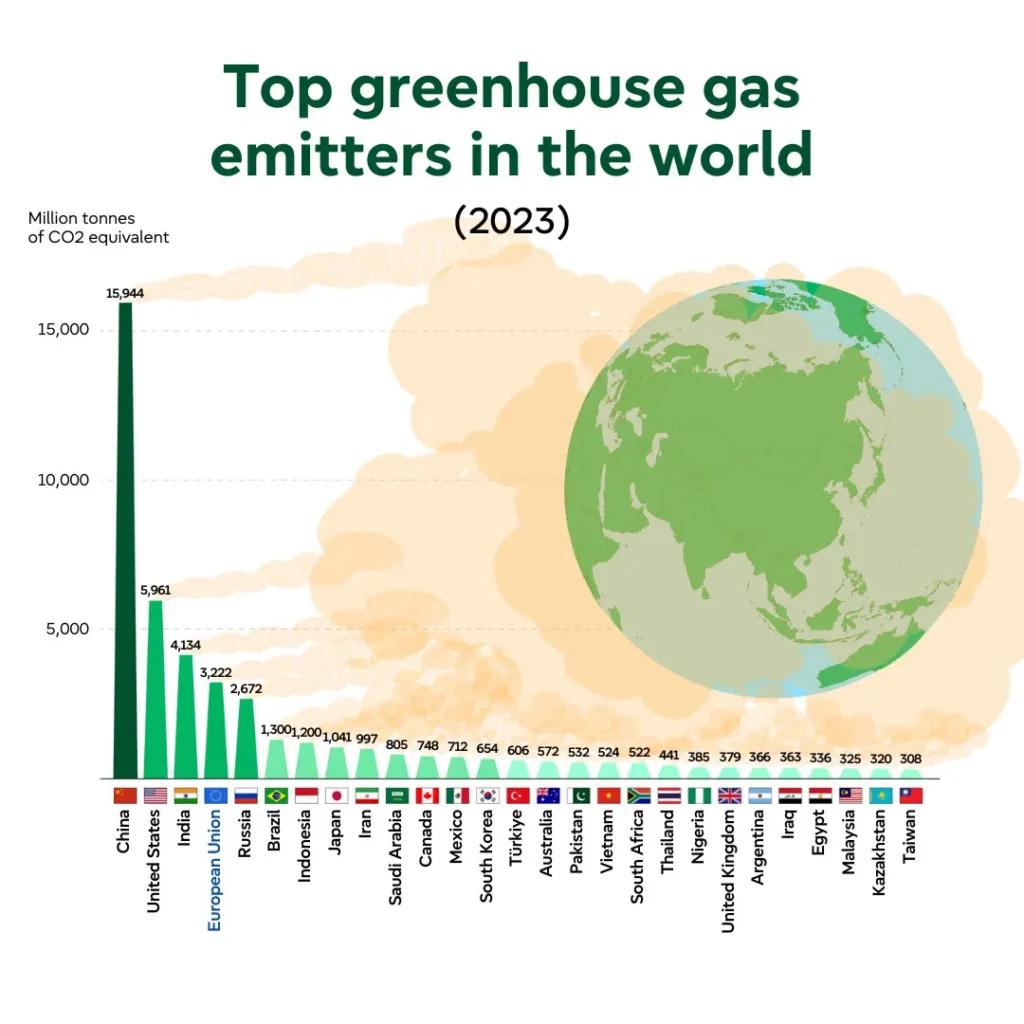
Greenhouse emissions were On top of these issues, which pushed the world to make massive research. Certainly, this issue creates lots of damage to human health, biodiversity, and the planet itself. The following infograph See Figure 2 shows which nations in the world contribute more to creating this environmental issue. China, the United States, India, and the European Union are the top countries.
Due to the GHG emissions’ effect globally on human health, biodiversity, the planet, and poverty levels, entities held global summits to solve this issue. The Kyoto Protocol is an extension to the UN framework for climate change in Brazil in 1992. It’s A treaty signed by 191 nations in Kyoto in 1997 for the target GHG emission. Also, the protocol identified climate change as a GLOBAL PROBLEM and took effect in 2005.
Key provisions of this protocol include
- Emission Reduction Targets: specifying emission reduction by the 37 countries and the EU, 5% below the 1990 levels.
- Greenhouse Gases Covered: the protocol includes six greenhouse gases, carbon dioxide (CO2), methane (CH4), nitrous oxide (N2O), hydrofluorocarbons (HFCs), perfluorocarbons (PFCs), and sulfur hexafluoride (SF6).
- Flexible Mechanisms: The protocol identified various mechanisms for the countries to follow, such as emission trading and joint implementation, to meet their reduction targets.
Planners and related people published research, studies to tackle this environmental planning problem, such as plotting worldwide endangered bioregions. They encouraged to build green belts and forests to halt desertification. Also, in this manner, connecting fragmented ecosystems ensures the migration of species in a natural way. All global entities occasionally publish papers and videos to show their efforts in tackling the GHG emission issue by pushing people to plant trees. They show the many benefits of planting trees, as the following video shows. ( Five reasons why are trees the solution to climate change).
In the following years, another summit took place and the generation of another global agreement, the Paris Agreement. Within the COP21 in France, the rise of this agreement and adopted on 15 December 2015.
Key goals of this agreement
- Temperature Limits: The aim was to hold the increase of global average temperature to below 2°C over pre-industrial levels. Make efforts to limit the temperature increase to 1.5°C.
- Nationally Determined Contributions (NDCs): All involved countries are to submit a climate action plan to achieve the key goals of the agreement.
- Financial Support: The agreement focused on supporting developing countries financially for their efforts to mitigate and adapt to climate change.
On the local scale, other environmental planning issues arise in the specified country. For example, the generated waste by people and how locals deal with it, and how it is deposited. Water quality of wetlands and the amount of polluted deposits, whether by locals or businesses in the area. Certainly, in some countries in the Middle East, they do not have land centers to collect environmental data but rely totally on satellite data provided by global entities.
The environmental planning process includes several steps to build an environmental plan :
- The government recognizes the need for an environmental plan.
- The government assigns people and funding for building a plan and advisory consultants to assist with the work.
- The whole planning team conducts an assessment survey for the environmental plan.
- The team develops environmental conditions and analyzes the information.
- The team reviews the plan in terms of vision, goals, and objectives to incorporate data and needs for the time span of the environmental plan.
- The team drafts the environment plan to articulate a set of land-use controls, financial incentives, infrastructure spending, tax programs, and building design regulations that will put all into action in practice.
- The government informs the public to provide input and adopt the environmental plan.
- The team implements, monitors, and evaluates the performance of the Environmental Plan through an annual review of progress toward benchmarks and then makes revisions and updates as needed.
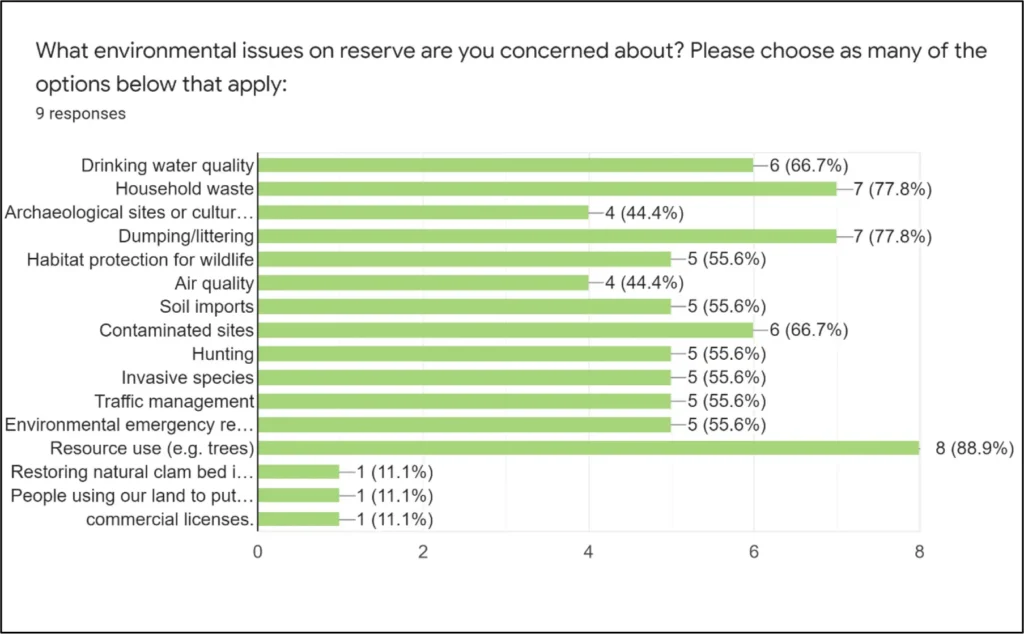
The following table shows the environmental planning team gathering data from the local community. They gathered questionnaires about the issues surveyed to see the community’s opinion on these issues. In this manner, the team will identify the most important issue that the community assesses its a danger and needs for solution. The table covers issues like drinking water quality, household waste, contaminated sites, and dumping. Table 1 is extracted from the Malahat Nation Environment Plan in Canada.
Table 1 Tabulated Responses to the EMP Questionnaire by Category
To make environmental planning for a community simpler by putting the plan together, three steps remain important.
- Target the most important problems for your community to solve.
- Set priorities for action and choose the solutions to implement.
- Put the plan together, making sure that all the Solutions fit together, including coordinating with regulatory agencies to make sure they agree.
At the project scale environmental planning process means achieving the three pillars of sustainable urban development: the social, economic, and environmental pillars. In addition to the green architecture requirements.
Sustainable urban development and green architecture focus on:
- In all, the focus lies on effective land use due to the high land cost.
- Reducing the amount of solid surfaces, especially roads and car park areas.
- Reduce the reliance on private car use.
- Encourage using the mass transit system, like trains and buses.
- Increase of green space for local use and enhance air quality.
- Use natural resources like the sun and light, and natural materials in construction.
- Reducing noise and dust in the air during construction and after.
- Encourage walkability by creating landscape paths for recreation and internal movements.
Related Topics
Net Zero Energy Building, Green idea, Sustainable Approaches.