Multi criteria analysis MCA is a framework for decision-making. In addition, it comes aligned with the use of several techniques. Also, these include the AHP analytic hierarchy procedure and sensitivity analysis. Furthermore, various industries individuals use MCA, such as in urban planning and business, to do scenario planning analysis.
Planners use MCA widely in urban planning practice. Surely, that’s when building scenario planning and scenario based strategic planning. Certainly, in this example from real practice work a planner gets the full experience view of scenario planning. In addition, he can utilize these steps to build his own analyses in practice for any project in the world.
Table of Contents
MCA framework for the scenarios
Calculating Scores for the criteria
I am going to show an example of using Multi-Criteria Analysis (MCA) and scenario planning. Specifically, I selected the Urban Development example. For instance, a developer wants to build a residential project of flats in three different locations in Baghdad. So, the three areas are in Al Yarmouk, Zafarania, and finally, Al Rashidia. Moreover, these three locations have three important criteria for the developer. Surely, these include land price, location, and quality of units, as well as terms of sales that suit the highest demand. Consequently, see Figure 1, which illustrates the three locations of the three development scenarios
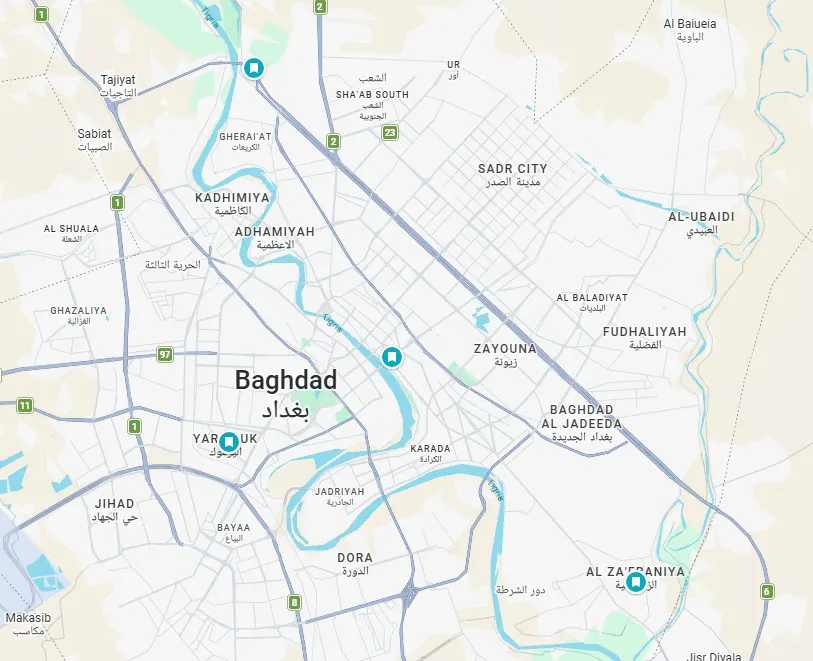
The three locations here I refer to them as three scenarios of the development: Scenario A, B, C.
Multi criteria analysis MCA framework for the scenarios.
The developer gives high priority to the sales unit in terms of market demand. Also, the second priority is the land price. While the last is the location, which means the services provided in the area for the project.
Firstly, the developer gave high priority to sales demand for the flat units, thus it takes 50%. Secondly, he gave priority to land price for the three locations, which is also important, and therefore I give 40%. The third Criterion of priority, which is the location of the services provided to the land, is the least important; thus, I give 10%.
Table 1, 3 Scenarios criteria and Numeric values
| Criterion | Priority | Weight | Scenario A | Scenario B | Scenario C |
| Unit Sales Price | 50% | 0.5 | 330000 $ | 135000$ | 82000$ |
| Land Price | 40% | 0.4 | 3000$ | 1100$ | 250$ |
| Location (services) | 10% | 0.1 | – | – | – |
MCA calculating Scores for the criteria.
Here I am going to use the AHP technique, which relies on pairing criteria. And in this example, I’m going to use the two priorities: the sales demand price and land use price. So, I’m going to calculate the scores for these pairs. Since the Target price of Maximum demand is around 200 million dinars, which is a little bit higher than 135,000$, then it is the gauge for the highest and lowest scores.
Based on the Perfect Price 140000$ I am going to calculate the score for the three scenarios. The equation is
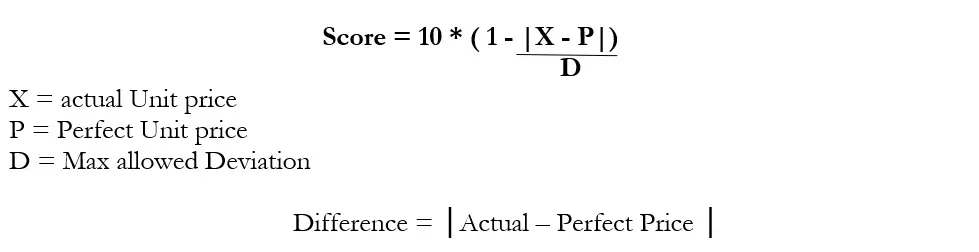
The perfect price for the maximum demand for sales comes in the range of 140000$ for a 150 sqm flat. From our unit sales, flat prices, we have Scenario A 330000$, B 135000$, C 82000$.
Certainly, for this calculation, I assumed my “dealbreaker” limit is the furthest unit in my list ($330,000). Thus, this makes D = 190,000$ (because $330,000 – 140,000 = 190,000$).
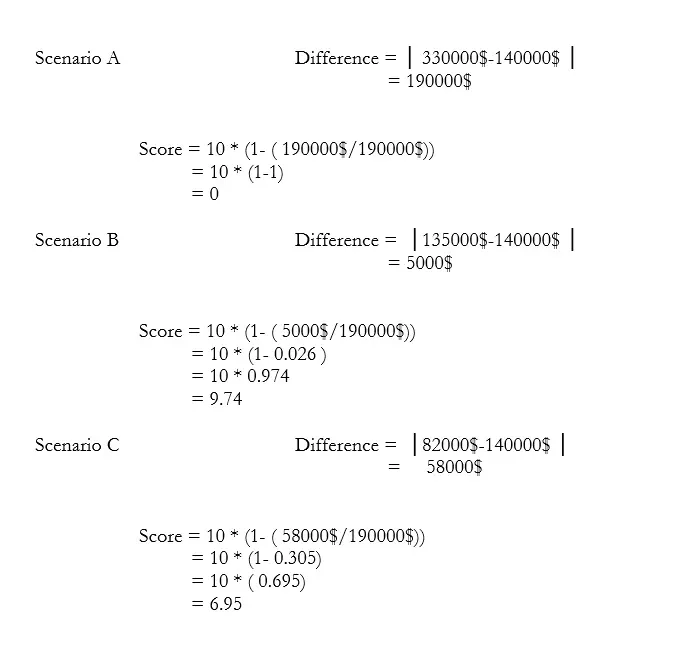
Table 2, Sales demand, Unit price for all scenarios scores.
| Scenario A | Scenario B | Scenario C | |
| Score | 0 | 9.74 | 6.95 |
Land price is connected to the third Criterion, availability of services. Since Scenario C has the lowest services available but lowest land price, therefore I gave it a 10 score. And Scenario A, which has the highest services available but the highest land price, thus I give it a 0 score. In the following, I’m going to normalize to calculate the score for scenario B.
Using the same equation for the lowest is better in the previous normalization Surely, I get the following scores.
Score = (( Max value – Actual value ) / ( Max Value – Min Value ) ) * 10
Score = (( 3000$-1100$)/(3000-250))*10
= 6.91 Score for scenario B
Table 3, Land Price scores for all scenarios.
| Scenario A | Scenario B | Scenario C | |
| Score | 0 | 6.91 | 10 |
The remaining criterion, which is the Location (services availability). Surely, the developer identified that a 3-mile distance from the Baghdad business center is preferred. Thus, this allows all users to use the shared private transport to reach it within 15 minutes. Also, scenario A location from the CBD is 5 miles. While Scenario B location from the CBD is 7.5 miles. Finally, Scenario C location from the CBD is 2 miles.
The equations used for calculating scores are
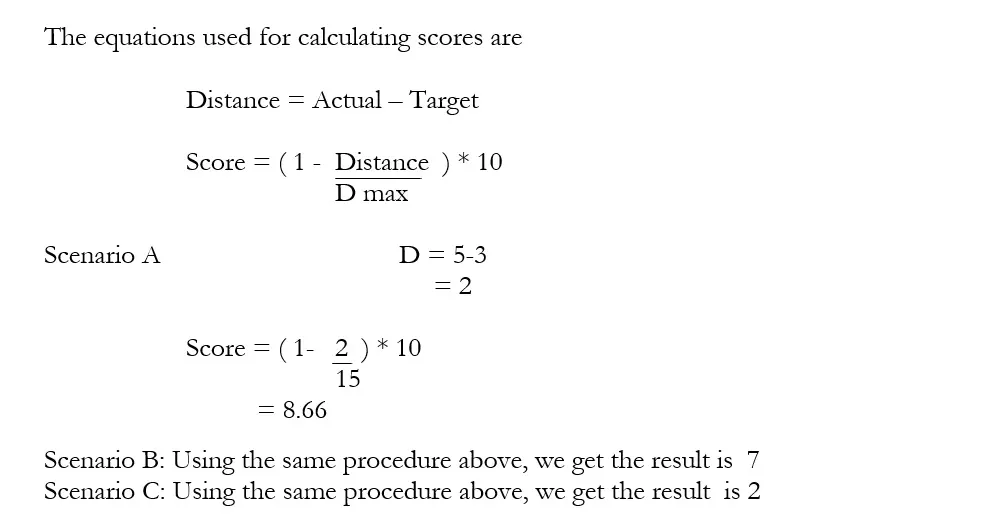
Table 3, Location scores for all scenarios.
| Scenario A | Scenario B | Scenario C | |
| Score | 8.66 | 7 | 2 |
Selecting the best scenario for the development
Here, I will show the last step of the selection of the best scenario for the development. Surely, based on the three criteria the developer identified and the calculated scores for each criterion. Also, the equation is used as follows:
Total Scenario Score = (Unit Price Score * Weight) + (Land Price score * Weight) + (Location score * Weight)
Scenario A = (0* 0.5) + (0 * 0.4) + (8.66 * 0.1)
= 0.866
Scenario B = (9.74 * 0.5) + (6.91 * 0.4) + (7 * 0.1)
= 8.334
Scenario C = ( 6.95 * 0.5) + ( 10 * 0.4) + ( 2 * 0.1 )
= 7.675
Scenario B wins the development competition as it has the highest score. In addition to its harmony with the developer’s preferred situations.
Running sensitivity Analysis for the Multi criteria analysis MCA
Furthermore, in many cases, the developer runs a sensitivity analysis to check their correct choice. Therefore, that’s what I am going to do here. In order to keep my calculations at the same proportions when I make the change, I am going to proportion all weights together. So, the first check is increasing the weight for the unit sale price by 10%.
Certainly, unit sales weight becomes 60% (0.6), then the new remaining space for other criteria 1-0.6 = 0.4. while the remaining space in the old weights is 1-0.5 = 0.5. So, we calculate the rate to multiply the old weights to get the new weights by New/Old. Then 0.4/0.5, which gives us 0.8. Surely, this is the number that we multiply by other criteria to keep proportions equal. Unit sales price weight becomes 0.6. Also, the land price becomes 40* 0.8, which equals 32 (0.32). Surely, for location, the weight becomes 10* 0.8, which equals 8 (0.8). See Table 4 for new weights.
Table 4, New weights for increasing unit sales price 10%
| Unit sale price | Land price | Location | |
| Weight New | 0.6 | 0.32 | 0.08 |
Scenario A = (0* 0.6) + (0 * 0.32) + (8.66 * 0.08)
= 0.6928
Scenario B = (9.74 * 0.6) + (6.91 * 0.32) + (7 * 0.08)
= 8.6152
Scenario C = (6.95 * 0.6) + (10 * 0.32) + (2 * 0.08)
= 7.53
When increasing the unit sales price, scenario B still wins the competition as well.
The second check is decreasing the weight for the unit sale price by -10%. Thus, unit sales weight becomes 40% (0.4), then the new remaining space for other criteria 1-0.4 = 0.6. while the remaining space in the old weights is 1-0.5 = 0.5. So, we calculate the rate to multiply the old weights to get the new weights by New/Old. Then 0.6/0.5, which gives us 1.2.
This is the number that we multiply by other criteria to keep proportions equal. So, the land price becomes 40* 1.2, which equals 48 (0.48). Moreover, for location, the weight becomes 10* 1.2, which equals 12 (0.12). See Table 5 for new weights.
Table 4, New weights for decreasing unit sales price -10%
| Unit sale price | Land price | Location | |
| Weight New | 0.4 | 0.48 | 0.12 |
Scenario A = ( 0* 0.4) + ( 0 * 0.48) + ( 8.66 * 0.12 )
= 1.0392
Scenario B = ( 9.74 * 0.4) + ( 6.91 * 0.48) + ( 7 * 0.12 )
= 8.0528
Scenario C = ( 6.95 * 0.4) + ( 10 * 0.48) + ( 2 * 0.12 )
= 7.82
In conclusion, when decreasing the unit sales price, scenario B still wins the competition. Surely, this way calculation, the developer is satisfied with his selection. Finally, I have finished the Scenario planning using AHP & SA in Multicriteria Analysis. In addition, I have shown its efficiency in urban planning practice. Surely, this practice of providing a real-world practice example rarely exists not even in specialized venues for urban planning.