Urbanism: Ecological Urbanism and Ecosystem Dialectic is the ninth article of a series1,2,3,4,5,6,7,8,9,10,11,12,13,14,15,16,17 . I will go through this relationship from the top scale of urbanism in the city to the smallest scale of urbanism parts of urban space.
In the last article, I defined urbanism through research, practice, and study. Urbanism interests many experts in city planning, urban design, and building. It also interests experts in, environment, and social fields. Urbanism is a two-sided coin. One side is its impact on people and the physical space. The other side is nature’s impact on urban design fields.
Ecological Urbanism and Ecosystem Dialectic articles primarily investigate and advocate for the dialectic of architecture and urban design. Doing so across many topics in research and practice — topics linked to urbanism till modern days. Ecology is the study of the environment to helps us understand how organisms live with each other in unique physical environments. An ecosystem consists of all the organisms and the physical environment with which they interact.
Ecological Urbanism and Ecosystem Dialectic in research
There has been a direct link between urbanism, ecology, and ecosystems since the last decade. Surely, this link guided the research and was the cause of the birth of many fields like eco-city and green urbanism. So, what is green urbanism and its link to the ecosystem? Steiner1 defines green urbanism as the term loosely used to describe an approach that uses eco systems as an inspiration to design and live sustainably in towns. It is a new field that does not yet have, nor aims to, a clear or single meaning. Winkelkotte2 says the idea of green urbanism can be seen as a bold new way to urban growth. Based on an ethical design practice, it calls for long-term teamwork. Certainly, between natural scientists and humanists to meet recent and future needs of city growth and change on a global scale.
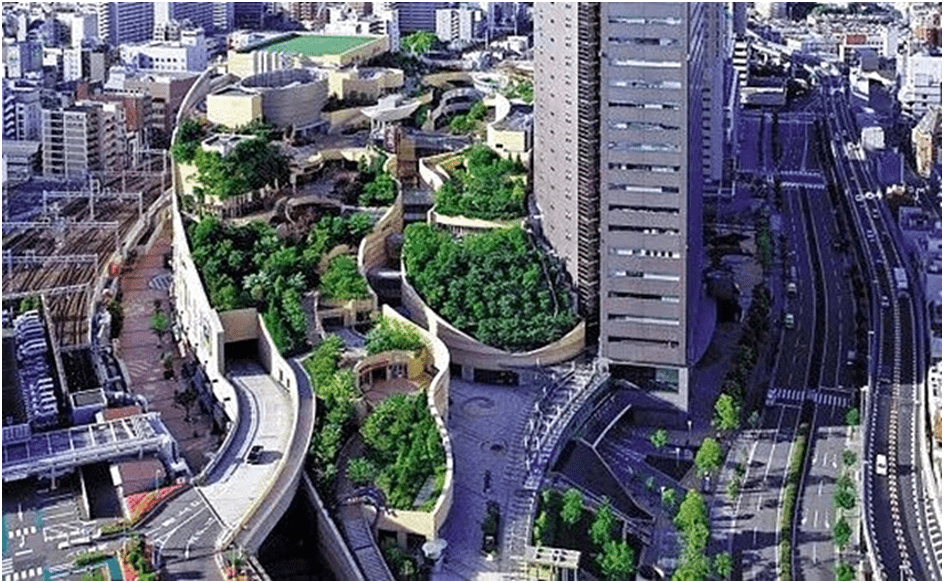
These challenges are no trifle: more than 50% of the world’s population now lives in cities. Lorrimar3 says ecological urbanism is a term loosely used to describe an approach that uses ecological systems as an inspiration to design and live sustainably in cities. It is an emerging field that does not currently have, nor necessarily aspires to, a definitive or single definition. Lin4 indicates that the initial discussions of ecological urbanism emerged out of the countercultural movements in the 1960s and 1970s, representing a new approach to urban development that emphasized respecting environmental limits instead of working against them. Japan’s government initiated several projects to achieve and build an eco-city model since 1997 based on ecological urbanism. See Figure 1.
In looking at the papers noted here, I find that ecological urbanism is in one way or another a sustainable development . We need to know why green urbanism came about since it has been in study, research, and practice for long time.
In going further in the analysis, the cause of the initiation varies. The population growth and the transition required from planned to market economies are putting more strain on ecological and natural resources. Rapid population growth rural to urban migration and the exploitation of limited resources. The global and local concerns and agreements of many countries in the world to decrease the impact on the environment and achieve high standards of living in cities. The most important is how to develop our neighborhoods, towns, and cities. Doing so with less damage to the ecosystem or efficient restructuring of the ecosystem.
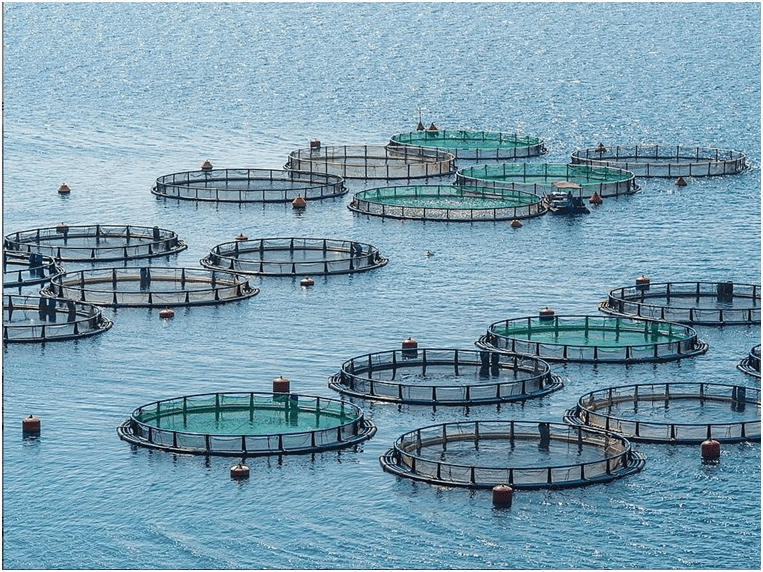
So, the main problem is how to control many factors. Like population growth, fast immigration from rural to city. Also, the rise of urban growth and its direct effect on the ecosystem. In addition, how to guard and reshape the ecosystem without harm. That to keep the global environment in steady balance. See figure 2.
I have pointed out from these papers of Ecological Urbanism and Ecosystem Dialectic the main problem within ecological urbanism. Know who is responsible for resolving this problem. Proper policies introduced to support the environment eco-balance. Economic development that reduces the burden on funds and income of local and global workforce. Geographic research aims to nature and habitat. Environmental policy that mitigates, protect, and issue regulations to control the damage to our earth and living species. Urban development guidelines that reduce the use of our resources and exploit them in development effectively and efficiently.it is a global responsibility as it is the individual responsibility of many specialists to work within the global environment, protect it, reduce damage, and develop efficiently. Professions like politicians, economists, geographers, researchers, engineers, environmentalists, architects, urban designers, urban planners, agriculturists, and so on.
In presenting various definitions of ecology, ecosystem, and the various definitions of ecological urbanism adding to that analysis of the reference papers here I come to conclude that the physical environment is the only part that is not involved in the new field of ecological urbanism. Ecological urbanism is about the relation, interaction, direct effect, and vis-a-vis of living species and the environment. Buildings are not part of the living environment. Our neighborhoods, towns, and cities are human creation, not natural creation, and we must integrate them into the ecosystem.
Ecological Urbanism and Ecosystem Dialectic nations experience in practice
In recent years, nations like Japan and China have moved to make government plans tied to eco-friendly growth. In Japan, the government started the eco-town project plan in 1997. Later, it turned this plan into a broader program of eco-city models in 2008. As a result, 28 Japanese towns have gained title as eco-model towns — from big cities like Yokohama to small towns like Minamata. In the end, this program and its models aim to craft models of green urbanism. In order to affect all towns in Japan and keep the nation at the front of sustainable growth worldwide.
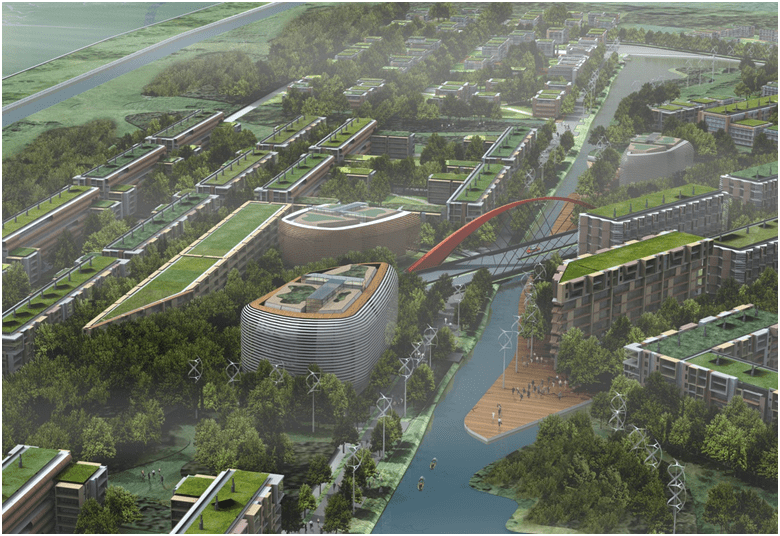
As for China, there has been a strong push to the eco-city plan and scheme seen in the big count and size of works in the last ten years. In China, more than one hundred new eco-towns are now in the works. And more than 250 towns said they will turn into an eco-city or low-carbon city. Two cases are Dongtan eco-city and Tianjin eco-city. See figure 3.
Back to our article, the focus is the link of architecture and urban design and where do architects meet in ecological urbanism?
Architects design buildings within a neighborhood, town, and a city. Yet, they do not become part of the ecosystem, but architects plant them within the system. As for location, they should mitigate, protect, and integrate the building sitting in the plot. Doing so while addressing the damage to the existing ecosystem. Notably, many writers and researchers focus on the building itself and its envelope relation to the adjacent environment, which is very important. Also, the building should not, by any means, disturb the three important elements of the physical environment — air, sun(light), and water — if parts of the ecosystem exist near the block, specifically water on the surface and water in soil. After all, these three elements are essential for living species on Earth to continue and grow. For instance, birds need trees, grass, and open air to move from place to place to catch food and to proliferate.
Trees need living species like birds to clean out some dangers like insects and need birds for fertilizer supply. Also, some trees need air to move in the surroundings to transfer pollen from place to place and so on. In terms of the building itself, the use of natural light, less water consumption, less cooling. In addition to heating, green roofs, less heat generator surfaces like parking, and more shading. Those are some of the factors that make the building eco-friendly.
looking in depth at the Ecological Urbanism and Ecosystem Dialectic In the world there are lot of agencies that provide, certify, and encourage the use of their strategies and guidelines to assess the building qualification and rating. Japan’s (CASBEE) Comprehensive Assessment System for Built Environment Efficiency is a multi-level research committee of academia, industry, and local and national government to certify the buildings. Beamplus is a similar accreditation system developed in Hongkong China read my article for more details here.
Urban designers creating a city plan should choose a site that has little impact on the local ecosystem. The site needs minimal infrastructure, such as roads, transit, and underground services. The development should connect well with nearby projects to promote low mobility use. The urban space should connect the site and its surroundings through corridors that ensure safety and continuity. The development plan must increase ecosystem elements, such as lawns, trees, and water features. See my previous article for a related project. The development plan should promote sustainable strategies for energy use, water quality, air quality, and light and heat.
Where this fits in practice: I show how ecological ideas reach projects as site analysis and environmental requirements in Urbanism Role in Professional Practice: How Research Became Hidden Rules.