Urbanism: Urban Change and Landscape Architecture Transformation is the eighth article of a series1,2,3,4,5,6,7,8,9,10,11,12,13,14,15,16,17 . It assesses the dialectic of architecture and urban design in the urbanism field. I will go through this relationship from the top scale of urbanism in the city to the smallest scale of urbanism components of urban space. The article aims to analyze how landscape urbanism transforms urban change.
In the first article, I have defined several definitions of urbanism. One of these is that urbanism is the way of life. The interaction of humans with the environment while in the activity of leisure, work, education, and many others. Another is that urbanism is all the activities happening in the world that are the output of change or causing change. The changes happening in the physical environment such as buildings, nature, or the moral ideas and values like culture and traditions. Adding to that the changes happening in the human being like talent, skills, and ideas.
I have analyzed these definitions. Thus, I concluded the direct link between urbanism and urban development change in the world. Many Human factors drive the urban development and change. These include poverty, unemployment, healthcare, education, prosperity, and so on. When it is related to an economy it’s like development funds, crises, and economic and business networks. Factors linked to politics include government approaches to deal with human and development demands.
how landscape urbanism transforms urban change
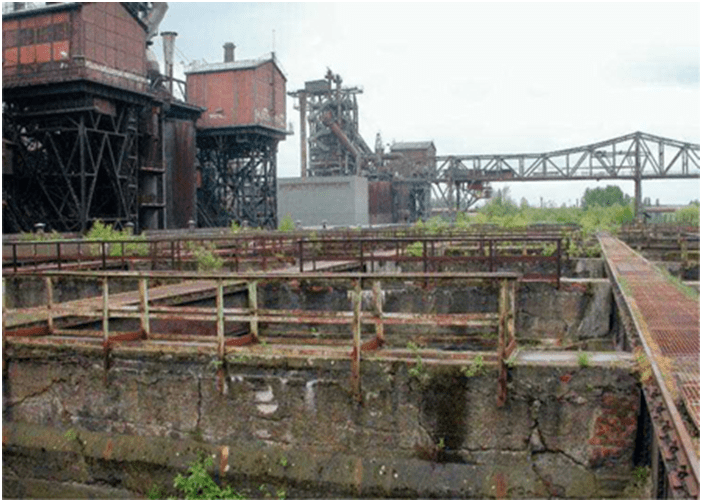
Many of these factors change. Also, urban change link landscape architecture and landscape urbanism. Sordi1 defines landscape urbanism as the overall connection point of the importance between natural environments and processes of urbanization, globally. Weller2 defines landscape urbanism in terms of scale as the field that bridges the divide between landscape design, landscape ecology, and landscape planning. It puts more focus on planning and design operations. It interprets and represents landscape systems that influence the creation of the urban form, processes, and patterns. Donadieu3 defines landscape urbanism as a branch of landscape ecology dealing with urban spaces abandoned by industry. Many industrial areas in Europe were subject to redevelopment by French organizations and related bodies. See figure 1.
Deng4 defines it as a new interdisciplinary and cross-subject theory, landscape urbanism uses landscape to shape the urban pattern as well as the structure and connect relevant specialties of urban planning design. Charles5 defines landscape urbanism as It is synthetic, combining in a single design strategy urbanism, infrastructure, ecology, architecture, and landscape architecture. It is multiscale, using processes rather than forms as the basis of design, which allows ideas to translate from one scale to the next, and across disciplines.
The world has witnessed many events like wars, disasters, technological development, and pandemics. Thus, had multiple effects on humans and the systems linked to them. Landscape urbanism appeared to respond to resolve the problem, as the researchers deem, of abandoned industrial sites and previous manufacturing plants. I doubt that this is the reason because many professional planners in the world are predicting serious matters related to the environment that will happen in the future. The abandoned places, which were the cause of the rise of landscape urbanism, were not under the telescope of these researchers since long ago?
Either the researchers were not capable of inducting the future in terms of physical environment matters or they neglected totally.
The rise of landscape urbanism in practice
Landscape urbanism was first coined by weldham5 in 1996 who studied at Pennsylvania University in the USA. In the following years, academia in USA invented a new program in this field. Going deeper into this matter of landscape urbanism and its appearance, application, and even the rise of a field of study I conclude the following:
Landscape urbanism is about the urban landscape. The urban landscape includes two divisions the man-made landscape and the natural landscape. Several problems appeared and mostly linked to the natural landscape. Thus, and these problems caught the attention and the focus of the international environmental lobby. These problems received great attention in the world and research, funds, and even protection were provided to areas like the marshes of Iraq. See figure 2.
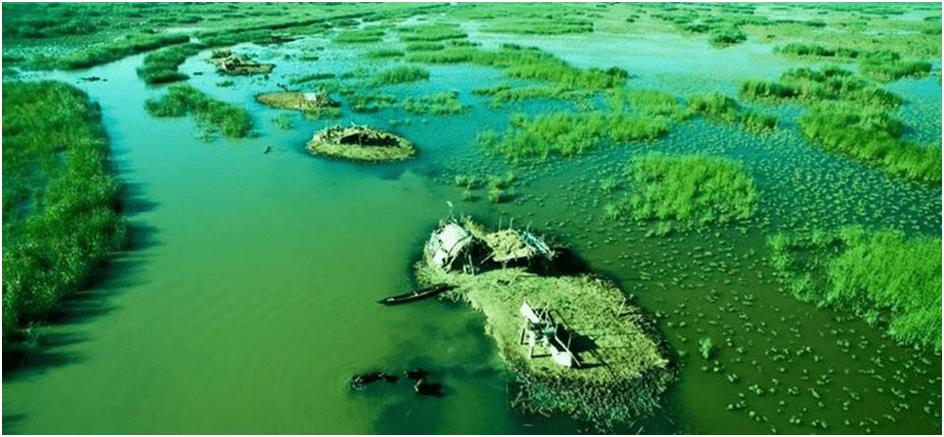
Marshes in the south of Iraq was one of the natural gifts and important environmental feature in Iraq for several reasons. It was the natural coolant for the oil wells in the city of Al Nasiriyah, it was the place of the proliferation of the migrating birds from the USSR in winter, it’s a source of income for many fishermen in Iraq, it is the place of balancing the ecosystem in the south of Iraq and adjacent countries.
These marshes were in the hot zone in Iraq at the time of the Iraq-Iran war. The destruction continued for 8 years. The marshes witnessed military operations for years and caused severe damage to the ecosystem, people living in the marshes, and environmental balance. The Iraqi regime at that time caused another damage to the marshes by withdrawing its water and diverting it to the river tigress. The marshes created environmental problems in the country. It continued neglected till the fall of the Iraq regime in 2003. So, this is one of the examples of how landscape urbanism transforms urban change.
Environmental problems closely related to the natural landscape were the main cause of the rise of landscape urbanism and its related research, and educational programs. The need for a specialist who possesses experience in dealing with landscape matters was the concern. Thus, the intervention rose from the landscape architecture field and related bodies, researchers, academics, and professionals.
Landscape urbanism is about how humans are affected when a natural landscape in the region is damaged, neglected, rehabilitated, and developed. Who should be involved in the process of the recovery or development? Who should be present in the research to identify the real problem and to lay out the resolutions?
Returning to our main concern of the article the intervention of architecture and urban design in practice related to landscape urbanism and related matters. Architects and landscape architects must work together to identify the natural landscape characteristics. Landscape architects should define the natural species, landscape, and their existing environmental conditions. Whether they could combine this environment for use for external human activity. Also, define the possible use of other types of landscape elements whether green or species in this environment.
Architects to consider these landscape elements when designing the buildings and the surrounding linked spaces and gaps. They should identify the benefits of each element to the building design in terms of views, space integration, and surrounding environment air quality. Urban designers in their work to develop a development plan, regional plan, or assist in an urban planning local plan should focus on the natural landscape locations. How architects combine the use and design of this natural landscape when plotting a development. Urban designers should consider and benefit from this natural feature as part of the development plan to reduce the use of virgin land to develop landscape and urban space.
How landscape urbanism transforms urban change: project from practice
Reflecting all this to one of the landscape projects I worked on in the Middle East that had similar problems.
A beach club rehabilitation project located at the far end of the Arab gulf region in the uae. For the staff of the biggest oil and gas company in the Gulf region, they built a club for the housing complex. The housing project included many public spaces, a kid’s playground, and a landscape space. The company neglected the beach club not purposely. Due to its far location from the housing complex development that requires a distance drive to reach it.
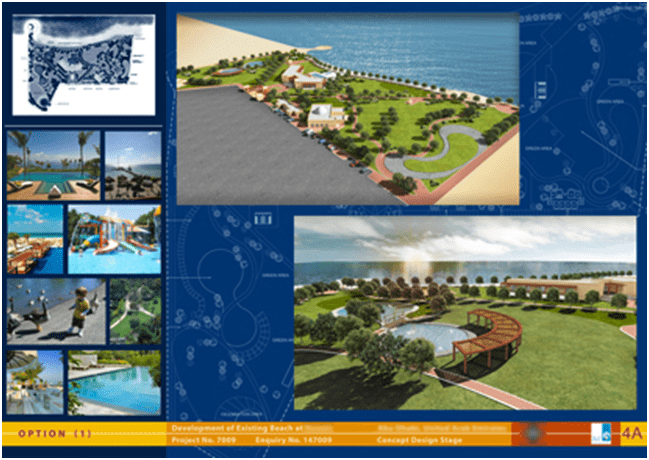
The beach club neglected a period that resulted in the decline of its infrastructure buildings, landscape, and the surrounding network. The staff of the company withdrew from using the club. Because they considered safety matters related to the open coastline water surface. A main problem made the beach club unsafe for families to use. The seaside was facing continuous changes in water movement. The tidal waves continuously changed the silhouette of the sea. The water level had fast tidal waves. Also, the water depth was deeper in near land to the seaside club entry point. Finally, all these were not only unsafe for families’ children but also for the elderly who do not know how to swim. See figure 3.
The Company assigned a landscape specialist consultancy from Malaysia to a project. To handle the execution of the landscape rehabilitation and design. An assessment with a geotechnical consultancy to survey the seabed and study the tidal wave movements. A dredging was required for the seabed, and a coastal protection wall was also required. This would prevent the tidal waves from entering the beach seaside for protecting swimmers. Many of the trees in the beach club were damaged and infected. They required an agricultural intervention and some of them already dried and dead. The lawns in all the areas were not useful for use and the removal was required.
The beach club soil used for planting also was damaged by the sand brought by wind from the seaside. Thus, the soil was removed and replaced by others. In assessing the feasibility of rehabilitating the seaside and considering the cost and usage of the club the client requested to build two swimming pools instead of using the seaside water for swimming activities. The seaside was cleaned, and minor dredging was conducted and a path the small harbor created was erected for future use. Two swimming pools one for the elderly and one for the children were designed in the project. A racing ring for small cars for kids was included inside the development as a small mosque. The landscape consultant considered rehabilitating the old and high trees only and replacing the small ones with new trees. See Figure 4 for the overall landscape design layout.

To sum up, landscape urbanism is about the natural landscape. Landscape urbanism is about how the natural landscape when considered by urban designers, landscape architects, and architects participates in shaping the urban form. It is about how the concerned parties protect the urban fabric and the physical environment. Also, predict future scenarios in terms of design, environment, planning, development, human prosperity, and protecting the living species and ecosystem.
Where this fits in practice: I show how landscape ideas arrive in practice as drainage, green corridors and brownfield regeneration in Urbanism Role in Professional Practice: How Research Became Hidden Rules.
Related Topics
For deeper exploration, see related content on Environmental planning, Green architecture, Sustainable urban development, TOD , Architecture practice , Urban Design , Smart Cities.
References
- Beyond urbanism (2016). Trento: Listlab Srl.
- Weller, R. (2008) ‘Landscape (sub)urbanism in theory and Practice’, Landscape Journal, 27(2), pp. 247–267. doi:10.3368/lj.27.2.247.
- Donadieu, P. (2006) ‘Landscape Urbanism in Europe: From Brownfields to Sustainable Urban Development’, Journal of Landscape Architecture, 1(2), pp. 36–45. doi:10.1080/18626033.2006.9723371.
- Deng, Y., Cai, L. and Li, X.L. (2011) ‘Dynamic Integrated Planning System based on Landscape Urbanism: An Approach of Sustainable Urban Landscape Planning’, Advanced Materials Research, 368–373, pp. 1895–1901. doi:10.4028/www.scientific.net/amr.368-373.1895.
- Weldham, C (2013) The Landscape Urbanism Reader, pp. 554–563. doi:10.4324/9780203094235-57.