Urbanism: urban fabric or urban form sustainability? Is the third article of a series1,2,3,4,5,6,7,8,9,10,11,12,13,14,15,16,17. Articles assessing the dialectic of architecture and urban design in the urbanism field? I will go through this relationship from the top scale of urbanism in the city to the smallest scale of urbanism components of urban space.
Table of Contents
Urban fabric correlation to sustainability
Urban form correlation to sustainability
Urbanism: the urban form determinants
Types of sustainability and how they can be achieved in practice
Urbanism practices studies link these topics: urban fabric, urban form, and sustainability. So how do these topics or fields intersect, intervene, and affect each other? Many are aware of the importance of sustainability when reading the word without going into detail. Why are specialists concerned about the urban fabric and the urban form?
In the first article, I shared definitions of urbanism. Urbanism helps many fields improve their work. It includes actions and activities in the city, showing how humans interact with the environment and man-made systems that affect city life.
The urban fabric and urban form are interchanging phrases in many practical studies and practices. Urban fabric, urban form, and morphology as well are related and linked elements in practical studies. So, these elements of a city are rarely separated.
Urban fabric correlation to sustainability
X.Li1 shows that the morphology of a certain area reflects many urban fabric shapes and elements. Cities in the world have many different ones that naturally grew, or planners designed them in an exact timeline in history, see Figure 1. Related studies use a variety of methods, such as space syntax, Isovists, and density-based quantitative analysis. In addition, they use some indicators for studying the urban fabric, for example, dense, compact, and fragmentation, in addition to variation and cohesion. The relation of each value and indicator to the others provides a complete understanding of the urban fabric.
The goal of these real-world studies is to show a clear view of the link between the various urban fabric shapes as well as the human inhabitants’ behavior in their daily life. Though these studies are central, they do not take buildings into account. And some results are hard to interpret about architecture and urban design relations. We need to identify how these indicators, although they are heavily related to two-dimensional relations, how they also relate to positive and healthy living in the city, and how to measure that.
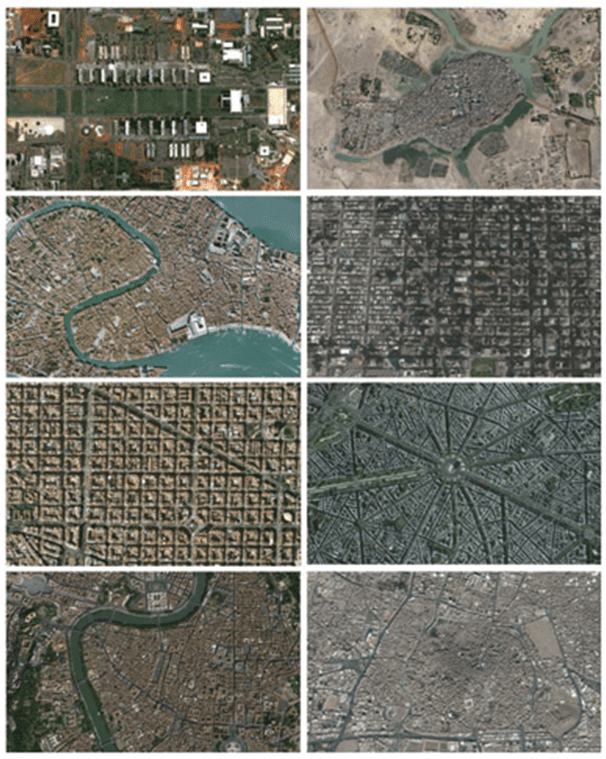
Many other factors make the urban fabric shapes unhealthy for people and have a negative impact on the city. For example, in old cities in the absence of planning and design urban fabric grew naturally without proper sanitary design. Swensen3 discusses the role of municipal planners against the questions of integrating the historic fabric in new urban development. He says that fragmented planning makes it difficult to consider the historic fabric, townscape, and the natural environment unity. Also, here when urban designers take into account the historic fabric, it affects the creation of the urban image within the process of change.
Specialists believe that the global economy creates the urban image, and these images arise from the interplay between politics, culture, and markets. So, architects and urban designers need to consider the role of politics and the planning system. Their effect in transforming urban development proposals within the historical fabric. In addition, how the historical fabric may affect the urban design layout. Furthermore, the building’s architecture in the urban development proposal.
The urban fabric and urban form, as indicated earlier, are linked to the field of morphology. What is the urban form?
Urban form correlation to sustainability
Oliveira2 describes this close relationship as rarely separated. Morphology means the study of the urban form, and the agents and the processes responsible for their transformation. The urban form (see Figure 2) refers to the main physical elements that structure and shape the city- the urban tissue (fabric), streets and squares, plots and buildings, and landscape. Oliveira indicates that although urban morphology was proposed to be a branch of biology, it was applied to different fields because of its abstract nature. Various authors from different fields provide different definitions depending on the area of application. One of these definitions is:
“A method of analysis which is basic to find (ing) out principles or rules of urban design… the study of the city as human habitat… Urban morphologists… analyze a city’s evolution from its formative years to its subsequent transformations, identifying and dissecting its various components’ ‘First, there are studies that are aimed at providing explanations or developing explanatory frameworks or both (i.e. cognitive contributions); and secondly, there are studies aimed at determining the modalities according to which the city should be planned or built in the future (i.e. normative contributions) “
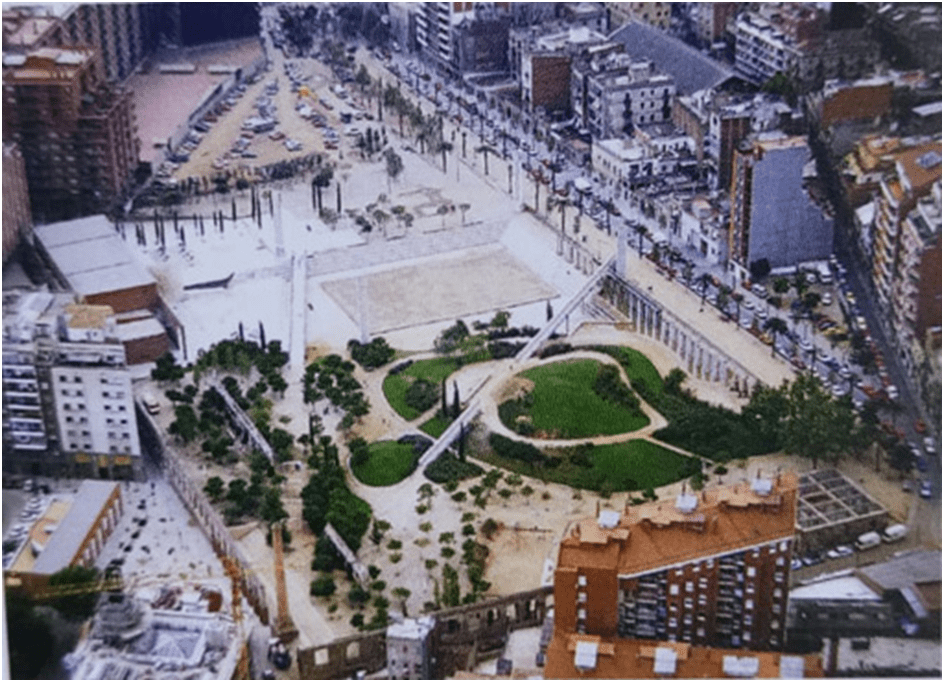
Another way of studying the urban form (its built environment). One that shows how urbanism affects not only the physical part of the city but also human behavior, as it is a two-way interaction. Rapoport6 says that the built environment provides cues for behavior, and according to that, people act upon reading them. Using this approach, it is surely possible to distinguish between two environmental effects. The direct are those where the environment affects behavior, mood, satisfaction, performance, or interaction, while the indirect are those that draw conclusions about the social standing and status of its occupants and modified behavior.
Urbanism: the urban form determinants
Urbanism is concerned with other urban form determinants. Morris6 developed two types of urban form determinants that a specialist can use in their practical studies.
- The natural world determinants: The natural include topography, climate, construction materials, and technology. Topography has a direct effect on the urban form, like cities built on a hillside or on top of a mountain or a valley. Climate as well, like cities that are under direct climate change, such as flood plains, typhoons, and hot desert weather.
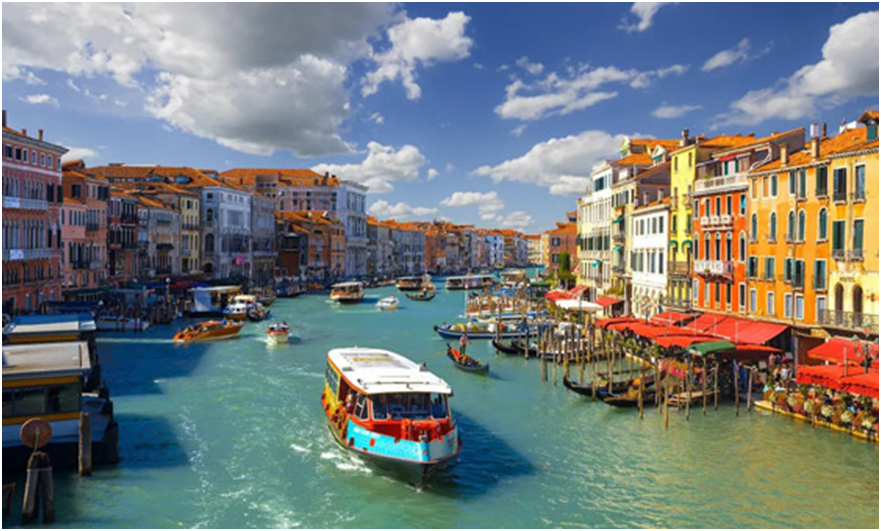
- The man-made determinants: The others include political, economic, religious, and technological. Technology affects the urban form in different ways. Such as the building itself and style of architecture and building mass and orientation. It is used when the buildings are designed in a different way than the usual and typical way. Or the buildings are located in areas that need special methods of construction, like the city of Venice in Italy, see figure 3.
The political effect comes when governments decide the type of development and fix its guidelines (non-design). while the economic comes when other entities, public or private, decide to pump in funds to finance a project of an area or a regeneration program of a derelict zone in the urban form. On the other hand, religion comes when one of its powers has an effect on developing religious buildings and funding them. Moreover, owning a location that could be built for religious purposes.
The many activities in the creation of the urban fabric or urban form affect the planet and the global environment. We have known how many factors, that relate directly to them, affect the urban fabric and urban form creation. When the environment comes into the debate of the urban fabric or the urban form creation, then we are into sustainability.
Many architects and urban designers know that sustainability is achieving the environmental, economic, and social pillars. Specialists say that the term sustainability is vague. Madhavan7 says that it means different things to different people. And it is supported by a contrast of many public attitudes, political agendas, cultural beliefs, emotions, and goals. Dev8 says that when the global concern gave existence to ecology, several definitions were given to it. Some of them limited to protecting ecosystems and natural resources. While others consider its three pillars, as well as well-being and equity factors. Newman9 says it is about balancing ecological nested systems and components in nature with each other.
Types of sustainability and how they can be achieved in practice
Sustainability can take many forms, like green building. Development relates to buildings, urban space. Also, to transport, and the economy. Each country has its own system for designs. The non-design aspect connects to people’s economics, education, equity, and rights. These factors come from social and political views.
Building sustainability is achieved by the architect’s work to reach a specific benchmark. Surely of reducing electrical and water usage by certain sanitary fixtures. Also, daylight and views, proper design of building façade and orientation, and building envelope. In addition, reducing heat gain by high insulation materials and an economic and efficient AC system. Reducing the heat island effect by removing much of the open hardscape and combining it with a greenery design. Covered car parking and using shared car lifts whenever possible.
Urban designers and planners reach project sustainability through proper design and planning. By:
- Selecting the proper development location with certain criteria such as near to transport node and encouraging walking.
- Developing a brownfield that protects the valuable land for agriculture to provide city inhabitants with food.
- Recovering water beds and specifically the polluted ones, as well as protecting precious water for living organisms.
- Reducing the number of roads and car usage to support the public transit system usage as well as to make it more efficient.
- The ecosystem keeps the earth in balance. Wildlife and related green systems have to be considered when creating a development.
- Compactness or urban density is an active criterion of sustainable development to protect virgin land and enhance public transport usage, as well as the best density for a high quality of living.
- And when developing on previously developed land, protecting heritage and cultural assets keeps the local character intact and people’s identity.
Know how urban fabric and urban form practices intersect and meet with sustainability? And how does it affect architecture and urban design in practice?
In the below table, we can see how the three parts of this article interact with the architecture and urban design profession.
Table 1, The interaction of architecture, urban design, with the urban fabric, urban form, and sustainability in practice.
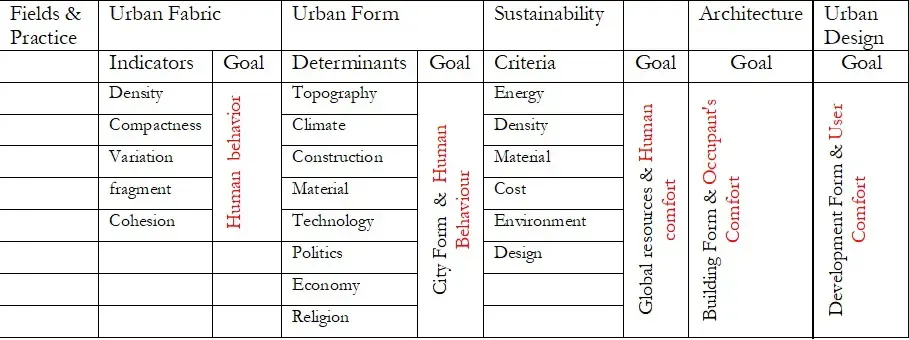
Surely, as we can see in the table, architecture in practice targets a good building form and efficient function, which together contribute positively to the city’s creation. Urban design, as well, on a larger scale, targets a good development form and the user comfort of the development. These two fields, or in other words, architects and urban designers, should look for Human comfort in the practical studies of the urban fabric and urban form. Which urban fabric pattern is most effective, and which urban form provides a quality of urban living as well.
Where this fits in practice: I explain how research on fabric and form became plot ratios, setbacks and conservation rules in Urbanism Role in Professional Practice: How Research Became Hidden Rules.
Related Topics
For deeper exploration, see related content on Environmental planning, Green architecture, Sustainable urban development, TOD , Architecture practice , Urban Design , Smart Cities.
References:
- Li, X. et al. (2016) “Assessment of urban fabric for Smart Cities,” IEEE Access, 4, pp. 373–382. Available at: https://doi.org/10.1109/access.2016.2517072.
- Oliveira Vítor (2022) Urban morphology an introduction to the study of the physical form of Cities. Cham: Springer.
- Swensen, G. (2012) “Integration of historic fabric in new urban development—a Norwegian case-study,” Landscape and Urban Planning, 107(4), pp. 380–388. Available at: https://doi.org/10.1016/j.landurbplan.2012.07.006.
- Busquets, J. (2005) Barcelona: The urban evolution of a Compact City. Rovereto (Trento): Nicolodi.
- Rapoport, A. (2016) Human aspects of urban form towards a man-environment approach to urban form and Design. Elkins Park: Franklin Book Company, Inc.
- Morris (1994) History of urban form: Before the industrial revolutions. Harlow: Longman scientific & technical.
- Madhavan, G. et al. (2013) Practicing sustainability. New York, NY: Springer New York.
- Dev, S.M. and Yedla, S. (2015) Cities and sustainability issues and strategic pathways. New Delhi: Springer India.
- Newman, P. and Jennings, I. (2008) Cities as Sustainable Ecosystems: Principles and practices. Washington, D.C.: Island Press.