Urbanism: urban regeneration and the architecture crisis is the fourth article of a series1 ,2 ,3 ,4 ,5 ,6 ,7 ,8 ,9 ,10 ,11 ,12 ,13 ,14 ,15 ,16 ,17 urban design in the urbanism field. I will go through this relationship from the top scale of urbanism in the city to the smallest scale of urbanism components of urban space.
Table of contents
Background
Urban Regeneration Vs urban renewal
Urban Regeneration tools
Main causes of deprivation
Background
In the last twenty years, p ractitioners used and still the terms urban regeneration and urban renewal interchangeably in the urban literature. Urban regeneration and renewal are one of the major tasks of international organization’s mission. (The video highlights this matter from world bank). to develop and enhance the quality of living in many destructed areas in the world like Asia and others. Architecture and the built environment creation became of the poorest quality. It lacks innovation and purpose in the deprived areas. Urban space is deprived because of the poor quality of urban design and urban design strategies.
The purpose of this article is to assess first the difference between urban regeneration and renewal. And why the built environment is facing problems of decay. Also, why architecture and urban design produce poor-quality projects in the first place that need renewal and regeneration.
Leary1 hes. But regeneration is more into a holistic response. Maria2 th century, Europe conducted wide renewal to cities. Specific ally in Paris, London, and Barcelon a. In order to provide proper sanitation and engineering work to the services by demolition and reconstruction of new buildings and to provide quality air and light to the city.
Urban regeneration is done to solve the multifaceted problems of urban areas. So as to improve the economic and built environment status of deprived area. Kulsrisombat3
Martins5
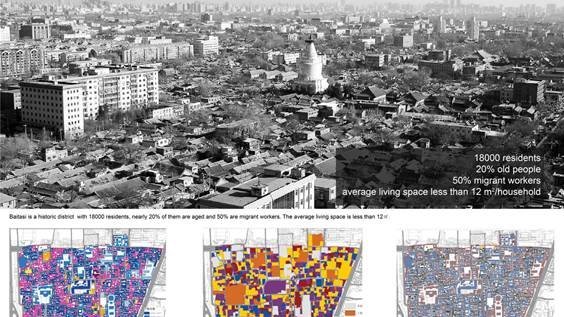
Cities, neighborhoods, and towns face several problems see Figure 1. As shown by the researchers in the definitions some are social, economic, and environmental. here we need to define the effect of urban regeneration on architecture. Thus, urban regeneration processes need to be identified Also methods to be assessed in depth.
Figure 1, urban regeneration to improve housing conditions for people.
urban regeneration in some practices they place it in the public interest. While in other practices they thought it shifted from place oriented to people oriented. It takes a strategic approach that includes regions in addition to local vision. Also, to the integration of various private and public entities. Thus, all regions work on a full urban policy delivery to implement it. Upon analysis if needed as another way a plan for a fiscal intervention from public resources to solve the targeted problem.
Urban Regeneration tools
Policy and public funds are the main tools of urban regeneration for any part of the city. Policymakers are from different professional backgrounds. Politicians, urban planners, geographers, historians, and social science professionals are involved in the policy-making of urban regeneration. Public funds may take several forms to many locations. For human health or to improve the medical service of the targeted area population. Funds are essential to support the social network labor force in times of unemployment. Student study programs are essential to supply the labor market with skilled professionals. Developing existing labor market by development programs that require funding from the public sector.
The main problems that may occur in a city that requires urban regeneration are physical, environmental, and social. In practice, they occur separately and officials and relevant authority look into them separately. But do all related officials deal with these problems or assess these problems in depth? Social, economic, or environmental problems cannot happen in isolation from each other. A low income leads to small care to the surroundings due to limited funds and that needs public support to solve it.
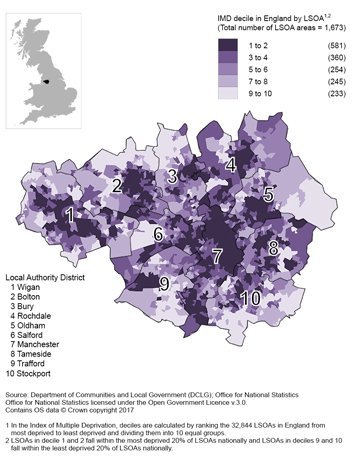
One of the main urban problems that are repeated mainly in European and other developed countries is deprivation see Figure 2. As per their indices of deprivation, it deploys the following domains: health deprivation and disability, education, skills, and training, barriers to housing and services, crime, and living environment. Leary1
Figure 2, deprived areas in Liverpool-UK.
Now let’s discuss how these problems occur together and where the role of architecture and architects exists. whether within the urban regeneration process or as external consultants doing his part of the work.
Main causes of deprivation
Why do areas in a city, town, or neighborhood become deprived?
Environmental pollution, disease, or pandemic may cause infection to the area. And damage happens to the main physical environment, urban space surrounding it. For example, to the landscape, and softscape all make the area not suitable for living. In the process of creating any town or neighborhood many organizations in the world call for international seminars and gathering. That to turn the specialist’s attention to this matter. but are architects and urban designers involved in the process of the urban planning and design of these towns and neighborhood from the initial stages of political decision? Are they being the cause of the bad architectural quality or the architectural decline?
Environmental changes like hurricanes, storms, and floods might hit the physical environment causing much damage to the buildings, homes, streets. Also, public service components making the area not suitable for living. Did these relevant entities alert the architecture bodies or architects involved in the creation of the relevant built environment object about these issues? and how they planned to reflect these issues to create solutions to prevent damage?
Climate problems like high humidity or water problems in the service system might create damage to the buildings and softscape making the area not suitable for living. Here how did architects respond to these problems when designing towns and neighborhoods?
Social deprivation happens when various issues rise in a town or neighborhood. One of these issues is problems related to race and the segregation of ethnic groups. In many cases in the world, this problem happens because of human psychological status. These problems happen in the built environment when it is tracked and assessed, in closed towns and areas where the place lacks suitable urban spaces for social activity. Community centers are not considered, and people or citizens are forced to gather in an unsuitable place where they in most cases annoy other people creating problems of race and segregation.
Is architecture responsible for this decline and area problem? Are the authorities aware of the effect of a low-budget reserved for development might cause on urban design or architecture? In many cases within this issue happening people start using street recreation, walls for demonstrating their opinions, politics, and other, as well as for punk art, alleys will be used for drug dealing or night drinking.
People with low income will not have sufficient funds to take care of their homes repair. And related authorities do not provide much funds. In this manner, people will leave their homes to other places leaving these homes damaged and the authorities will not take action till public fund from the government is assigned and approved. This area will sink in extreme damage leaving the homes for drug dealers and gangsters and irresponsible youth to use for non-proper uses like prostitution. How do the authorities sit and decide and plan for new development for social housing? where are the architects and how architecture is involved in the process to prevent this issue from happening?
Lack of jobs and high unemployment force people to move from area to area to obtain suitable jobs to support themselves. So, if people are considered properly within the plan of support to use public transport and facilitating them, this shift will not occur in high percentage. How the development of towns and neighborhoods are studied, planned, and implemented? Who are the people involved in this matter? How much architectural knowledge do they have? Are they concerned about this matter or not?
Problems are more than I have discussed here if you think about them wherever it happens. Why do all these problems happen when we have specialists in architecture and urban design, urban planners from an architecture base? Why shouldn’t we consider these matters at the beginning of creating towns, and neighborhoods and wait for the problems to happen to find solutions for them?
Many EU countries in the world abandoned physical planning . Because they think it damage the society, creating segregation, and lack of liberty and non-democratic practice. It is proper to have a team of specialists involved in the urban planning development. But architecture should not be a minor subject but a major one. Now did these problems disappear or still happening regardless of the great international attention and introduced policies and treaties?
For free-form policy, see my previous articles , in the recent century we are still facing the same problems, at the very least in developed countries, regardless of the change of planning approach from fixed policies to free-form policies. What is the main cause and why these problems are recycling creating damage to the physical environment and architecture produced in very low quality?
Where this fits in practice: I show how regeneration research reaches funding decisions and the work of architects in Urbanism Role in Professional Practice: How Research Became Hidden Rules .
Related Topics
For deeper exploration, see related content on Environmental planning , Green architecture , Sustainable urban development , TOD , Architecture practice , Urban Design , Smart Cities , Urban renewal .
references:
Leary, M.E. and McCarthy, J. (2014) The routledge companion to urban regeneration . Abingdon, Oxon: Routledge.
Maria , G. and Tabasso, M. (2016) From urban renewal to urban regeneration: Classification criteria for urban interventions. Turin 1995–2015: evolution of planning tools and approaches [Preprint].
Kulsrisombat, N. (no date) ‘De facto urban regeneration: A case study of chiang mai city, Thailand’, Sustainable City Regions: , pp. 77–100. doi:10.1007/978-4-431-78147-9_5.
Martins, M.L. and Santos Pereira, A.L. (2019) ‘Urban regeneration in the Brazilian urban policy agenda’, European Planning Studies , 27(6), pp. 1129–1145. doi:10.1080/09654313.2019.1598021.