Urbanism: Urban Design, Architecture & Public Space Quality is the seventeenth article of a series1,2,3,4,5,6,7,8,9,10,11,12,13,14,15,16,17. Article assessing the dialectic of architecture and urban design in the urbanism field. I will go through this relationship from the top scale of urbanism in the city to the smallest scale of urbanism components of urban space.
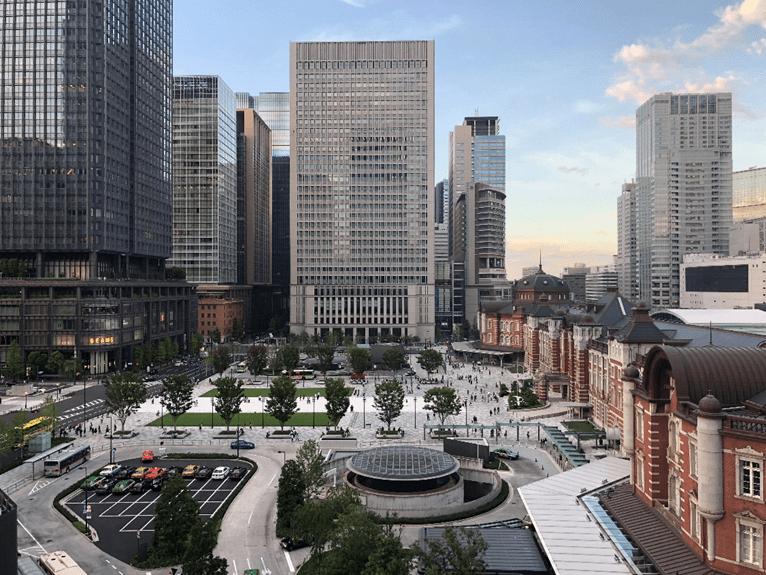
This article focuses on creating urban public space within urban planning, urban design, and architecture. Also analyzes the quality of that space. Urban planners, regardless of their specialty, define needs when building a local development plan for a town or neighborhood. This plan studies and analyzes all public spaces, nodes, people movement, and economic functions. It also allocates and defines new public spaces for several functions. Urban designers then study and analyze the allocated urban public space in more detail. Urban public space can serve many functions. For example, an open area between buildings or new buildings under construction. This way it can create new public transit nodes for metro, train, or bus stations. (see Figure 1 — Tokyo Station is surrounded by open area and landscape).
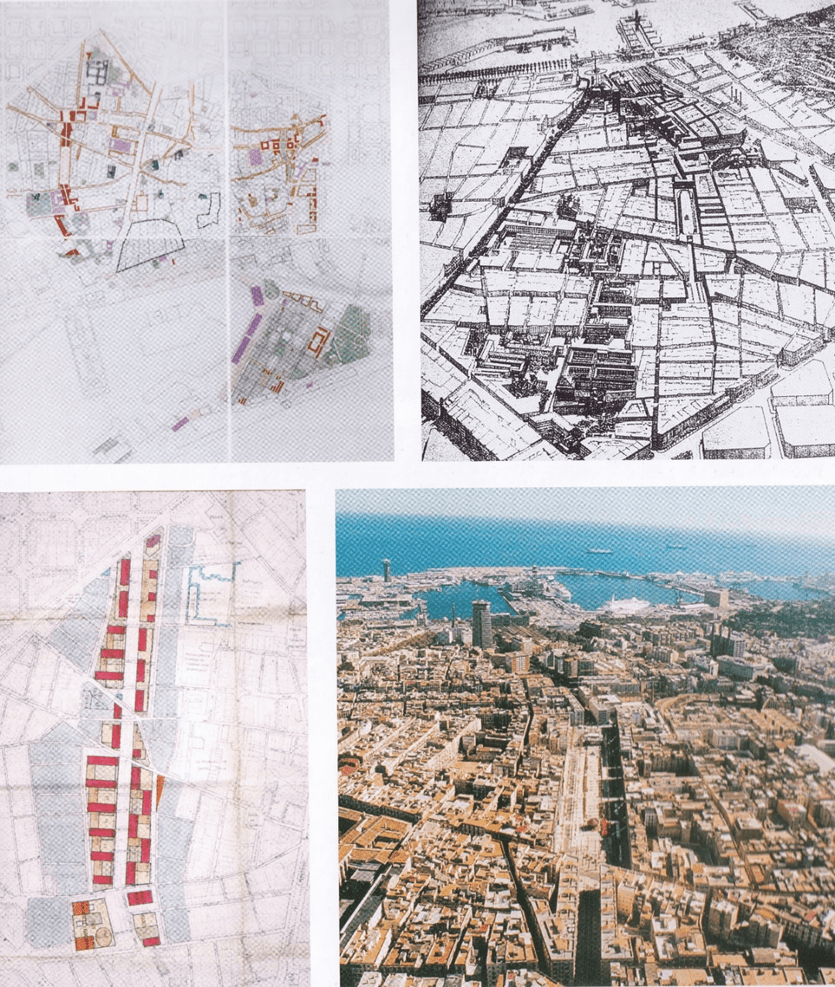
Urban designers create urban public space to serve as a development for an area’s traffic intersection. In addition, this can occur either within an existing development or in a newly proposed urban development. Furthermore, a network of open spaces connects to a new urban open space that urban planners and designers have identified. Consequently, this open space functions as part of a movement corridor in the city or town. Moreover, urban regeneration programs and development focus on creating new urban spaces. These can be either green landscapes or an urban corridor that links old neighborhoods to each other and to transit areas. Ultimately, the goal is to bring life to the old city, encourage more urban development, and attract investment from other parts of the country or world. For instance, see Figure 2 — the Ciutat Vella urban corridor in Barcelona.
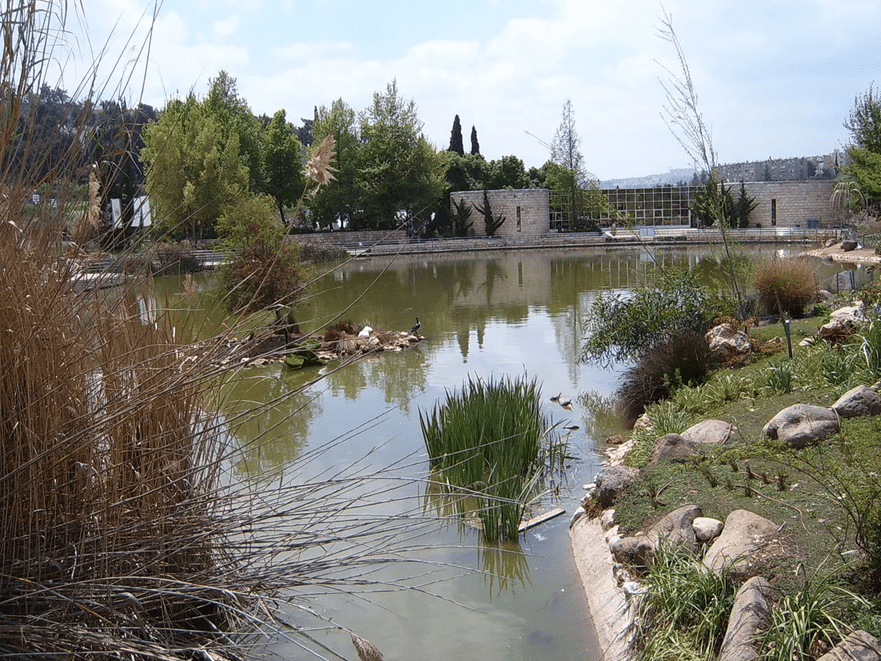
Urban designers create Urban public space within the urban renewal programs and projects. Surely, to revitalize a town or deprived neighborhood to add a social gathering point for the community. A landscaped area within a development could bring life to a derelict town area and become a social gathering urban space. See Figure 3, the botanic garden in Jerusalem.
People gather in many areas of the city, including landscape areas and open spaces near stations and buildings. Additionally, there are water features located in the middle of town. Moreover, some areas serve specific events, such as avenues for military or public ceremonies. In fact, urban renewal programs around the world reform public spaces to include venues for public events, ceremonies, and private events — such as fashion and music shows in cities like Paris, Barcelona, Berlin, and other European countries. Consequently, architects and urban designers focus on creating public spaces for events in their development plans for towns and cities.
Urban renewal reforms squares in road networks and even within urban development in old areas of towns and cities to include memorial sculptures. For example, such a statue could honor a military figure, political leader, scientist, someone who contributed greatly to the country, or an artist like a writer. Typically, these memorial spaces sit within a roundabout or open urban space, thereby adding a focal point where people gather to socialize. As a result, it becomes a source of inspiration for conversation.
Public art become in recent years part and a tool to add attraction to the urban public space. In many countries of Europe, it become a fashion and also a tool to cover deprived areas of the town. Areas of deprived zones in a town that are not included in urban development either lack interest, funds, social value, historical context, or economic value become areas of introducing fashion of art and craft work on walls and alleys. See Figure 4, public art painting on old homes and buildings.
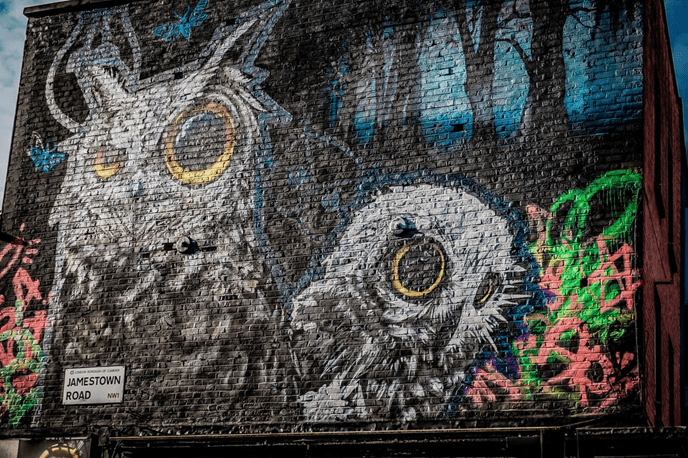
Public art of this type (Figure 4) often lacks any clear purpose. It does not indicate what kind of conversation it aims to start with the public, nor what social benefit it provides. Public art in urban open spaces should carry meaning and create a function — whether political, economic, social, environmental, or otherwise. City planners and researchers should study how this type of art affects the public and the neighborhood where it stands.
There are certain criteria to define and plot public art in urban open spaces in a town, neighborhood, or city. Specifically, urban designers select the location of public art depending on the goals of the project and the general criteria for locating public art in urban spaces. To begin with, the location should have a direct relation to the meaning of the public art. In addition, it should have a human function, such as aesthetic appeal, conversational engagement, and other aspects. Moreover, public art should fit the context, which means it must have a direct relation to the surroundings, not only within the urban space but also concerning the physical environment, such as buildings and landscapes. Finally, it should be a focal point within the image of the city; thus, it should serve as a landmark to direct social movement in the city.
In this way, public art within urban space can serve as a memorial. For example, a historical memorial can occupy many areas of the city. In France, planners located the Arc de Triomphe along the axis between the Louvre Museum and the new Paris Gate. A National Day memorial can sit in an urban public space at the city center, where people can hold events for that day. A large-scale flag on a high steel pole can also serve this purpose, as many cities in the Middle East region demonstrate.
Public art could point to a scientific advance in any field of knowledge like the innovation of the automobile, the invention of the steam engine in Spain, the printing machine in Germany, and the sand clock in Baghdad. See Figure 5, the public art of air compressors in Yokohama Japan
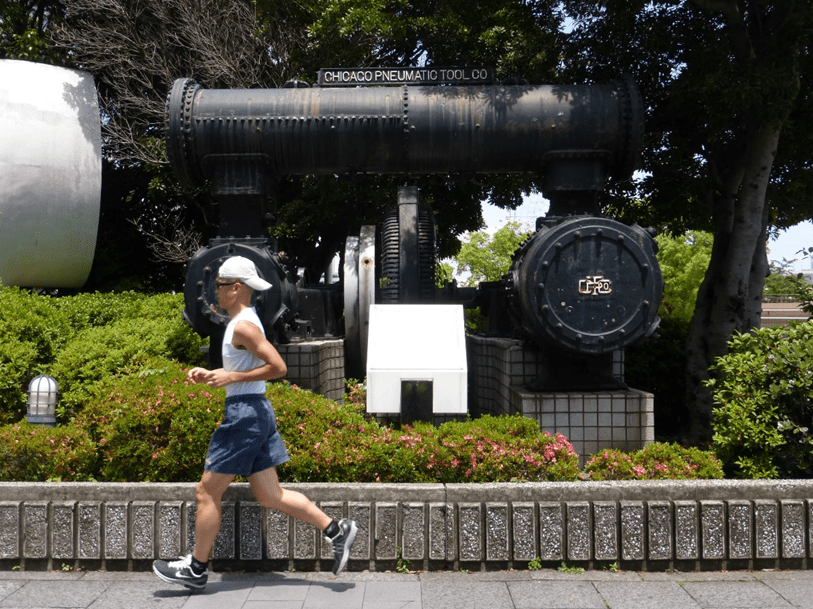
Many public art in the world serve to put in memory of the city or town people a memory of disaster this location passed. For example, a typhoon that caused great damage to people. Or a pandemic that killed lots of people, or a location where a battle happened. Two places in the world have this type of public art that served this purpose. The 11 September attacks in New York and the Hiroshima and Nagasaki nuclear attacks on the two cities. These two special public arts have had a great effect on people’s emotions to this day.
Public art sculptures in urban open spaces — whether in a roundabout or a space designed for this purpose — memorialize public figures. These figures have contributed to the country in various ways. They could be political leaders like the country’s president, military figures like Napoleon, or a scientist who introduced a new theory that advanced world knowledge and science.
Finally, Urban designers can connect public art to a global event related to the environment, education, industry, and society. For example, in Japan in Kita-Urawa Park there are many public arts in various locations one of which is the Bankara Statue as a sign for people to remember that there was a high school in this place. The statue is a high school boy wearing a school uniform with a hat on his head.
Where this fits in practice: I explain how public space passes from the plan to the urban designer to the architect in Urbanism Role in Professional Practice: How Research Became Hidden Rules.
Related Topics
For deeper exploration, see related content on Environmental planning, Green architecture, Sustainable urban development, TOD , Architecture practice , Urban Design , Smart Cities, Urban renewal.
References:
- Kushner, J.A. (2002) ‘Smart growth, New Urbanism and Diversity: Progressive Planning Movements in America and their impact on poor and minority ethnic populations’, UCLA Journal of Environmental Law and Policy, 21(1). doi:10.5070/l5211019395.
- D.T. Chen, D. (2000) ‘The Science of Smart Growth’, Scientific American, 283(6), pp. 84–91. doi:10.1038/scientificamerican1200-84.
- Liu, L.L. (2012) ‘An analysis of the influencing factors in new urban planning under the conception of smart growth’, Applied Mechanics and Materials, 174–177, pp. 2433–2439. doi:10.4028/www.scientific.net/amm.174-177.2433.
- Kim, J.I. and Hyun, J.Y. (2018) ‘Do smart growth urban development strategies reduce jobs-housing distance in a high-density city? the case of the seoul metropolitan area’, Journal of Planning Education and Research, 41(2), pp. 149–159. doi:10.1177/0739456×18773500.
- Salama, A. M. (2017). PLURALITY AND DIVERSITY IN ARCHITECTURAL AND URBAN RESEARCH. ArchNet-IJAR, 11(2), 1. https://doi.org/10.26687/archnet-ijar.v11i2.1280
- Korff, R. (1996). Global and local spheres: The diversity of Southeast Asian urbanism. Sojourn, 11(2), 288–313. https://doi.org/10.1355/sj11-2e
- Day, K. (2003). New urbanism and the challenges of designing for Diversity. Journal of Planning Education and Research, 23(1), 83–95. https://doi.org/10.1177/0739456×03255424
- Grant, J., & Perrott, K. (2009). Producing diversity in a new urbanism community: Policy and practice. Town Planning Review, 80(3), 267–289. https://doi.org/10.3828/tpr.80.3.3
- Moroni, S. (2016). Urban density after Jane Jacobs: the crucial role of diversity and emergence. City, Territory and Architecture, 3(1). https://doi.org/10.1186/s40410-016-0041-1